AI Consultant Paris: 2026 Rates and Expected Deliverables
Intelligence artificielle
Stratégie IA
Gouvernance IA
Gestion des risques IA
Droit IA
In 2026, an **AI consultant in Paris** doesn't sell "AI." They sell the ability to **transform a concrete use case** (support, sales, ops, product, finance) into a **measurable result**, with real IT integration, safeguards (GDPR, security, AI Act), and sustainable operation...
An AI consultant in Paris in 2026 doesn't sell "AI." They sell the ability to transform a concrete use case (support, sales, ops, product, finance) into a measurable result, with real IT integration, safeguards (GDPR, security, AI Act), and sustainable operation.
The problem is that the market still mixes up many profiles (freelance, firm, agency, one-off "prompt engineer"), so rates vary widely, and deliverables are sometimes vague.
This guide gives you 2026 rate ranges (indicative) and, more importantly, the expected deliverables to buy an AI mission without ending up with an unusable demo.
What "AI Consultant" Covers in Paris in 2026
In practice, behind the query "AI consultant Paris," there are several realities.
1) "Strategy" AI Consultant (scoping, opportunities, governance)
Objective: decide what to do, in what order, with which KPIs, and with what acceptable risks.
Typically useful if you have many AI ideas and teams testing tools, but few proven results.
2) "Delivery" AI Consultant (prototype, pilot, integration)
Objective: deliver a V1 that runs in your workflows.
This profile must understand architecture (APIs, integrations, security), evaluation (quality, costs, risks), and production deployment.
3) "Adoption" AI Consultant (training, change management, team rules)
Objective: ensure AI is actually used, without tooling chaos or data leaks.
In 2026, value often comes from a combination: scoping (1) + delivery (2) + adoption (3).
2026 Rates for an AI Consultant in Paris: Realistic Ranges
The amounts below depend heavily on seniority, risk level (sensitive data, regulated decisions), integration needs, and the expected level of "production readiness."
Important: these ranges are indicative (B2B market in Paris in 2026), excluding potential API/model costs, hosting, and tooling.
The Billing Models You Will See Most Often
Daily Rate (TJM): standard for freelancers and certain consulting missions.
Fixed Price per Phase: frequent for an audit, a pilot, or a scoped V1.
Retainer (monthly subscription): useful for continuous improvement, monitoring, and adoption.
Observable Daily Rate Ranges (Paris, 2026)
Profile (simplified)
Expected on the mission
Indicative Daily Rate Range (excl. VAT)
Junior AI Consultant (supervised execution)
POC, prompts, simple tests, light documentation
€600 to €900
Confirmed AI Consultant (delivery)
Instrumented MVP, simple integrations, iteration with business units
Useful reading: if you pay "little" but your context is complex (IT, GDPR, integrations), you will often pay later in rework, incidents, or refactoring.
Budgets by Mission Type (What it Costs "Globally")
If you want more formalized scoping, a good framework consists of separating: Business KPIs, AI Quality, Safeguards. Impulse Lab details a measurement approach in its content on KPIs and production deployment (see, for example, the logic exposed in the article on strategic AI audit and ROI-oriented approaches).
What a "Good" AI Audit Deliverable Looks Like (Beyond a Slide Deck)
A serious AI audit is not just a list of ideas. In 2026, companies expect an audit that reduces risk and accelerates delivery.
Here is what it should contain.
1) A Prioritized Impact/Effort/Risk Heatmap
Not "20 AI ideas," but a top 3 to top 7, with a clear rationale.
2) A KPI Baseline (Pre-AI)
Without a baseline, your ROI becomes a matter of opinion. A typical example:
Average handling time (minutes)
Weekly/monthly volume
Error rate / returns / escalations
Customer response time
3) A Register of Risks and Safeguards
In France, you must think at least in terms of GDPR (personal data, minimization, sub-processing) and, depending on the case, requirements related to the AI Act.
For an assistant or an agent, "the AI" is just one brick. The real system includes: orchestration, context (RAG), actions (tool calling), logs, secret management.
Run: knowledge base maintenance, prompt adjustments, tool evolution.
A Simple Formula to Estimate the Monthly "Run" Budget
Without getting into complex models, you can ask the provider to estimate:
Item
Question to Ask
Expected Result
Variable Model/API Cost
"What is the cost per 1,000 realistic requests?"
monthly envelope and alert threshold
Hosting/Tooling
"Which services, which region, what fixed cost?"
fixed estimate + safety margin
Monitoring/Observability
"What is logged, how much does it cost?"
cost and retention policy
Knowledge Maintenance (RAG)
"Who updates it, how often?"
process and monthly load
Support
"What internal SLA and which channel?"
clear responsibility
If your project relies on model APIs, costs and quotas are a real subject in production. A good consultant must be comfortable with this topic, otherwise you risk surprises.
Questions to Ask to Compare Two AI Consultants in Paris
You don't need a "tech for the sake of tech" interrogation. You need questions that reveal if the person knows how to deliver.
Result-Oriented Questions
What is the North Star KPI of the use case, and what is the plan to establish the baseline?
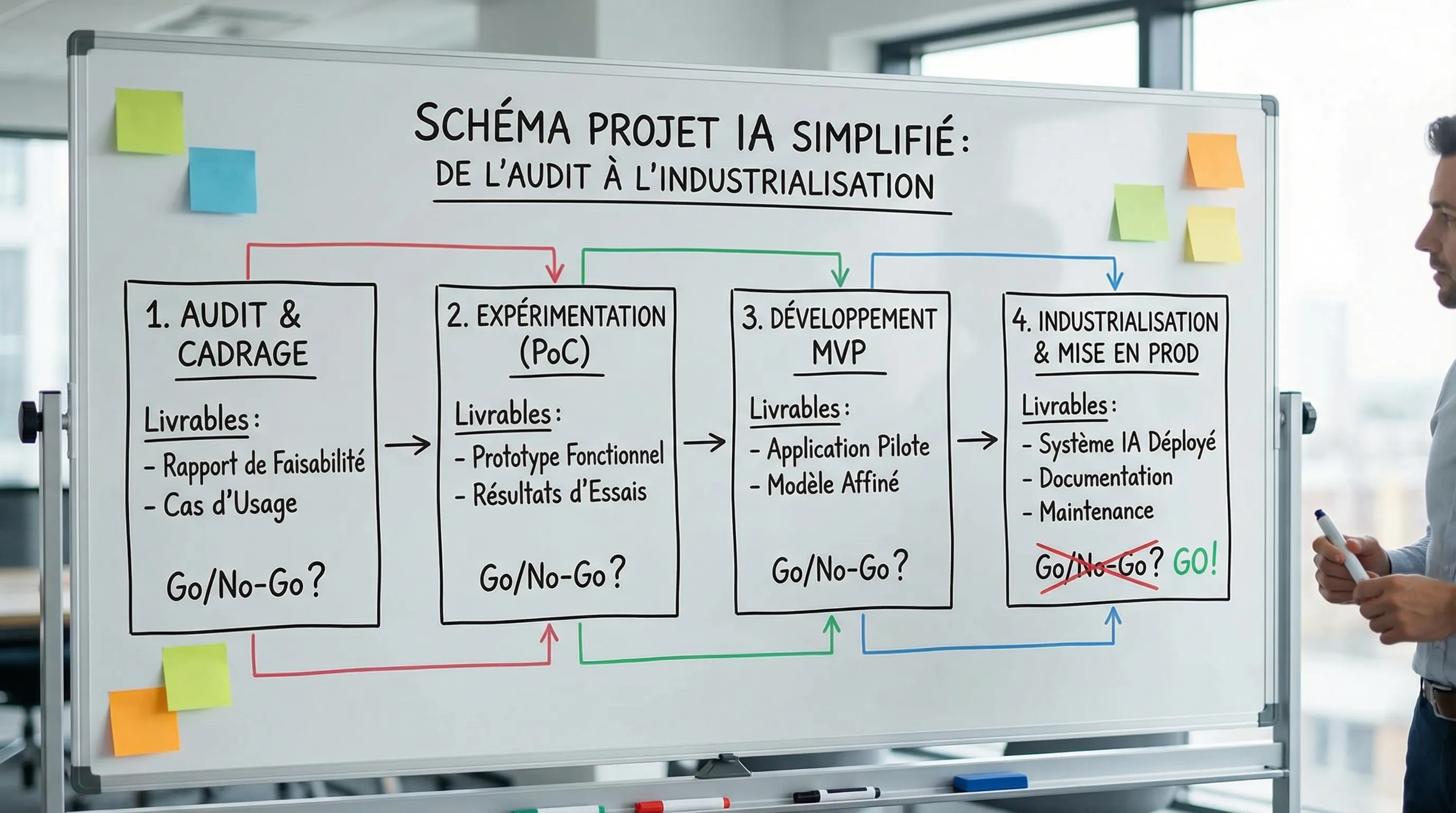
What decision will be taken at Day 30 or Day 45 (go/no-go), based on what criteria?
Integration-Oriented Questions
Which tools must be connected from V1 (CRM, helpdesk, ERP, drive, intranet)?
What is the authentication and access control plan (especially internal)?
Reliability and Risk-Oriented Questions
How do you handle hallucination (sources, RAG, constraints, refusals)?
What anti-prompt injection and anti-data exfiltration measures do you put in place?
What is logged, for how long, and who has access to it?
Operation-Oriented Questions
Who owns the solution on the client side, and what recurring tasks are planned?
What is the runbook in case of an incident (cost, quality, potential leak, degradation)?
Three Concrete Scenarios with Budgets and Expected Deliverables (SMEs and Scale-ups)
The intention behind "AI consultant Paris rates" is often: "how much does it cost for my case?". Here are three frequent cases.
Scenario A: Internal Knowledge Assistant (RAG) for Support, Sales, or Ops
Objective: reduce search time, standardize answers, decrease escalations.
Typical duration: 4 to 8 weeks to a useful pilot.
Indicative budget: €30,000 to €120,000 depending on integrations and security.
Key deliverables: indexing and source rules, golden set, quality metrics, logs, permissions by role, dashboard.
If you aim for a robust version, the RAG approach in production deserves real discipline (evaluation, monitoring, source updates). See: Robust RAG in Production.
Scenario B: Website or Helpdesk Chatbot (Customer Support) with Escalation
Objective: reduce response time, increase self-service rate, better capture requests.
To scope the measurement, a good basis is to structure KPIs by layer (AI quality, operations, business result). Impulse Lab has a resource dedicated to Essential AI Chatbot KPIs.
Freelance vs. AI Agency in Paris: Impact on Price and Deliverables
The cost difference doesn't just come from the margin. It comes mainly from the skill coverage and continuity.
A very senior freelancer can be excellent for scoping and launching a V1, but you will sometimes need to supplement (design, security, data, full-stack, run).
An agency can provide a team (product, dev, integration, UX, governance), often more suitable if you want to deliver fast and well, with less dependency on a single person.
Run Plan (maintenance, ownership, indicative monthly budget).
Going Further: A Deliverables and ROI-Oriented Approach
If your goal is to move quickly from "AI idea" to a useful V1, the best starting point is often a scoped opportunity audit, then an instrumented pilot.
Impulse Lab supports SMEs and scale-ups on this exact sequence (audit, training, custom development, integration, and automation). You can explore: