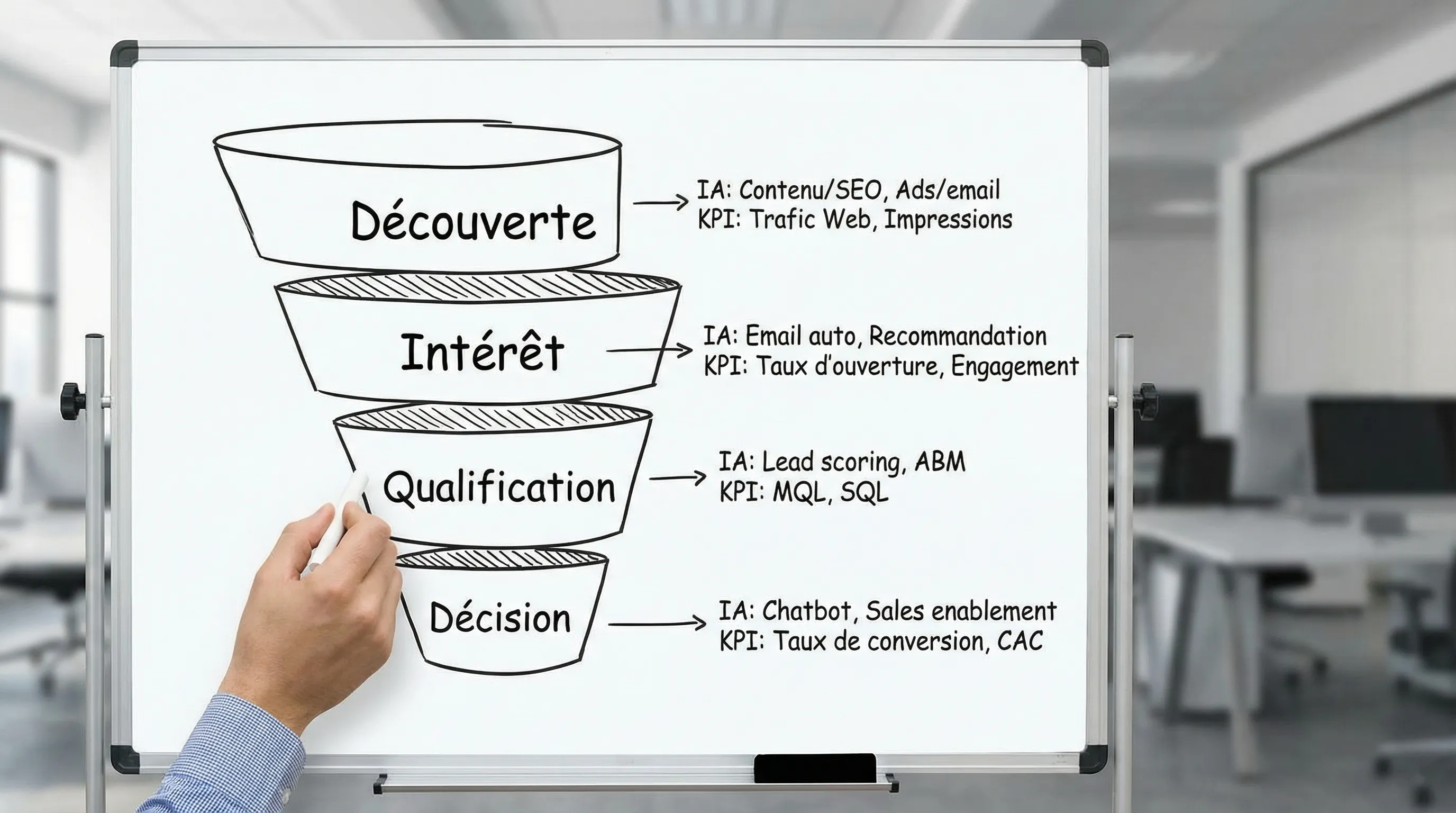
When running an SME (or a scale-up in the structuring phase), marketing is often caught between two fires: producing more and being more precise, with limited resources. This is exactly where **AI in marketing** becomes useful, not as a gadget, but as a lever for productivity and performance.
When running an SME (or a scale-up in the structuring phase), marketing is often caught between two fires: producing more (content, campaigns, responses, reporting) and being more precise (segmentation, personalization, attribution), with limited resources. This is exactly where AI in marketing becomes useful, not as a text generation gadget, but as a lever for productivity and performance, if connected to the right processes and data.
According to McKinsey, marketing and sales are among the functions where generative AI has the greatest potential for economic value (via productivity gains and commercial performance). Source: McKinsey, The economic potential of generative AI.
In this article, you will find concrete use cases, KPIs to track, and a simple method to choose your first topics without spreading yourself too thin.
AI in marketing, for an SME, what does it mean (concretely)?
We can group marketing AI into 3 levels of maturity. SMEs save time by understanding where they stand.
Copilot (assistants): AI helps a human produce faster (briefs, outlines, copy variations, call summaries, analysis). Low integration, quick wins.
Automation (workflows): AI is triggered by an event (new lead, form, call, ticket, opportunity) and pushes a result into a tool (CRM, emailing, Notion, Slack). Structuring gains.
AI Product (integrated experience): AI is directly in your site, your client portal, your back-office, with measurement, guardrails, and iterations. Competitive gains.
The classic trap is staying at the first level (“one-shot” prompts) without instrumenting performance or connecting AI to the funnel.
10 AI in marketing use cases that actually work for SMEs
Below, each use case is presented with: simple version (quick win), integrated version (scalable), and KPIs.
1) Market research and messaging: clarifying ICP, pains, and objections
Objective: accelerate market understanding, and above all make the value proposition sharper.
Quick win: synthesize client interviews, sales notes, reviews, call reports to generate an “objection library” (objections, answers, proof points, use cases).
Scalable: pipeline where every call (Sales, CS, support) is transcribed, summarized, tagged, then aggregated into themes (objections, competitors, requested features).
Useful KPIs:
Landing page conversion rate (visit → lead)
MQL → SQL rate (see also the concept of MQL and SQL)
Win rate, sales cycle (if B2B)
2) “Brand-safe” content production (without diluting your positioning)
Objective: produce faster, while maintaining editorial consistency.
Quick win: generate outlines, titles, introductions, paragraph variations, reformulations, LinkedIn adaptations, short video scripts.
Scalable: creation of a style kit (tone, authorized claims, proof points, forbidden words), plus a validation workflow (human, legal if needed).
Useful KPIs:
Production time per piece of content
% of content published vs content in backlog
Engagement (Email CTR, social CTR, time on page)
3) AI-assisted SEO: better targeting, structuring, and updating
Objective: industrialize pragmatic SEO without turning AI into a “text machine”.
Quick win: help with intent research, Hn structuring, FAQ, readability improvement, internal linking suggestions.
Scalable: automatic refresh of content “that is dropping” (detection via Search Console), generation of update hypotheses, then human validation.
9) “Narrative” marketing reporting: fewer dashboards, more decisions
Objective: reduce time spent producing slides, increase time spent acting.
Quick win: generation of a weekly summary (what’s up, what’s down, hypotheses, recommended actions).
Scalable: multi-source consolidation (Ads, CRM, analytics, emailing) and generation of insights with traceability (links to sources).
Useful KPIs:
Reporting production time
Number of actions decided and executed per week
Evolution of core KPIs (CPL, conversion, pipeline)
10) Enablement and asset reuse: capitalizing on what you produce
Objective: stop reinventing the wheel between Marketing, Sales, and CS.
Quick win: transform a client case into 10 formats (post, email, script, one-pager, FAQ, objection responses).
Scalable: “single source of truth” base (proof points, claims, use cases), with semantic search and updates.
Useful KPIs:
Objection response time (Sales)
Consistency of discourse (qualitative, audits)
Asset reuse rate
Summary table: choosing your priorities without spreading yourself thin
Use Case
Main Value
Necessary Data
Priority KPIs to Instrument
Market research, objections
Better messaging, better conversion
Call notes, Sales/CS feedback
Landing conversion, MQL → SQL
Brand-safe content
Content productivity
Guidelines, existing content
Prod time, organic leads
Assisted SEO
Sustainable qualified traffic
Search Console, content, analytics
Clicks, SEO leads
Assisted Ads
Rapid testing, budget control
Ads data, tracking
CPL, landing conv rate
Email lifecycle
Activation and retention
Segments, events, CRM
CTR, activation, retention
Lead scoring
Sales prioritization
CRM, engagement signals
Lead speed, Meetings, MQL → SQL
ABM lite
Pipeline on target accounts
Account list, CRM, signals
Response, Meetings, pipeline
Prerequisites (often forgotten) before “adding AI” to marketing
In many SMEs, the problem is not the AI tool, it’s the lack of foundations.
1) A clear definition of the funnel and statuses
If “lead” means something different depending on the team, AI amplifies the confusion. A useful reminder: structure your statuses and your MQL → SQL transition.
2) Minimal CRM hygiene
mandatory fields (source, segment, size)
deduplication rules
discipline on notes and reasons for loss
3) Data rules and compliance (GDPR)
You don’t need to be perfect, but you must be explicit about what is allowed or not (PII, sensitive data, trade secrets). For a regulatory baseline, the European Commission maintains a reference page on the AI Act.
Week 1: Frame and choose 1 single “north star” KPI
Choose 1 to 2 use cases maximum, with a result KPI (e.g., qualified meetings, SEO leads, CPL). Define a baseline over 2 to 4 weeks if possible.
Week 2: Prototype with real data
Prototyping means: an end-to-end flow, even if imperfect, with edge cases. This is also the right time to formalize prompts and guardrails (see the glossary Prompt engineering).
Week 3: Integrate “just enough”
The goal is not to integrate your entire IS, but to avoid permanent copy-pasting. Often, a first CRM or emailing integration is enough to make the use case useful.
Week 4: Pilot, measure, decide
Measure, compare to the baseline, and take an explicit decision:
Confusing “nice content” with “business results” (no KPIs, no baseline).
Multiplying tools (tool sprawl) instead of a clear workflow.
Forgetting the point of truth: the CRM and the funnel.
Letting AI invent facts (hallucinations) on sensitive content (prices, promises, legal).
Not training teams, leading to under-adoption.
FAQ
Which AI in marketing use cases give ROI the fastest in SMEs? Often: generation of variants (ads, emails), call synthesis, narrative reporting, and simple lead routing, because they require little complex data.
Do I necessarily have to connect AI to the CRM? Not at the start, but if you want to industrialize (scoring, ABM, lifecycle), the CRM connection quickly becomes necessary to avoid friction and measure correctly.
Will AI replace my marketing team? No. It mainly replaces repetitive tasks (variants, summaries, sorting, reporting) and increases the team's capacity. Strategy, positioning, and validation remain human.
How to avoid hallucinations in marketing content? Use controlled sources (internal documents, official pages), add guardrails (authorized claims, proof points), impose proofreading, and prioritize “grounded” approaches if you automate.
What KPIs to track for a marketing AI pilot? Choose 3 to 5 KPIs maximum: 1 north star KPI (e.g., qualified meetings), 1 to 2 process performance KPIs (time saved, lead speed), and 1 to 2 guardrails (quality, compliance, error rate).
AI Act and GDPR: do I have to stop using AI tools? No, but you must frame your usage (authorized data, contracts, logs, traceability) and adapt the architecture according to the risk level.
Moving from idea to measurable pilot (without spreading yourself thin)
If you want to identify the best AI in marketing use cases for your SME, prioritize them, then integrate them properly into your tools (CRM, site, emailing), Impulse Lab can help you via:
an ROI-oriented AI opportunity audit
adoption training (marketing, sales, ops)
development and custom integrations to move to production
To get started, you can discover the agency's approach at impulselab.ai.
IA et cybersécurité : les contrôles minimums pour une PME
Un assistant qui résume des contrats, un outil connecté au CRM ou un agent qui prépare des factures : chaque usage crée de nouveaux accès à contrôler. Pour une PME, **IA et cybersécurité** doivent donc se traiter ensemble, avant de connecter des données confidentielles ou d’autoriser des actions aut...