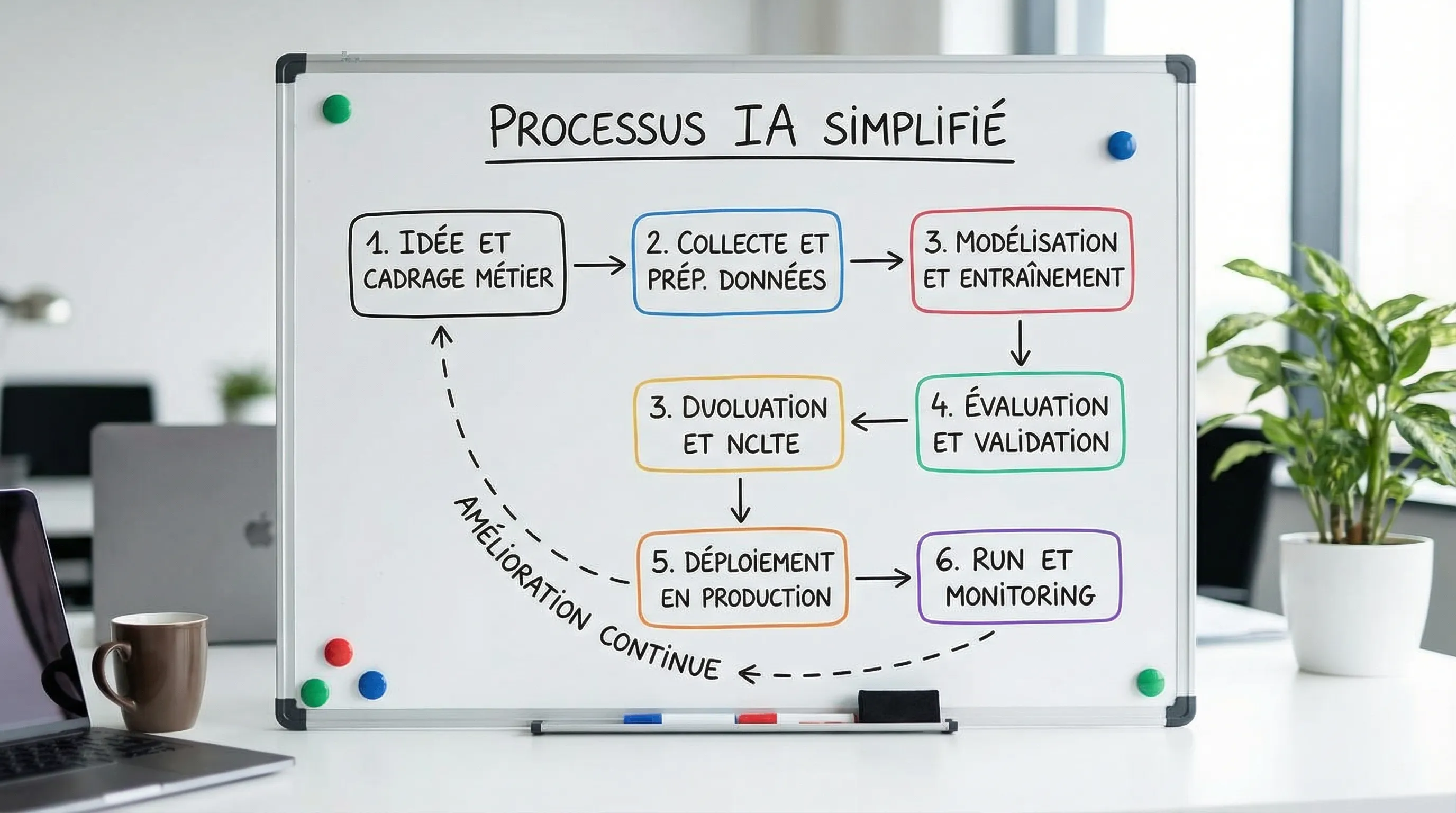
Many companies have "obvious" AI ideas, but few manage to bring them to life **in production** with KPIs, clean integration, and controlled costs. Success rarely depends on the "best model," but rather on a clear AI process.
March 31, 2026·8 min read
Many companies today have "obvious" AI ideas (summarizing calls, answering support, automating back-office tasks), but few manage to bring them to life in production, with KPIs, clean integration, and controlled costs. The difference rarely comes down to the "best model," and much more to a clear, repeatable AI process managed like a product.
This guide proposes an AI process: from idea to production in 6 steps, designed for SMEs and scale-ups that want to deliver quickly, without ending up with an unusable demo.
What we call an "AI process" (and why it's different from a traditional software project)
An AI project resembles a software project in some ways (UX, integrations, security, deployment), but it adds a probabilistic dimension.
Outputs can vary (even with the same input).
Quality heavily depends on data, provided context, guardrails, and testing.
Execution costs can be variable (especially with generative AI).
Result: if you don't formalize a process, you often get an "impressive POC" that doesn't hold up to 3 weeks of real usage.
On the governance side, keep in mind two structuring frameworks in Europe and in business:
The GDPR (personal data, minimization, legal basis, subcontracting).
The AI Act (European framework for AI systems, obligations based on risk level).
And for AI risk management, the NIST AI RMF is a useful reference to structure the approach, even for an SME.
Overview: The 6-step AI process
The goal is not to have "6 heavy phases," but to have 6 decision gates with simple deliverables. Each step produces evidence that reduces risk.
Step
Objective
Main Deliverable
Decision
1
Transform an idea into a measurable business problem
KPI + baseline + scope
Go if value and metric exist
2
Choose a "production-ready" use case
Usage contract (who, when, how, limits)
Go if workflow is clear
3
Secure context and data
Source inventory + data rules
Go if data is accessible and "clean"
4
Design the integration architecture
Pattern (API, RAG, agent) + integration schema
Go if integration is realistic
5
Build an instrumented and testable MVP
Prototype + tests + metrics
Go if quality and cost are controlled
6
Manage, industrialize, and operate
Runbook + monitoring + adoption
Go if sustainable usage and ROI observed
Step 1: Scope the value (KPI, baseline, scope)
An AI idea is often formulated as a capability ("answer emails," "build a chatbot"). In production, you must reframe it as a business outcome.
Examples of useful scoping:
Support: reduce first response time, increase first contact resolution rate.
Sales: increase the qualified meeting rate, reduce preparation time.
Back-office: reduce processing time, decrease errors.
To produce right now:
North Star KPI (1 main indicator).
2 to 4 management metrics (volume, time, quality).
1 to 2 guardrails (risk, compliance, satisfaction).
Baseline: your situation before AI (even approximate) to avoid measuring "usage" rather than impact.
If you don't have a baseline, you might deliver something, but you won't know if it's worth maintaining.
Step 2: Write the "usage contract" (the core of the AI process)
Before talking about models, write a simple usage contract. It makes explicit what the AI is allowed to do, and under what conditions.
Recommended content:
Users: who uses it, and when.
Input: what the user provides (format, constraints, mandatory fields).
Output: the expected format (structured summary, email draft, classification, assisted decision).
Limits: what the AI must not do, and when it should escalate.
This document is short, but it prevents the ambiguity that kills AI projects (everyone imagining a different assistant).
Step 3: Prepare data and context (without falling into the "data-lake trap")
For an SME or scale-up, the goal isn't to "centralize everything" before acting. The goal is to have a single source of truth that is usable within a limited scope.
Practical questions to settle:
What are the authorized sources (CRM, helpdesk, Drive, Notion, knowledge base, ERP)?
What is the sensitivity level (personal data, contracts, secrets)?
Who has the right to access what (RBAC, groups, roles)?
How to avoid sending unnecessary data (minimization)?
If your use case relies on internal documents, you will often need to use a RAG approach (retrieve sources, then generate a response). In this case, quality heavily depends on document hygiene (versions, duplicates, "official source").
For data and compliance best practices, the CNIL regularly publishes useful resources.
Step 4: Choose the right architecture pattern (API, RAG, agent)
At this stage, you have a clear need and identified data. Now you must choose an integration pattern.
Three patterns dominate in production:
AI API: you encapsulate a capability (classification, extraction, generation) behind a stable endpoint.
RAG: you connect the AI to "source of truth" documents to reduce hallucinations and improve traceability.
Agent: the AI plans and executes actions via tools (CRM, helpdesk, emails) with guardrails.
The right choice depends on the risk and the need to take action.
Pattern
Good choice if...
Main risk
Key control
AI API
precise capability, structurable input/output
quality drift, variable cost
input contracts + logs
RAG
need for answers "grounded" in your docs
poor quality retrieval
sources, citations, tests
Agent
need to chain multi-tool actions
dangerous actions, errors
validations, permissions, traceability
If you are working on agents or chatbots, keep in mind classic application risks (injection, exfiltration, unintended actions). The OWASP Top 10 for LLM Applications is a good foundation for framing protections.
Step 5: Build an instrumented MVP (and test it like a system)
An AI MVP is not a demo. It is a minimalist, yet measurable version, used on real cases.
Two rules:
Instrument from the start.
Correlation ID per request.
Useful logs (without storing more than necessary).
Cost measurement (tokens, latency, errors).
Test with a set of representative cases.
You need a "business" test suite (20, 50, sometimes 200 cases): real customer requests, tickets, emails, documents, edge cases.
Reasonable exit criteria to move to the next step:
Acceptable quality on the test set.
Estimable average cost per action (and compatible with your ROI).
Classic mistakes that break an AI process (and how to avoid them)
Here are the most common pitfalls, especially during the scaling phase.
Measuring usage instead of impact: "200 prompts a day" means nothing if time saved or quality doesn't change.
Not integrating into the workflow: if the AI isn't in your tools (CRM, helpdesk, Google/Microsoft suite), it remains just another tab.
Forgetting the data: the best AI cannot compensate for a contradictory knowledge base.
Launching an agent too early: if the API or RAG isn't robust, the agent amplifies errors.
No run phase: no owner, no alerts, no source maintenance, so the solution degrades.
The "minimal kit" to execute this AI process in an SME
You don't need a 15-person team. But you do need the right roles, even part-time.
Sponsor (leadership): arbitrates and protects focus.
Business owner: owns the KPI and validates quality.
Data/tools lead: knows where the sources are and how to access them.
Development/integration: builds the product and connects it to the IT system.
Compliance lead (depending on context): GDPR, contracts, risks.
How Impulse Lab can help you (without locking you in)
If you want to implement this AI process quickly, Impulse Lab supports SMEs and scale-ups across three areas, depending on your maturity:
AI opportunity audit: to prioritize 1 to 3 use cases with KPIs, risks, and a roadmap.
Custom development and integration: to build a useful solution within your existing tools (automation, platform, agents, RAG).
Adoption training: to ensure AI is used correctly and sustainably.
To get started, the most "no-regrets" approach is often to validate a use case, a KPI, and a scope, then deliver an instrumented V1 in short cycles. You can discuss this directly with the team via Impulse Lab.