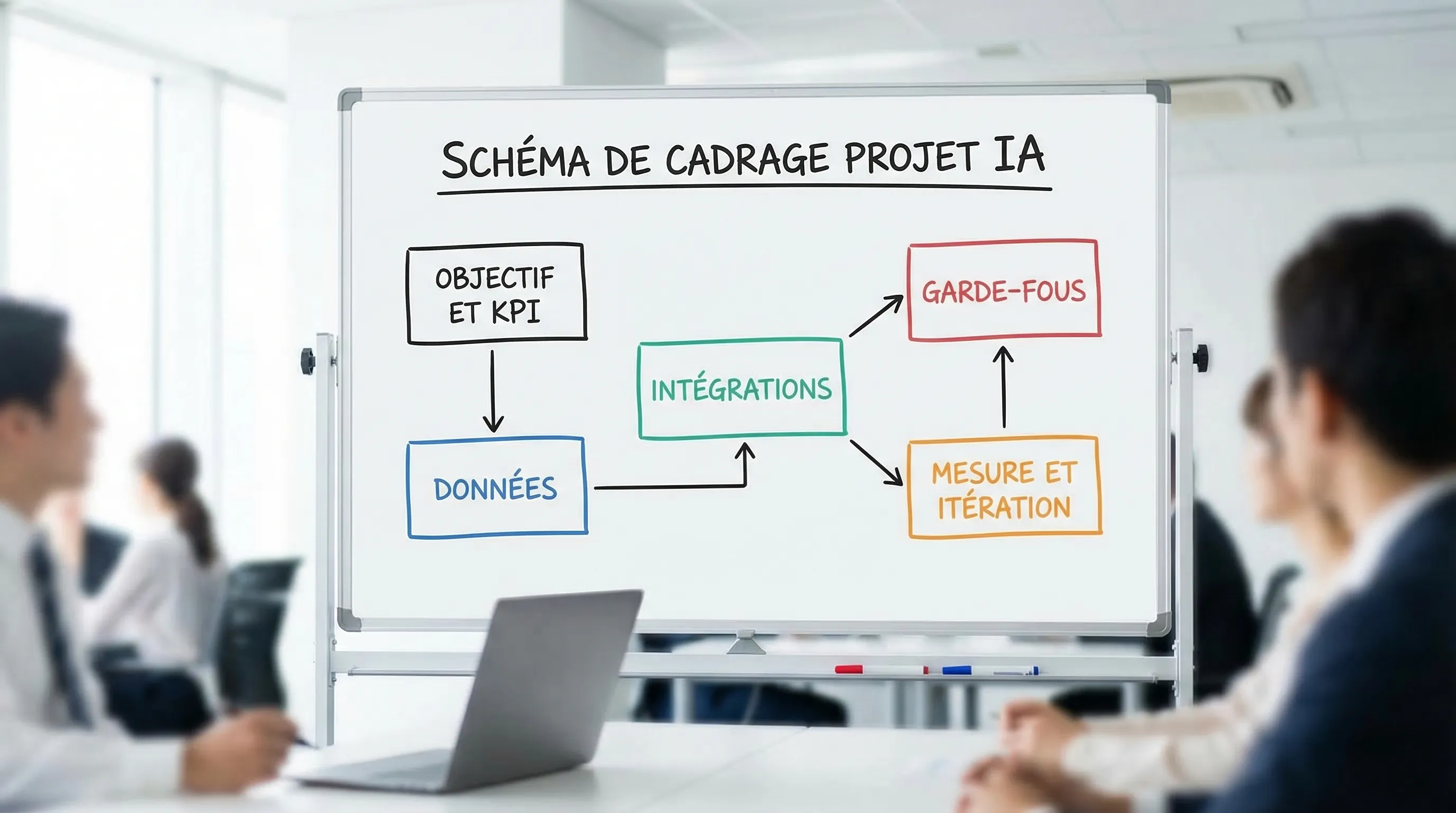
An **AI project** rarely fails because “the model isn't good enough”. It fails much more often because the scoping mixes several objectives, underestimates data constraints, or forgets integration into the real workflow. Classic result in SMEs and scale-ups: an impressive POC...
March 10, 2026·9 min read
An AI project rarely fails because “the model isn't good enough”. It fails much more often because the scoping mixes several objectives, underestimates data constraints, or forgets integration into the real workflow. A classic result in SMEs and scale-ups: an impressive POC, then… nothing in production.
This scoping checklist helps you lock down key decisions before developing, to deliver a useful, measurable, and industrializable V1.
Who is this checklist for (and when to use it)
Use it if you are an executive, Head of Ops, PM, RevOps, or CTO and you have:
an “AI assistant”, “agent”, “chatbot”, “RAG”, or “automation” idea
a motivated sponsor, but fuzziness regarding value, scope, data, or the run phase
the will to deliver in short cycles, without debt and without unnecessary legal risk
If you are still at the stage of “we want to do AI, but we don't know where”, start instead with a quick identification of quick wins (see the Impulse Lab resource: AI Audit: express checklist for quick wins).
The 12 decisions that (really) make an AI project succeed
The checklist below is organized as production-oriented scoping. You don't need to have all the perfect answers, but you must know who decides, on what basis, and at what moment.
1) Business problem: what job-to-be-done, for what scope
Start by formulating the problem without AI.
Who does the task today?
In which tool (CRM, helpdesk, ERP, Google Workspace, Notion, etc.)?
Where are the frictions (time, errors, escalations, rework)?
Expected output: 1 sentence like “Reduce X (task) for Y (team), in Z (tool), without degrading W (quality/risk)”.
2) KPIs and baseline: how to prove value (and not just usage)
An AI project without KPIs becomes a “demo” project. Before developing, define:
1 “North Star” KPI (main gain)
2 to 4 support KPIs (productivity, quality, delay)
1 to 2 guardrails (e.g., errors not to exceed, escalations, compliance)
Indispensable: a baseline (the measurement before AI). Without a baseline, you won't be able to conclude.
To go further on measurement, you can rely on a structured approach like “AI KPIs” (Impulse Lab resource in English: AI KPIs: Measuring the Impact on Your Business).
3) Users and usage “contract”
Explicitly define:
primary users (those who use it)
impacted users (those who receive the result)
usage context (real-time, asynchronous, mobile, under pressure)
what the system is allowed to do, and what it is not allowed to do
Simple contract example: “The assistant proposes, cites its sources, and triggers no action without confirmation.”
4) Target workflow mapping (before talking tech)
The right scope describes the flow:
trigger (when the need appears)
input (available data)
processing (reasoning, search, rules)
output (response, document, action)
feedback loop (correction, validation, learning)
Tip: if your flow isn't clear on 1 page, it is often too big for a V1.
The scoping must include a test protocol, otherwise you will “test in prod”.
To prepare:
a pack of representative scenarios (20 to 100 cases)
success criteria per scenario
a non-regression strategy (reference cases)
an observability strategy (logs, quality, costs)
If you work on RAG, robustness depends heavily on evaluation (reference datasets, drift monitoring). See: Robust RAG in production: best practices, evaluation, and strategic choices.
Custom development and integrations when value depends on the workflow and existing tools
Adoption training to align rules, usage, and security
FAQ
How long does it take to scope an AI project correctly? An effective “V1” scoping is often done in a few workshops and actionable deliverables over 1 to 2 weeks, if business, data, and IT owners are available.
What is the minimum to have before developing? A bounded use case, a KPI baseline, access to data (and their owners), a chosen architecture pattern, and a representative test pack.
Is a RAG absolutely necessary for an AI project? No. RAG is useful when you must answer from a verifiable document source. For extraction, scoring, or an encapsulated capability, an API approach may suffice.
How to avoid hallucinations in production? By combining sources of truth (often via RAG), guardrails (refusals, confirmations), tests on real scenarios, and monitoring (quality, escalations, errors).
Who should be responsible for an AI project in an SME or scale-up? Ideally a pair: a business owner (value, adoption) and a product/tech owner (integration, run), with security and legal involved depending on sensitivity.
Moving from checklist to delivered V1 (without debt)
If you have an AI project to scope, the goal isn't to produce a perfect file, but a decision pack that allows delivering a measurable V1 in short cycles.
Impulse Lab can accompany you from scoping to V1 (audit, integration, custom development, and training), with a results-oriented approach and weekly deliveries.