2025 marks the year AI moves from the lab to the core of operations. Beyond the hype, executive boards now expect measurable gains, solid governance, and a robust compliance framework. This 2025 AI report synthesizes key trends, pitfalls to avoid, and a roadmap for business value.
décembre 15, 2025·8 min de lecture
2025 promises to be the year AI definitively moves out of the lab to settle at the heart of operations. Beyond the hype, executive management now expects measurable gains, solid governance, and a robust compliance framework. This 2025 AI report synthesizes the key trends to follow, the pitfalls to avoid, and a pragmatic roadmap to turn promises into business value.
Key trends reshaping AI adoption in 2025
The signals are converging. Companies are moving from isolated POCs to reasoned industrialization, anchored in compliance and economic performance. Here are the most structural dynamics to integrate into your action plan.
1) From POC to AI product portfolio
High-performing AI programs are abandoning the opportunistic approach. They are structuring a portfolio of use cases aligned with P&L priorities, with clear prioritization criteria, quantified objectives, and value governance. Product discipline is taking over, with short cycles, explicit metrics, and an iterative culture.
Prioritize by impact and feasibility, not by hype.
Fund in stages, based on observable proof of value.
Integrate data, security, legal, and business teams right from the scoping phase.
2) Data and LLM architecture, from theory to execution
Winning architectures combine robust data foundations with modular AI components. Retrieval-augmented generation (RAG) is progressing, relying on reliable connectors, metadata normalization, vector indexing, and, increasingly, knowledge graphs to structure context. Organizations are upskilling on LLM evaluation and observability to orchestrate prompts, tools, and guardrails in production.
3) Agents, not just chatbots
In 2025, value shifts toward operational agents that trigger actions in your systems, apply rules, and orchestrate workflows, with human supervision. Chat is no longer the sole interface. Preference is given to UX integrated into the workstation—for example, in the ERP, CRM, or ticketing tool—to reduce time-to-result rather than time-to-click.
4) Inference cost optimization and sobriety
Economic and energy sustainability is becoming central. Effective levers combine choosing a relevant model rather than a systematically giant one, semantic caching, compact prompts, task distillation, and tool call governance. AI FinOps is moving closer to production, with dashboards tracking cost, latency, and perceived quality.
5) Compliance, security, and trust by design
The European AI Act adopted in 2024 brings a structuring of responsibilities and controls across the lifecycle. Coupled with GDPR, sectoral policies, and national requirements, it pushes for documenting datasets, bias evaluation, traceability, testing, and guardrails. Winning programs integrate governance and application security right from the design phase.
6) Training and change management, decisive factors
Adoption cannot be decreed. Organizations reaping real gains invest in targeted training by job function, ready-to-use use case libraries, and internal communities. Usage KPIs are tracked with as much attention as technical KPIs.
2025 AI Maturity Matrix
Review your current position and your 12-month objectives.
Domain
Level 1, opportunistic
Level 2, piloted
Level 3, industrialized
Level 4, at scale
Strategy and portfolio
Isolated ideas
Prioritized backlog, defined objectives
Value governance, quarterly reviews
Dynamic budget allocation and P&L trade-offs
Data and integration
Siloed sources
Key connectors, minimal RAG
Catalogues, quality and metadata, targeted graphs
Data products, lineage, multi-country governance
Models and tools
Consumer tools
Models selected by usage
Agent orchestration, secure tool calling
Modular internal AI platform
Security and compliance
Generic policy
Guardrails in sandbox
Evaluations, logging, reinforced privacy
Compliance by design, regular audits
Delivery and adoption
Sporadic POCs
Bi-monthly sprints, first production releases
Weekly deliveries, integrated UX
Changes at scale, continuous training
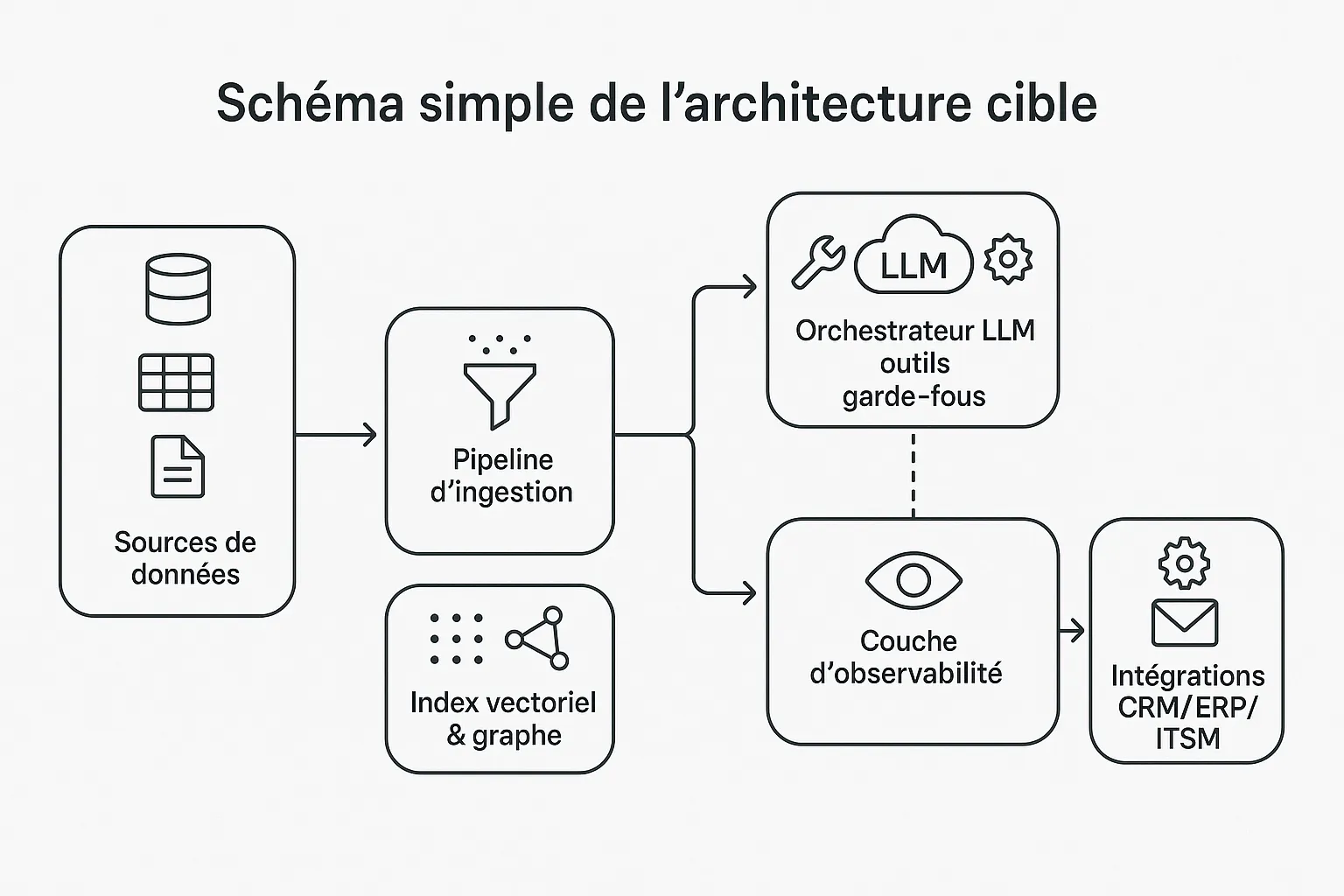
Target architecture, simple and pragmatic
A modular architecture avoids getting bogged down. The following bricks cover 80 percent of 2025 needs.
Ingestion and preparation, connectors to CRM, ERP, ITSM, legal folders, DMS. Normalize formats, metadata, and access policies.
Knowledge, hybrid indexing, vectors, structured fields, possibly a knowledge graph for business relations.
LLM orchestration, management of prompts, functions, tools, and policies, with security guardrails and sensitive data redaction.
Evaluation and observability, metrics for quality, latency, cost, security, user satisfaction, with improvement loops.
Front and back integration, UX in existing tools and webhooks to trigger actions, with complete logging.
Cost, performance, and quality, the right trade-offs
The best ROI comes from combining technical and organizational levers. This table helps choose according to your priorities.
Lever
Cost impact
Quality impact
Difficulty
Ideal for
Choosing a task-adapted model
High
Medium to high
Low
Cases with high latency and budget constraints
Semantic caching and reuse
Medium to high
Neutral to positive
Low
Frequent questions, internal assistance
RAG with reliable sources
Medium
High
Medium
Business knowledge, compliance
Concise prompt design
Medium
Medium
Low
All cases in production
Distillation and specialized SLMs
High
Medium
High
High volume, repetitive tasks
Tool call governance
Medium
High
Medium
Operational agents
Security, compliance, and risk management in 2025
Compliance must not brake innovation; it guides it. Three priority workstreams stand out.
Data governance, minimization, PII masking, retention policies, and end-to-end traceability.
Continuous evaluation, representative test sets, drift detection, guardrails against prompt injection and exfiltration.
Documentation and auditability, use case sheets, sources of truth, design decisions, and clearly established responsibilities.
For compliance teams, progress is tangible. In France, anti-corruption obligations are pushing for modernizing risk mapping. AI approaches allow scanning large volumes of data, extracting weak signals, and prioritizing controls. For a concrete overview, see how AI can automate Sapin II risk mapping, with levers like semantic extraction, risk scoring, and human supervision.
Use cases that are truly advancing in 2025
Use cases with high traction share two traits. They are close to revenue or costs, and they integrate into the workstation.
Customer relations, contextualized responses, exchange summaries, assisted drafting, next-best-action in the CRM.
Operations and supply chain, document normalization, data extraction, reconciliations, order generation, planning-related notifications.
IT and internal support, copilots to create tickets, propose patches, automate simple diagnostics with human validation.
To maximize impact, link these use cases to a rigorous measurement method. Our detailed advice on value is synthesized here, see Transforming AI into ROI, proven methods.
Evaluation and observability, the sinews of war
Putting an agent into production without reliable measurement is like flying blind. In 2025, test sets and metrics are being standardized.
Operations, p95 latency, cost per execution, tooling errors, human escalation rate.
The best teams combine automatic evaluations, targeted human reviews, and actionable logs. They treat prompts, tools, and guardrails like versioned code.
90-day roadmap to scale
A tight, realistic plan that generates internal traction.
Weeks 0 to 2, value and risk scoping, 3 use cases, quantified objectives, data hypotheses and compliance rules, backlog and simple UX design.
Weeks 3 to 6, framed prototyping, RAG on a validated source, integration into a business tool, first user tests, baseline metrics.
Weeks 7 to 12, limited production release, complete observability, cost/quality optimization, targeted training, arbitration committee for next steps.
How Impulse Lab supports you
Impulse Lab is an expert agency that transforms AI into measurable value for your organization. Our product and technical team intervenes from diagnosis to industrialization, always with a focus on integration and operational simplicity.
AI opportunity audits, aligning your use cases with your business objectives and your data and compliance constraints.
Custom web and AI platforms, agents, copilots, and integrations with existing tools.
Process automation, reducing delays and costs on high-volume tasks.
Operational efficiency, time-to-result, automation rate with human validation, backlog processed.
Quality and compliance, critical error rates, incidents avoided, auditability.
Adoption, active users, sessions per week, satisfaction by persona.
Common mistakes to avoid
Deploying a chatbot without integrations or access rights; the tool becomes an isolated island.
Ignoring evaluation; confusing demo with production.
Choosing the largest model by default; the bill soars without tangible gain.
Neglecting application security; API exposures, data leaks, uncontrolled prompts.
Forgetting change management; without training or dedicated UX, usage stagnates.
In summary
The 2025 AI report highlights a clear line. AI creates value when conceived as a product, plugged into governed data, measured rigorously, secured by default, and adopted by business lines. The underlying trends—operational agents, cost/quality optimization, compliance by design, and targeted training—converge toward a single objective: a tangible impact on your P&L.
Ready to structure your roadmap and deliver your first gains in a few weeks? Contact the Impulse Lab team for an AI audit and an execution plan adapted to your organization, https://impulselab.ai