AI software: choosing, integrating, and measuring ROI in SMEs
automatisations
Intelligence artificielle
Stratégie IA
Outils IA
ROI
In 2026, the problem for SMEs is no longer "finding AI," but avoiding tool chaos and transforming **AI software** into measurable gains, integrated into processes, with an acceptable level of risk (GDPR, security, AI Act). The difference between a tool that impresses in a demo and one...
In 2026, the problem for SMEs is no longer "finding AI," but avoiding tool chaos and transforming AI software into measurable gains, integrated into processes, with an acceptable level of risk (GDPR, security, AI Act). The difference between a tool that impresses in a demo and a tool that improves margins often plays out on three simple points: selection, integration, ROI measurement.
1) AI software in SMEs: what are we (really) talking about?
In an SME, AI software rarely designates an isolated "model." It is rather a software (SaaS, suite module, or custom solution) that embeds AI capabilities to:
assist a user (copilot)
answer questions based on a knowledge base (RAG, semantic search)
automate part of a workflow (classification, extraction, routing, draft generation)
trigger actions in your tools (CRM, helpdesk, ERP, messaging)
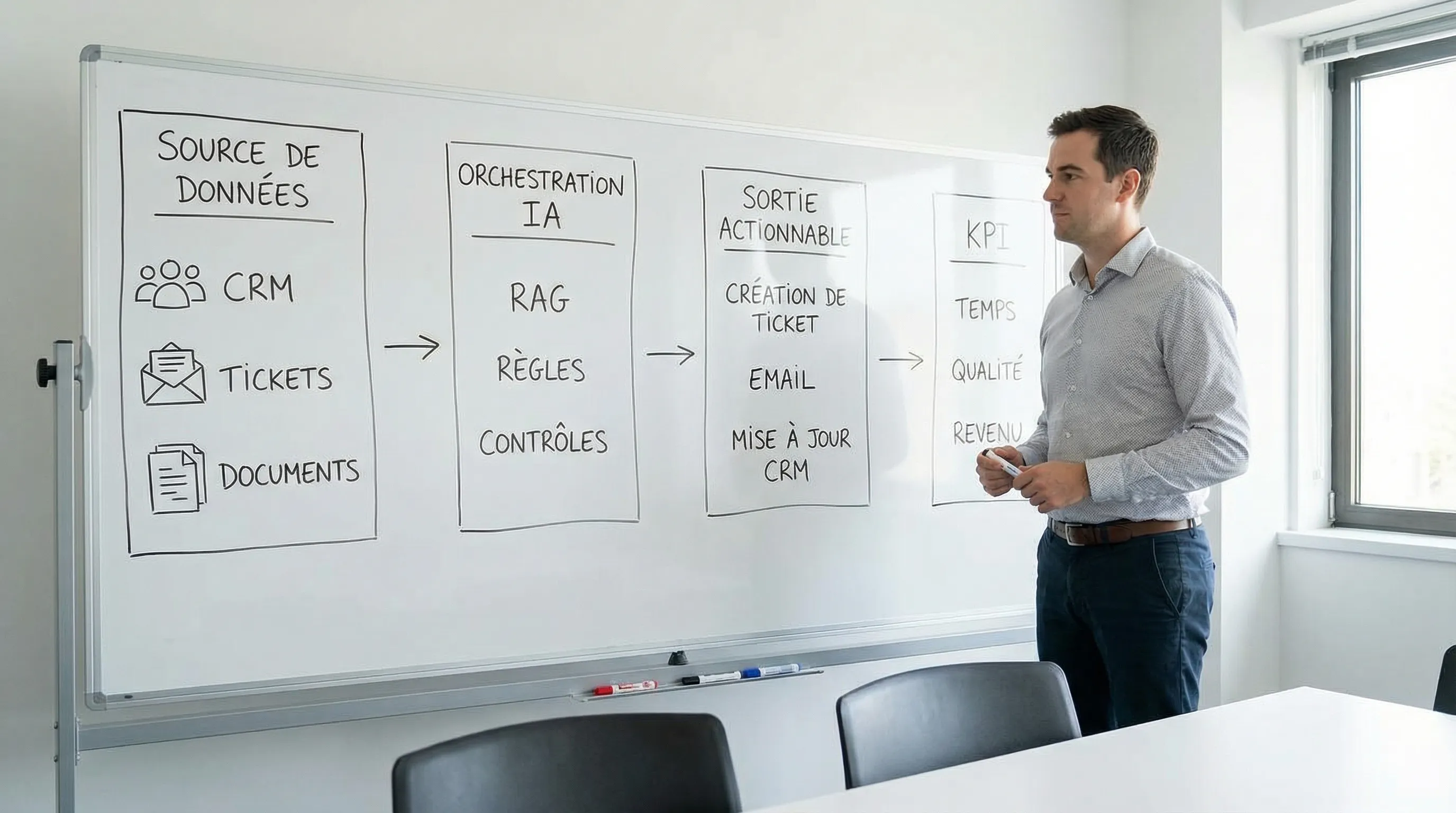
What matters for profitability is not "the AI" but the value chain: input (data) → processing (AI + rules) → output (action in a tool) → effect (business KPI).
2) Choosing AI software: the method that avoids "tool-first"
A good choice follows this order: use case → KPI → constraints → field tests → decision. The reverse (tool first, ROI later) almost always ends in an undeployed PoC, or "shadow AI."
Frame the use case with a useful question
Replace "we want AI" with a sentence like this:
"We want to reduce the time spent handling level 0 support requests by 25%, without degrading customer satisfaction, and with response traceability."
This is the sentence that conditions everything: the data to connect, the integration level, the guardrails, the dashboard.
The 9 criteria that decide in SMEs
You can evaluate most AI software with these criteria, without falling into an endless RFP.
Criterion
To verify concretely
Good signal
Workflow alignment
The tool "sticks" to your daily actions (CRM, helpdesk, drive)
A simple testing protocol (and more honest than a demo)
Without getting into a heavy protocol, test the tool on:
a set of scenarios (questions, documents, tickets) from real life
constraints (partial data, ambiguous requests, "out of scope" cases)
a measurement objective (time saved, correct answer rate, escalation rate)
AI software that "shines" only when you give it the perfect prompt and complete context is rarely good in production.
3) Integrating AI software: from "copy-paste" to actionable tool
In SMEs, integration is not a luxury. It is often the condition for profitability: a non-integrated tool creates friction, thus low adoption, thus fragile ROI.
The 4 levels of integration (practical) in SMEs
Level
Description
Advantage
Limit
Level 0: manual usage
Copy-paste, prompts, team templates
Immediate start
Capped ROI, data risk
Level 1: ad-hoc API
Call AI from a script or internal app
Automatable, traceable
Need dev + monitoring
Level 2: tooled workflow
Integration via connectors (CRM/helpdesk/automation)
Fast gains on repetitive flows
Watch out for silent errors
Level 3: custom platform
Orchestration, RAG, rules, observability, costs
Control, quality, scale
Higher initial investment
This choice depends mainly on the frequency of the use case, the risk level, and the need to write in your tools (create/update objects).
Three architecture principles that protect your ROI
Separate orchestration from the tool: Avoid locking all your logic in non-exportable "workflows." Keep an orchestration layer (even a light one) that you control.
Make outputs auditable: Log at minimum the input, output, sources (if RAG), user, and triggered action. This is essential for support, compliance, and continuous improvement.
Add proportionate guardrails: Human validation on critical actions, deterministic rules on sensitive fields, anti-injection filters for assistants connected to external sources. On this subject, the NIST AI Risk Management Framework is a good base for pragmatic governance.
A good maturity signal: you have 1 North Star KPI (the result), 2 to 4 support KPIs (the mechanism), and 2 guardrails (risk/cost). Impulse Lab offers a more detailed framework here: AI chatbots: essential KPIs to prove ROI (useful even outside chatbots, as the measurement logic is transferable).
How to prove ROI without waiting 12 months
In SMEs, you can often demonstrate ROI in a few weeks if you:
measure a baseline (e.g., average time per ticket, volume, transfer rate)
deploy an instrumented pilot on a limited scope
compare before/after or, ideally, with a control group
Even an imperfect "before/after" is better than team impressions.
5) A realistic 90-day plan to choose, integrate, and measure
The best tempo is one that forces a decision, without sacrificing safety.
Period
Objective
Expected deliverables
Weeks 1-2
ROI-first scoping
prioritized use case, KPI + baseline, data/GDPR constraints
Weeks 3-6
Integrated MVP
minimal integration, logs, guardrails, test protocol
ROI/risk scorecard, industrialization plan or stop
This plan works particularly well if you voluntarily limit the scope to 1 or 2 frequent workflows (not "the whole company").
6) Mistakes that destroy AI software ROI
Believing the "tool" replaces integration
If your team has to copy-paste, switch tabs, or re-enter info, adoption erodes. ROI erodes with it.
Launching without usage rules and data classification
This is the shortest path to shadow AI and incidents. The CNIL regularly publishes useful benchmarks on data protection, and it is often your practical starting point for compliance.
Measuring usage rather than impact
"Number of prompts" says nothing about your margin, your cash, nor your quality.
Forgetting knowledge maintenance
A RAG assistant "works" on day 1, but drifts if no one updates the sources, corrects answers, or tracks "unresolved" tickets.
Frequently Asked Questions
AI software and Generative AI, is it the same thing? No. Generative AI is a family of technologies (LLM, text generation, etc.). AI software is a product (SaaS or custom) that uses AI and inserts it into a usage, a UX, integrations, and governance.
What is the best AI software for an SME? The one that sticks to a frequent workflow, with simple integration, manageable costs, and measurable KPIs. "Best" depends on your data constraints, your stack, and the criticality level.
How to avoid exposing sensitive data in an AI tool? By classifying data (sensitive or not), checking clauses (retention, training), limiting sent fields, and instrumenting a usage framework. For a start, prioritize a pilot on non-sensitive data.
Which KPIs to track first to measure ROI? One business KPI (e.g., tickets avoided, time saved, conversion), one process KPI (processing time, delay), and one guardrail (quality, escalation rate, cost per action). Only then do you refine.
Should I buy AI SaaS or build custom? Often a mix. Buy when the need is standard and integration acceptable. Go custom when you need specific UX, deep integrations, cost control, or strong security/governance requirements.
Move from AI tool to measured ROI with Impulse Lab
If you are hesitating between several AI software options, or if you already have trials underway without clear ROI, Impulse Lab can help you:
frame an AI opportunity audit oriented towards gains and risks
integrate AI into your existing tools (CRM, support, ERP, knowledge)
deliver an instrumented pilot with KPIs, logs, and guardrails
train your teams to secure adoption
You can start with a quick scoping via the site: Impulse Lab.