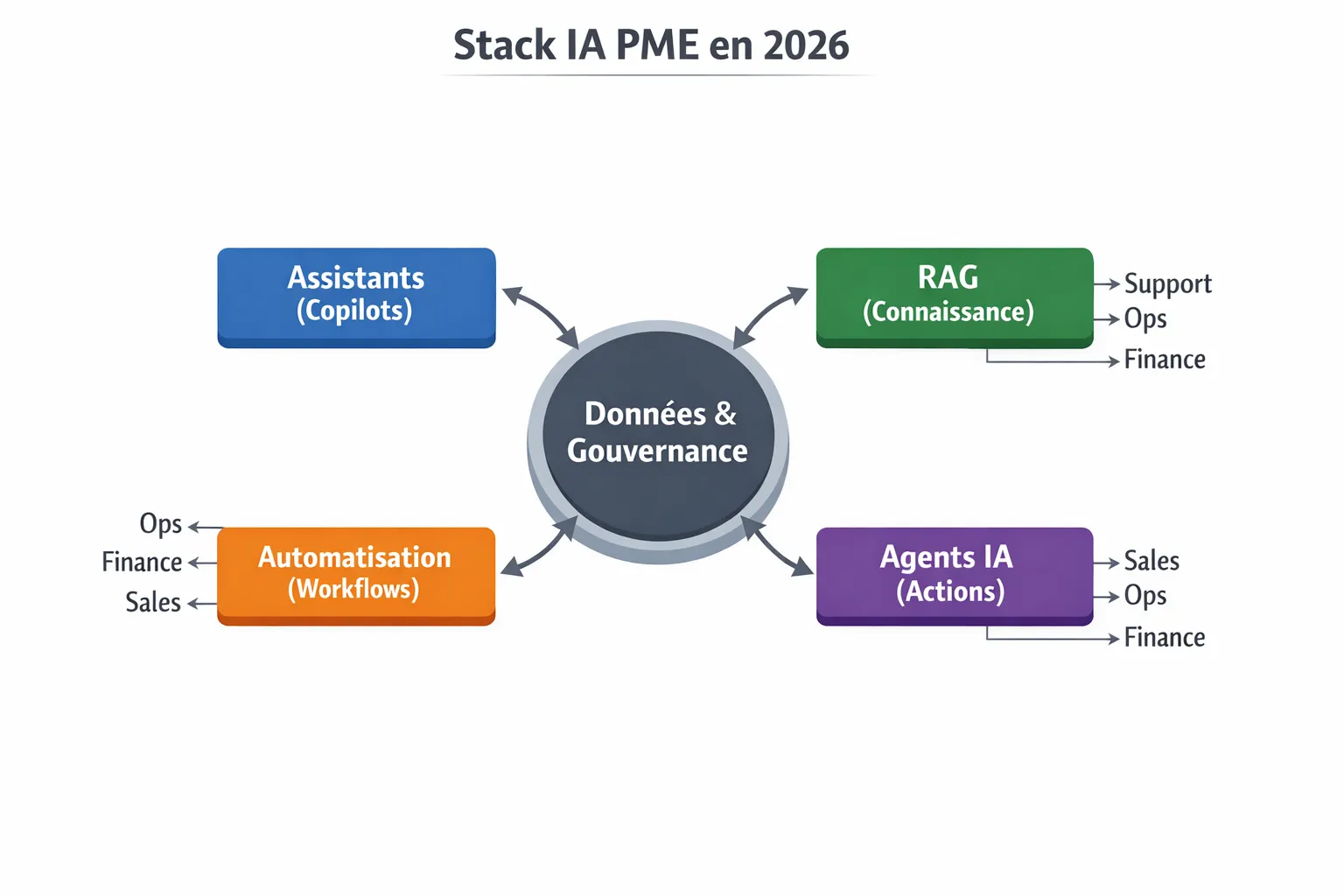
In 2026, the question is no longer "which AI is trendy?", but "**which AIs are actually useful for an SME** (and in what order to deploy them)". Between writing assistants, autonomous agents, RAG, automation, multimodal AI, and specialized tools, it quickly feels like...
In 2026, the question is no longer "which AI is trendy?", but "which AIs are actually useful for an SME (and in what order to deploy them)". Between writing assistants, autonomous agents, RAG, automation, multimodal AI, and specialized tools, it quickly feels like you need to know every AI to not miss the train.
Good news: you don’t need endless monitoring. What matters is understanding the major families of AI, their profitable use cases for an SME, and the criteria for choosing reliable, integrable, and compliant solutions.
“All AIs” in 2026: An Ecosystem in 7 Families (Not an Endless List)
In companies, people often confuse “AI” and “chatbot”. In reality, AIs useful to SMEs are grouped into a few functional blocks. The benefit of this breakdown: you can build a progressive stack instead of just piling up tools.
1) Assistants (Copilots): Producing Faster, with Human Control
These are the AIs your teams use directly to write, summarize, rephrase, analyze, code, or prepare materials.
Typical SME use cases:
Drafting and rephrasing (emails, business proposals, job offers)
Summaries (meetings, support tickets, documents)
Analysis aid (spreadsheets, notes, reports)
Coding aid and technical documentation
Key point in 2026: an effective assistant in a corporate setting is rarely “generic”. It must be contextualized (company language, offers, processes, rules). This relates to topics like prompt engineering and, above all, access to your internal knowledge.
2) Knowledge AI (RAG): Answering with Your Documents, Traceably
RAG (Retrieval-Augmented Generation) allows a language model to fetch information from your sources (document base, intranet, CRM, wiki, procedures) and then answer based on them.
This is the most profitable brick when:
Your teams waste time “re-explaining” or “searching for info”
Your answers must be sourced, verifiable, and aligned with rules
You want to industrialize AI without trusting “general” knowledge
An AI agent isn't limited to generating text. It observes, decides, and acts (for example, by calling APIs, creating tickets, updating a CRM). This is a major evolution in 2026, as we move from an “assistant” to an “operator”.
Concrete examples:
Qualifying a lead and automatically creating the file in the CRM
Preparing a sales brief before a meeting (based on history, emails, notes)
Sorting incoming requests and triggering a workflow (support, quote, follow-up)
Here, “generative” AI is not always necessary. More classic models (vision, extraction, classification) can be more stable and less expensive.
7) AI for IT and Product: Accelerating Without Compromising Security
For technical teams (or SMEs with a SaaS product), the most frequent uses:
Assistance with code, testing, refactoring, documentation
Technical support aid (searching in incidents, runbooks)
Generation of integration scripts and queries
The trap: accelerating delivery without strengthening governance (reviews, secrets, dependencies, traces). AI must fit into your practices, not bypass them.
Quick Map: Which AI for Which SME Need?
This table does not try to list brands. It helps you recognize the right family of AI according to your objective.
Useful AI Family for SMEs (2026)
Main Objective
Required Data
Typical Risk
When It's Worth It
Assistants (Copilots)
Save time on production and analysis
Low initially, then business context
Confidentiality, variable quality
As soon as you standardize deliverables (emails, offers, reports)
RAG (Knowledge AI)
Answer with your documents, traceably
Document base, procedures, FAQ, CRM
Poor indexing, obsolete sources
When “searching for info” is costly and the answer must be reliable
AI Agents
Execute actions and orchestrate tasks
API access, business rules, logs
Incorrect actions, governance
When you have recurring and measurable workflows
Automation + AI
Streamline end-to-end processes
Connected tools + clean data
Fragility of integrations
When the bottleneck is the sequence of steps between tools
Customer AI (Chat/Voice)
Reduce response time, qualify better, serve better
Knowledge base, customer history
Bad routing, hallucinations
Building an SME AI Stack: 3 Maturity Levels (Without Overinvesting)
The frequent mistake: buying “powerful” tools before clarifying uses, data, and rules. A more robust approach consists of progressing by levels.
Level 1: “Framed Adoption” (2 to 4 weeks)
Objective: Make AI useful daily, without touching critical systems.
Define a usage charter (forbidden data, human validation, authorized use cases)
Train teams on concrete scenarios (not generic training)
Measure 2 to 3 simple gains (production time, perceived quality, delay)
Objective: Connect AI to your tools and knowledge.
RAG on a controlled document base
Connectors for CRM, helpdesk, drive, HR database (depending on priority)
Logging and evaluation (at a minimum to understand errors and drift)
In this phase, the question becomes: “how to industrialize without getting trapped?”. This is often where architecture and integrations account for 80% of success.
Level 3: “Custom AI and Agents” (8 to 16 weeks)
Objective: Automate complete workflows, with fine-grained control.
AI Agents with limited permissions (what the agent can read, write, trigger)
The 8 Criteria for Choosing Useful AIs (and Avoiding “False Good Ideas”)
In 2026, SMEs do not lack tools. They lack a selection framework. Here are the criteria that prevent the majority of failures.
Integration: Does the tool really plug into your CRM, helpdesk, SSO, drive?
Confidentiality: Where does the data go, who accesses it, what are the retention options?
Traceability: Do you have logs, sources (for RAG), an audit possibility?
Evaluation: Can you measure quality (error rate, edge cases) before generalizing?
Total Costs: Licenses + team time + integrations + maintenance + support.
Control: Rules, guardrails, human validation, permissions, escalation.
Adoption: Does the tool change the workflow (otherwise it will be bypassed)?
Compliance: GDPR and sector-specific requirements, and anticipation of the European framework.
On the regulatory front, two references often come up in serious initiatives: the European AI Act and the NIST AI Risk Management Framework (useful as a governance guide, even outside the USA).
A Simple Roadmap for “All Useful AIs” (Without the Complexity)
Frame by Value, Not by Technology
Before talking about models and tools, start with 3 questions:
Where do we lose the most time (or money) each week?
Where is quality unstable (errors, rework, omissions, delays)?
Where is execution speed a competitive advantage?
This logic aligns with an ROI-first approach (useful if you want to avoid POCs with no future).
Choose 1 “Showcase” Use Case and 1 “Foundation” Use Case
A good SME pattern in 2026:
A “showcase” case oriented towards teams (assistant, support, sales) to create buy-in
A “foundation” case oriented towards knowledge or process (RAG, document extraction) to create a lasting base
Measure From the Start, Even Simply
No need for a complex setup. The essential: a baseline, then a before/after.
Productivity: Average time per task, number of tasks processed
Quality: Error rate, rework rate, compliance with rules
Experience: CSAT, response time, resolution rate
FAQ
What are the most useful AIs for an SME in 2026? The most useful ones are those that integrate into your workflows: assistants to save time, RAG to leverage your internal knowledge, automation to connect your tools, and AI agents to execute repetitive tasks with control.
Should we choose a single tool to “do it all”? Rarely. In practice, a high-performing SME combines a few bricks (assistant, RAG, automation) and adds agents only when processes and permissions are well framed.
What is the difference between a chatbot and an AI agent? A chatbot answers. An AI agent can also act (create a ticket, update a CRM, trigger a workflow) according to defined rules and access. To understand the basics: AI Agent.
How to avoid sharing sensitive data with AIs? You need a clear usage policy (types of forbidden data), privacy settings on the provider side, and ideally an architecture where the AI accesses information via controlled connectors (rather than copy-pasting data).
How to prove the ROI of an AI project in an SME? By defining 3 to 5 KPIs per use case, with a baseline and post-deployment tracking. A complete framework: AI KPIs: Measuring the Impact on Your Business.
Moving from “All AIs” to a Useful, Measured, and Deployed Stack
If you want to turn this mapping into an action plan, Impulse Lab supports SMEs and scale-ups with: opportunity audits, integrations, automation, custom platform development, and adoption training.
To quickly identify your most profitable use cases and risks to address: Strategic AI Audit
Accelerating Product Sheet Creation with Artificial Intelligence
Exploring AI content creation addresses a key need for e-commerce SMBs: producing more product listings without monopolizing copywriting teams. AI can draft descriptions and adapt tone, but compelling copy does not ensure factual accuracy—making clean data and structured review essential.