Autonomous Agents: When They Actually Work in Enterprise
Intelligence artificielle
Stratégie IA
Automatisation
“Autonomous agents” fascinate because they promise more than a chatbot or a copilot: they observe a situation, decide on a sequence of actions, call tools, then loop until they reach a goal. In practice, they can create a lot of value, but only under...
February 23, 2026·9 min read
“Autonomous agents” fascinate because they promise more than a chatbot or a copilot: they observe a situation, decide on a sequence of actions, call tools, then loop until they reach a goal. In practice, they can create a lot of value, but only under fairly precise conditions. Otherwise, they become a generator of incidents, variable costs, or operational debt.
The goal of this article is simple: to help you decide when an autonomous agent actually works in an enterprise context, how to scope the right level of autonomy, and how to manage it without turning your organization into a permanent laboratory.
What we (really) call an autonomous agent in enterprise
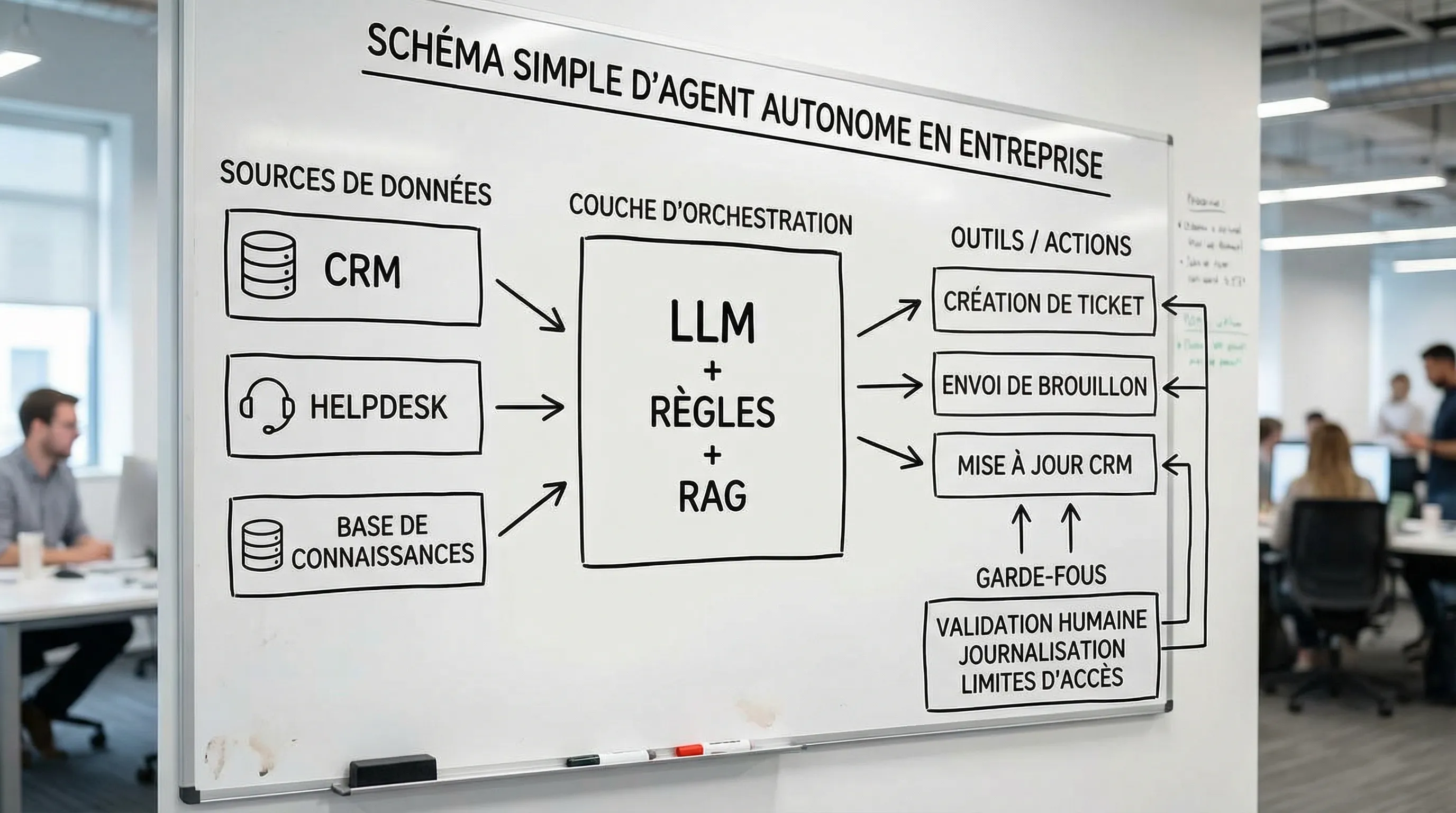
In a business context, an autonomous agent is generally a system based on an LLM, connected to data (often via RAG) and tools (CRM, ERP, helpdesk, messaging, knowledge base, etc.), capable of executing a loop: plan, act, verify, correct.
To avoid misunderstandings, it is useful to distinguish between agents, chatbots, and deterministic automation.
Format
What it does
When it’s the right choice
Main risk
Chatbot (conversation)
Answers, guides, collects info
Repetitive questions, triage, qualification
Hallucinations, poor routing
Copilot (assisted)
Proposes, human validates and executes
Tasks requiring human judgment, drafting, analysis
Low adoption if poorly integrated
Deterministic automation (RPA, rules)
Executes stable rules
Repetitive processes, little ambiguity
Fragile if the process changes
Autonomous Agent
Chains actions and self-corrects
Tooled, verifiable, high-frequency workflows
Unwanted actions, cost, security
If you need a more “system” definition, you can also consult the glossary entry: AI agent.
When autonomous agents create value: 6 non-negotiable conditions
An autonomous agent doesn’t “work” because the model is good. It works because the environment is agent-compatible: clear objectives, reliable data, bounded actions, controls, and business accountability.
1) An operational, bounded, and testable objective
A good agent objective looks like: “process a standard request from A to Z with verification and escalation.” A bad objective looks like: “optimize our customer relations.”
In practice, the objective must include:
a start (trigger event: ticket, email, form, status change)
an end (achievable state: ticket resolved, quote sent, document completed)
stop rules (timeout, max number of iterations)
a definition of quality (what is acceptable, what must be escalated)
2) Reliable (and traceable) context, otherwise the agent improvises
Without reliable context, an autonomous agent gets creative in the wrong places. In enterprise, this generally imposes a knowledge layer (RAG) and governed sources.
For the documentary foundation, see: RAG (glossary) and, if you wish to standardize tool connections, MCP (glossary).
3) “Tooled” and reversible actions
Autonomous agents work best when they act via tools that offer:
stable contracts (APIs, fields, statuses)
previews (dry-run, draft)
reversibility (undo, revert to previous state)
idempotency (repeat without breaking)
This is the opposite of an agent clicking through a fragile interface or “tinkering” in mailboxes without guardrails.
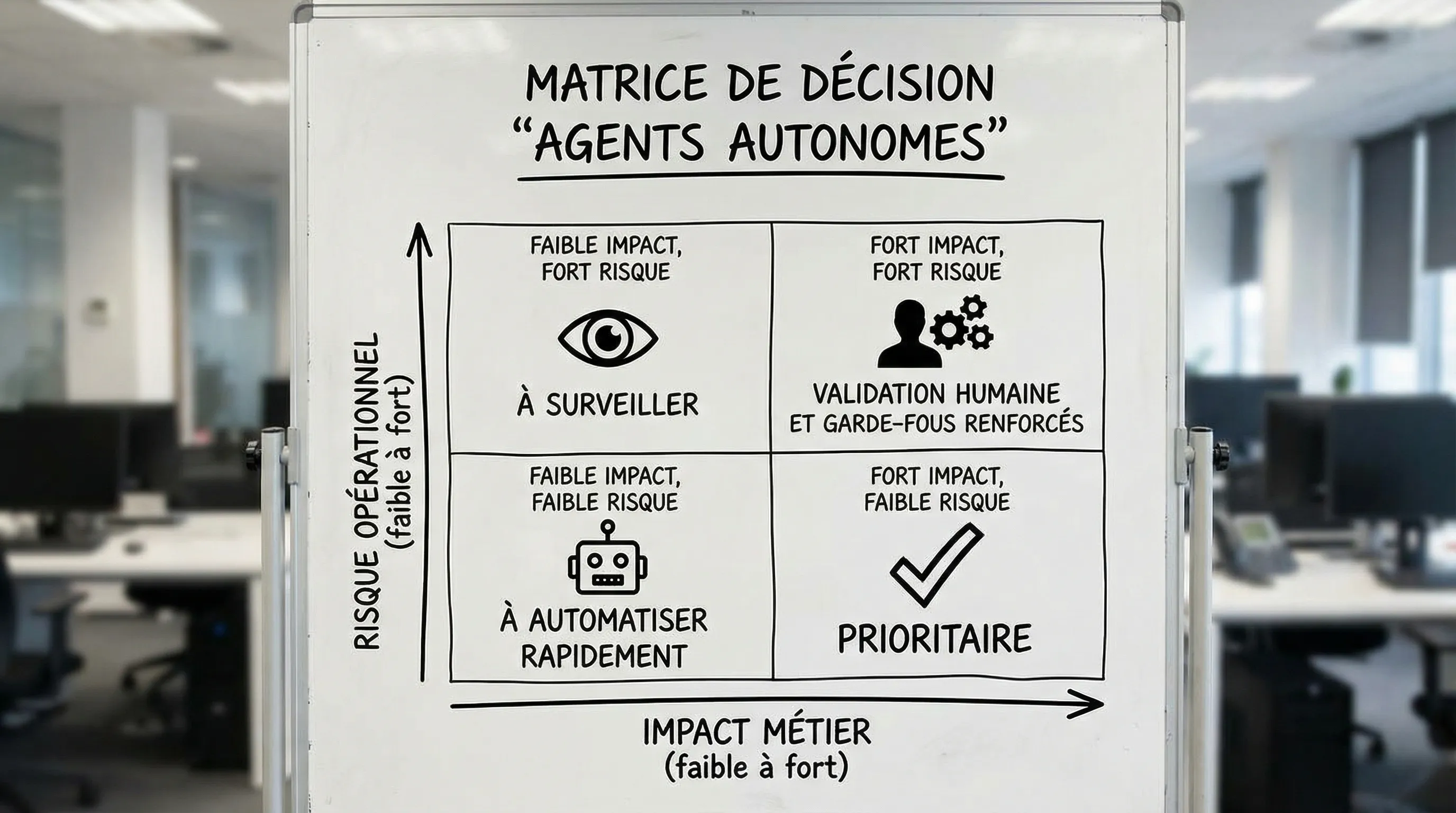
4) Guardrails proportionate to the risk (not “total freedom”)
In enterprise, useful autonomy is not “100% autonomous.” It is the right level of autonomy.
A robust pattern consists of defining 3 zones:
Green Zone: the agent acts alone (e.g., enrich a record, classify a ticket, propose a plan)
Orange Zone: the agent acts with human validation (e.g., send a client email, modify an opportunity)
Red Zone: the agent does not act, it assists (e.g., regulated decisions, sanctions, credit, sensitive HR)
5) Observability, tests, and metrics, otherwise you are managing nothing
An autonomous agent is a mini-product. It must be instrumented.
Without logs, traces of called tools, escalation rates, failure reasons, and costs, you cannot improve it, nor prove the ROI.
When an agent makes a mistake, who decides? Who corrects the source? Who adjusts the escalation rule?
Without a business owner, you will have an “orphan” agent: it works in demo, then drifts in production.
Use cases where autonomous agents work best
Those that work best combine frequency, structure, tools, and verifiability.
1) Tooled triage and routing (support, ops, service desk)
Concrete examples:
qualify a ticket, propose a response, create a task, assign to the right group
check for minimal information, automatically follow up if incomplete
apply a priority policy with explanation
Why it works: high volume, existing business rules, and a clear output (correctly routed ticket).
2) Documentary back-office with validation (invoices, contracts, files)
The agent can: extract, verify fields, compare against rules, then prepare an action (create entry, request document, draft response). It becomes very efficient if human validation is simple.
3) Sales ops and CRM hygiene (highly tooled environment)
When the CRM is well-defined, the agent can:
summarize an exchange (call, email)
propose field updates
create next tasks
The key: do not let the agent “invent” client information, and require a trace (sources, extracts, context).
4) Internal multi-tool operations (but bounded)
Example: prepare a weekly meeting by fetching metrics from 2 or 3 systems, producing a brief, then opening missing tickets.
Use cases where autonomous agents work poorly (or cost too much)
Even in 2026, there is unfavorable terrain. Here are the most common ones.
1) High-stakes decisions with low error tolerance
As soon as an error is costly (legal, sensitive HR, compliance, regulated finance), the right strategy is often: copilot + strict validation, not autonomy.
2) Vague processes or unwritten policies
If teams “know it in their heads,” the agent cannot be reliable. You must first transform this knowledge into rules, examples, and sources.
3) Incoherent, ungoverned, or hard-to-access data
Without a data inventory, clear access rights, and sources of truth, the agent spends its time guessing.
4) Long, multi-step tasks without objective verification
The longer the horizon, the more the agent can drift. High-performing agents are those that loop over short, verifiable steps, with stops.
Warning Signal
What it causes
Often better alternative
Business rules are not written
Inconsistent decisions
Copilot + progressive formalization
No source of truth
“Plausible” hallucinations
Governed RAG + citations
Irreversible actions
Incidents, internal fear
Drafts + validation + rollback
No metrics
Impossible to prove ROI
Minimal dashboard, tests, logs
The minimal architecture of a “production-grade” autonomous agent
The trap is believing that an agent = a prompt. A robust autonomous agent looks more like a small platform.
Typical components:
Orchestration: the “brain” that plans and executes (and limits the loop)
RAG / context: retrieval of documents, policies, product sheets, procedures
Tool calling: tooled functions, bounded, with rights
Identity and access management: permissions by role, secrets, scopes
Logging and audit: action logs, prompt versions, decision traces
Evaluation: test sets, edge cases, failure rates, cost per task
Important point: a serious “agent” deployment almost always requires a usage registry, data rules, and an escalation strategy. If you are structuring your AI organization, this resource can help: AI Organization: roles, governance, and responsibilities.
Pragmatic method: testing an autonomous agent without betting on the wrong horse
The most frequent mistake is starting too “generalist autonomous agent.” A more reliable approach consists of slicing autonomy and proving impact in stages.
A pilot in 4 milestones (over 30 days)
Milestones
Objective
Expected Deliverables
D1 to D5
Scope a frequent task, define green/orange/red zones
Definition of done, stop rules, KPI baseline, risks
D6 to D15
Build a minimal “tooled” agent, with logs
Orchestration + 2 to 4 tools + traces + test scenarios
Conclusion: autonomy is not a goal, it’s a setting
In enterprise, autonomous agents work when you consider them as:
a capability (acting within tools)
in a bounded workflow
with controls (human, rules, logs)
and a measurement (KPI, cost, quality)
The right question is not “can we make an agent?” but “what level of autonomy maximizes ROI without increasing risk faster than value?”
Frequently Asked Questions
Is an autonomous agent just a more advanced chatbot? No. An autonomous agent is not limited to conversing; it plans and executes actions via tools (API, CRM, helpdesk), with a verification loop and stop rules.
What is the best first use case for autonomous agents in SMEs? Most often: triage/routing of requests (support, ops), or documentary back-office with validation. These are frequent, tooled, and measurable flows.
How to prevent an autonomous agent from going rogue? By bounding its actions (permissions, authorized tools), imposing validations on the orange zone, logging all actions, and testing on representative scenarios.
Is RAG absolutely necessary for an autonomous agent? Not necessarily, but as soon as the agent must rely on policies, procedures, offers, or internal data, RAG (or an equivalent context source) becomes a key component for reliability.
Are autonomous agents compatible with GDPR and the AI Act? Yes, but they impose a “privacy and governance by design” approach: data minimization, access rights, traceability, and guardrails proportionate to the risk level.
Sorting it out: where an autonomous agent can generate ROI for you
If you are hesitating between copilot, classic automation, and autonomous agents, Impulse Lab can help you audit opportunities, scope a measurable pilot, then develop and integrate a solution adapted to your tools (CRM, support, ERP, data), with training and adoption support.
You can discover the offer on impulselab.ai and share your context (processes, tools, constraints) with us to identify the right level of autonomy, in the right place, with the right guardrails.