Moltbot in 2026: Use Cases, Limitations, and Deployment Checklist
Intelligence Artificielle
Stratégie IA
Gestion des risques IA
Automatisation
In 2026, "deploying a bot" means more than just a chat widget. Successful companies treat their bot as a **mini-product**: integrated with tools, fed by verifiable sources, measured, secured, and maintained.
February 23, 2026·9 min read
In 2026, “deploying a bot” no longer means putting a chat widget on a site. Companies that get results (SMEs, scale-ups, structuring teams) treat their bot as a mini-product: integrated with tools, fed by verifiable sources, measured, secured, and maintained.
If you are evaluating Moltbot this year, the right angle isn’t “is the demo impressive?”, but rather “can Moltbot hold up in production on our use cases, our data, our constraints?”. This article gives you:
use cases for 2026 that actually pay off,
limitations to anticipate (quality, security, compliance, costs, adoption),
a pragmatic deployment checklist to go from testing to pilot, then to production.
Method note: I do not assume “specific” Moltbot features without verifiable documentation. Instead, I give you an evaluation grid and a deployment plan that work for Moltbot, or any comparable solution.
What Changed in 2026 (and what you must demand from Moltbot)
Three evolutions make bots more useful, but also more demanding to deploy.
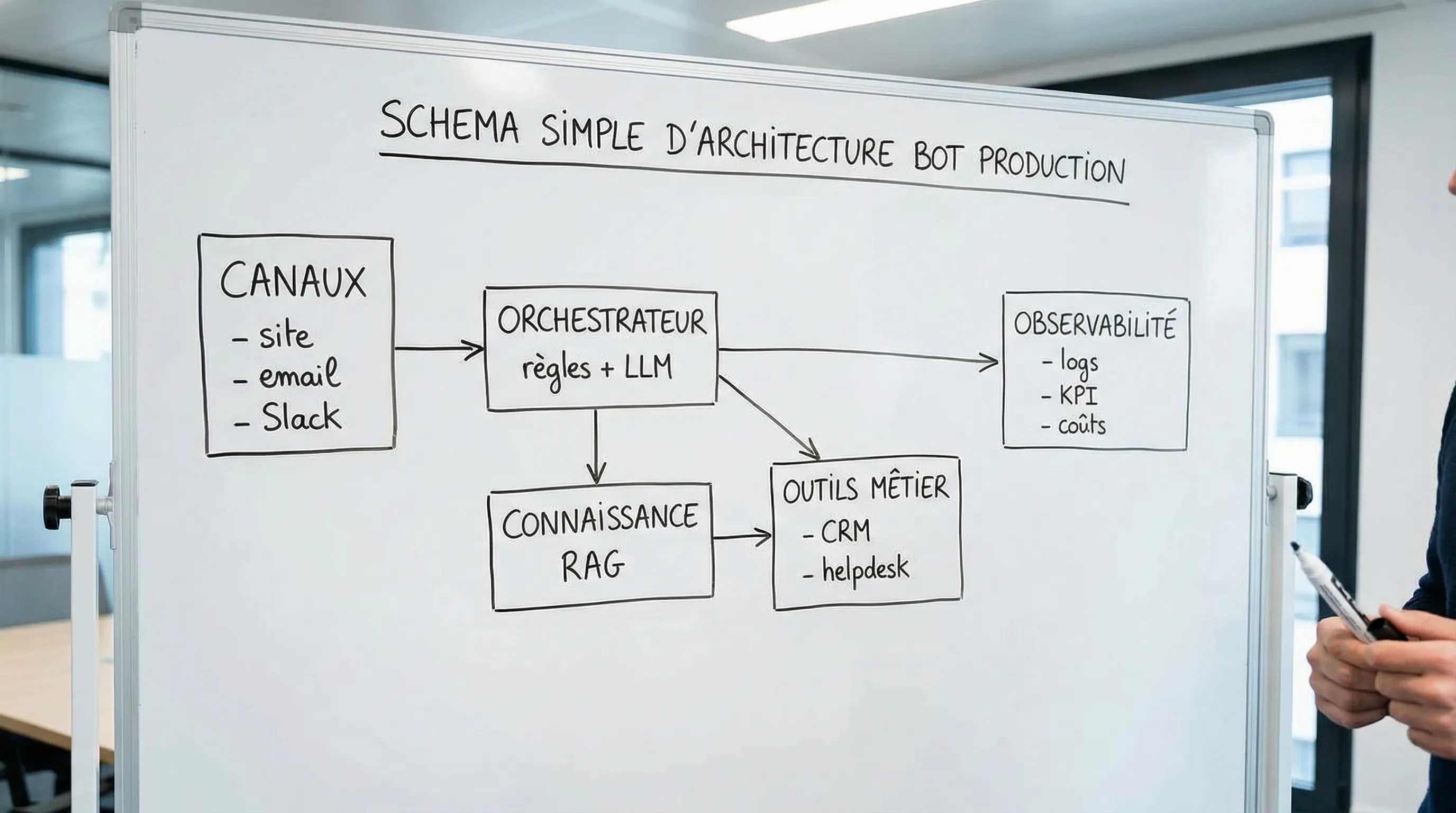
1) Integration comes before the model
Models have become a commodity. Value is created in:
the connection to sources of truth (docs, CRM, helpdesk, ERP, product base),
the capacity to act (create a ticket, qualify a lead, prepare a quote, trigger a workflow),
observability (logs, quality, cost, response time, escalation).
2) Reliability is a “system” issue, not a “prompt” issue
Prompts alone do not “fix”:
the lack of clean data,
unsourced answers,
prompt injection attacks,
silent errors (worse than visible errors).
In practice, guardrails are needed (RAG, rules, filters, validations, human escalation). The OWASP list dedicated to LLM applications is a good benchmark to frame technical risks, see OWASP Top 10 for LLM Applications.
3) Compliance arrives “inside” the product
In Europe, the regulatory trajectory pushes for documentation, tracing, and controlling based on risk (GDPR, security, and AI Act). For a starting point, consult the official page on the EU AI Act.
Moltbot Use Cases in 2026 (those that create measurable value)
The frequent mistake is wanting to cover everything (support, sales, HR, IT) from V1. In 2026, profitable deployments start with 1 to 2 very frequent journeys, with minimal but real integration.
Here are typical use cases, with prerequisites and concrete KPIs.
Level 0 Customer Support (triage and guided answers)
Objective: reduce response time, absorb repetitive requests, direct to humans when necessary.
A bot connected to tools can become an attack surface. Even a simple documentary base can be exploited (malicious instructions in a doc, trapped links).
Mitigation: input filtering, role separation, action allowlist, light red teaming, audit logs.
GDPR, confidentiality, retention, and data localization
Before any production launch, clarify:
what data transits (PII, contracts, health, finance),
where it is stored, how long, and for what purposes,
who can access it (vendor support, subcontractors).
Mitigation: minimization, pseudonymization when possible, DPA, “no retention” configuration if available, and usage rules. The NIST framework is a good support point to structure risk management, see NIST AI RMF.
Where MCP can help (if Moltbot adopts it, or if you add it)
In 2026, the challenge is to standardize access to tools and context. The Model Context Protocol (MCP) aims to make these connections cleaner, controllable, and reusable. In a “platform” logic, it is a delivery accelerator and a governance lever.
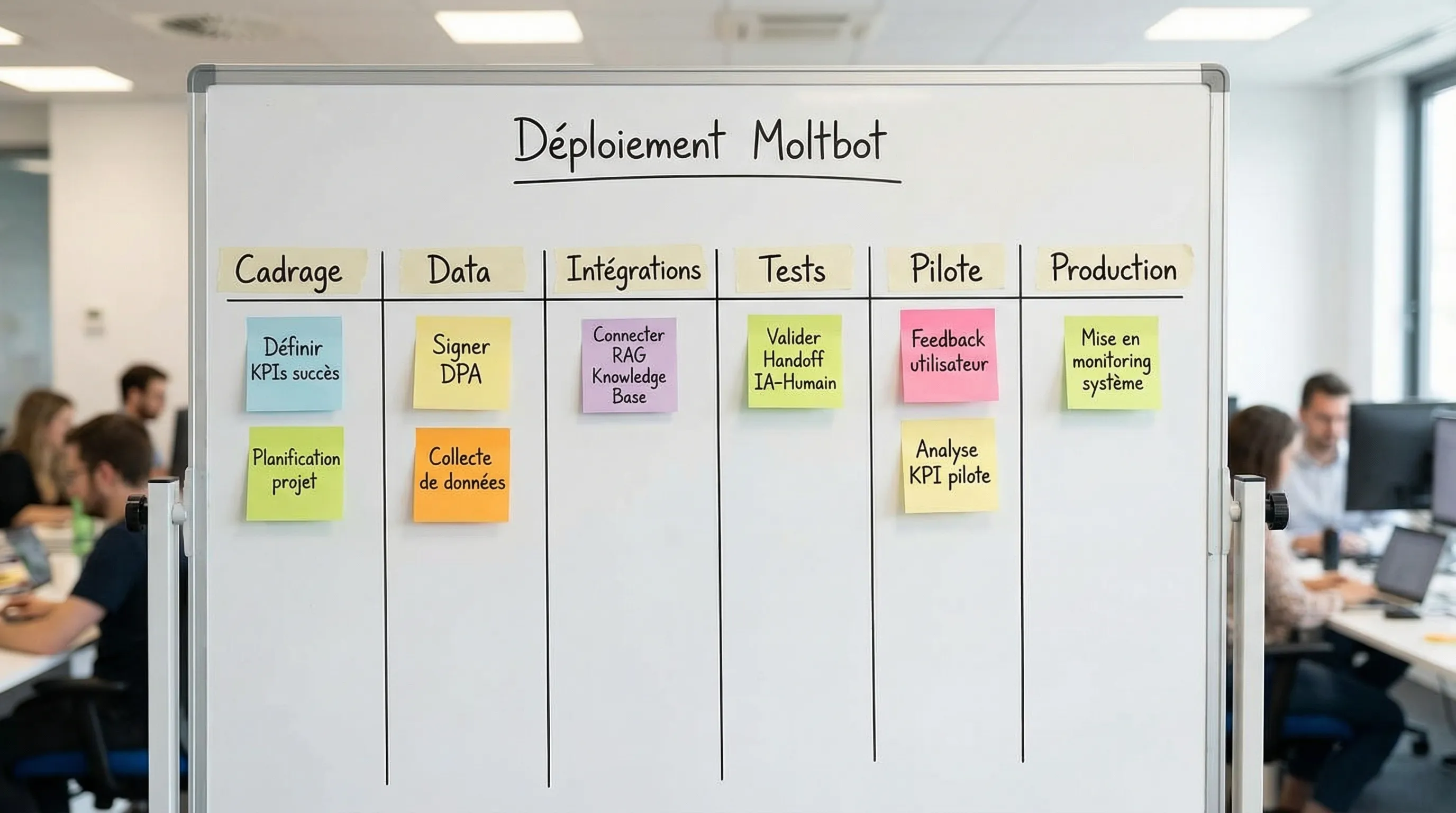
Moltbot Deployment Checklist (POC → pilot → production)
This checklist is intentionally execution-oriented. The idea is to ship fast, without sacrificing security or measurement.
1) Scoping (1 to 3 days)
Define a single priority journey, with:
a business owner (decides on trade-offs),
a North Star KPI (e.g., processing time, meeting rate, avoided tickets),
a stop rule (if quality doesn’t reach X, we stop or reduce scope).
2) Data and “sources of truth” (2 to 7 days)
Inventory of sources (FAQ, docs, product base, helpdesk).
If you want to deploy Moltbot properly, without risky bets
Impulse Lab accompanies SMEs and scale-ups on three complementary needs: opportunity audit, integrated deployment (web + AI), and adoption training. If you already have a Moltbot use case in mind, the most profitable step is often to quickly validate:
the priority journey,
the KPIs and the baseline,
the data and security constraints,
the minimal integration to produce a real result.
You can start from a short and instrumented pilot, then decide factually to scale, iterate, or stop.