The query "AI good or bad" keeps recurring in 2025. This implies a binary answer, yet AI is a multiplier of both value and risk. The difference lies in execution, targeted use cases, and safeguards. We analyze real impacts, high-ROI areas, and costly traps.
December 19, 2025·8 min read
Good or bad, the real question is impact
The query "artificial intelligence good or bad" keeps coming up in 2025. Phrased this way, it invites a binary answer, whereas AI is a multiplier of both value and risk. The difference lies in what you do with it, the targeted use cases, and the safeguards put in place. In this article, we scrutinize the real impacts observed in companies, high-ROI zones, costly traps, and a concrete method to decide where to invest now.
What the data shows in 2025
Productivity and quality. Multiple academic and industrial studies note gains in speed and quality on knowledge work tasks, especially when AI assists rather than replaces. The Stanford AI Index 2024 documents rapid progress in capabilities while highlighting performance gaps depending on tasks and datasets.
Value creation. McKinsey's 2024 analyses estimate a potential annual economic value from Generative AI of several trillion dollars, concentrated in customer service, marketing, and R&D. See McKinsey, The State of AI 2024.
Security. AI applied to threat detection significantly reduces identification and containment times for incidents—by over 100 days according to the IBM Cost of a Data Breach 2024, which strongly mitigates average costs.
Operational translation: AI is good or bad depending on your ability to select high-value use cases and reduce uncertainty with adapted architecture and governance.
Where AI is already working well
1) Customer support and self-service
Instant answers based on your knowledge base, automatic ticket classification, drafting aid for agents. Typical benefits: lower first response time, higher first contact resolution rate, reduced cost per ticket. For concrete SME examples, consult our article Chat bot for SMEs, use cases that pay off.
2) Information retrieval and QnA on documents
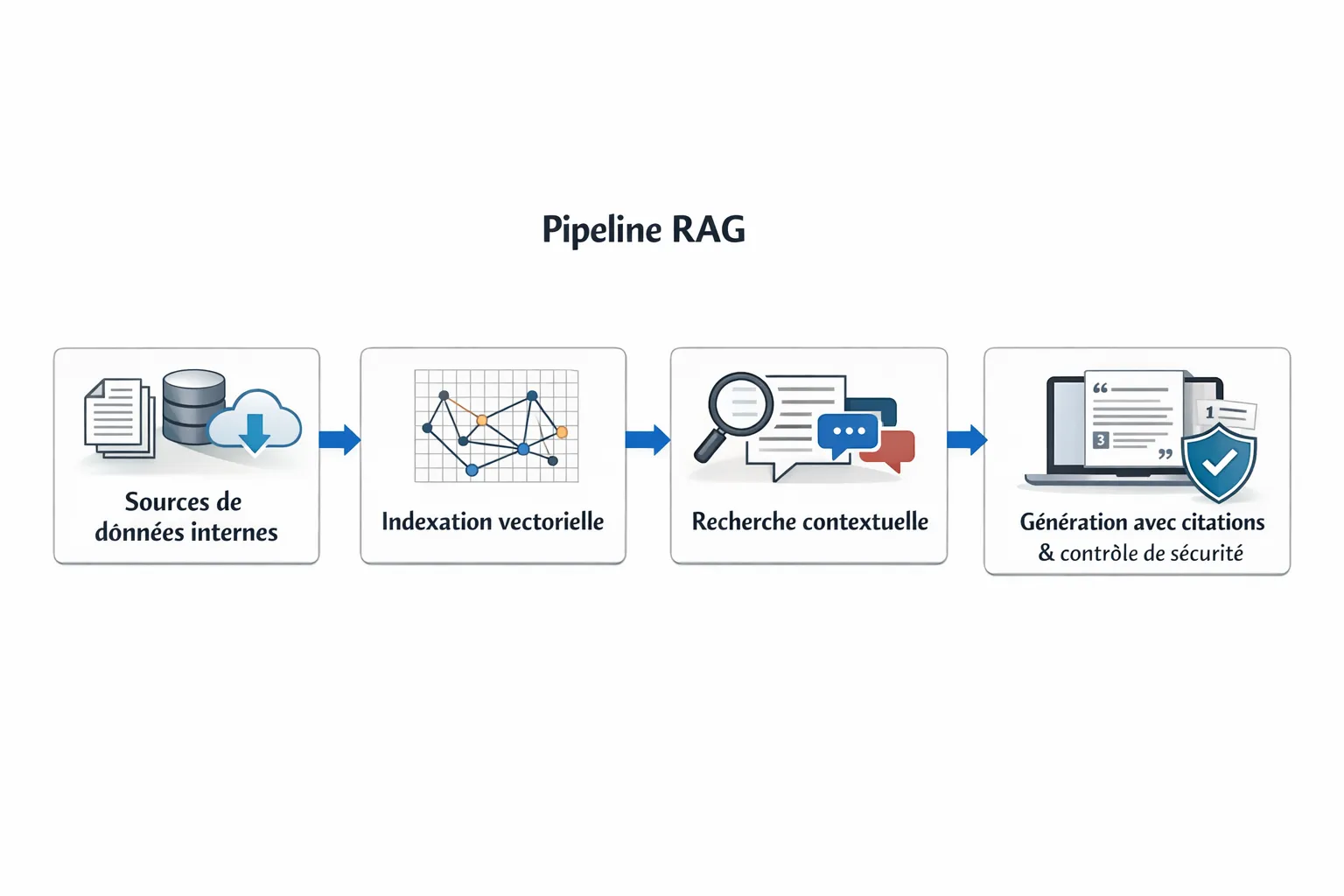
Retrieval Augmented Generation (RAG) allows querying internal corpora—contracts, procedures, technical notes—and generating sourced answers. Properly configured, it reduces search time and improves answer compliance because they rely on your data.
3) Back-office operations automation
Data extraction from invoices, emails, and PDFs, classification, enrichment, reconciliations, drafting operational summaries. AI complements RPA to handle exceptions, which streamlines workflows without drifting into maintenance costs.
4) Marketing acceleration and sales enablement
Briefs, message variations, product sheet enrichment, generation of contextualized pitches. Steering via A/B tests and brand safeguards is essential to preserve consistency and avoid slip-ups.
5) Software development aid
Completion, test suggestions, guided refactoring, documentation generation. Impact depends on tooling maturity and the security framework—private repositories, secrets policies—and the role given to human review.
6) Agentic workflows
Agents orchestrate several steps: retrieving data, reasoning, calling APIs, verifying, retrying. This approach changes the scale of automation when tooled with controls, timeouts, sandboxes, and monitoring. We detail our method in Agentic AI and MCP, the automation revolution.
Where extra caution is needed
Decisions with high regulatory impact: HR, credit, health. The EU AI Act imposes a risk-based approach, documentation, traceability, and conformity assessment. Anticipate obligations rather than waiting for the deadline.
Content generation without validation. Hallucinations exist, especially outside your data perimeter. Keeping a human in the loop and requiring verifiable citations for every factual claim strongly reduces risk.
Sensitive data in public services. Inadvertent leaks happen when teams paste code, contracts, or PII into public forms. Prioritize secure integrations, filtering, and anonymization policies. See our best practices in AI APIs, clean and secure integration models.
LLM-specific application security. Prompt injection attacks, role confusion, or exfiltration via tools are real. Refer to the OWASP Top 10 for LLM applications and test systematically.
Inference costs and latency. Costs depend on volumes, model, and context (prompt size). Without optimization, they can skyrocket. Caching, context compression, model selection per task, and well-designed RAG reduce the bill.
Impact, benefit, and risk matrix
Domain
Business impact when done right
Main risk
Mitigation measure
KPIs to track
Customer Support
Reduced response time, increased FCR, lower cost per ticket
Hallucination, off-brand tone
RAG on knowledge base, style guide, human validation
FRT, FCR, CSAT, cost per ticket
Internal Search
Time savings, better capitalization
Obsolete or unsourced answers
Incremental indexing, mandatory citations, access control
Adoption rate, search time, share of sourced answers
Back-office
Fewer manual tasks, fewer errors
Sensitive data, cost drift
Anonymization, retention policy, model selection per task
Automation rate, error rate, cost per document
Marketing and Sales
More variants tested, campaign velocity
Brand inconsistency, GDPR
Templates, tone safeguards, validation
Conversion rate, CPA, time to market
Software Dev
Velocity, better test coverage
Secrets leaks, silent bugs
Secret scanners, sandbox, code review
Architecture and governance that make the difference
Retrieval Augmented Generation. Always inject your sources into the context. This reduces hallucinations and anchors answers on up-to-date documents. Combine chunking, adapted embeddings, query rewriting, and citations.
Application safeguards. Security policies at the prompt and application level, input and output filters, tool limits, network and file-system sandboxes, logging for audit.
Human in the loop. Validation steps must be explicit with confidence thresholds and escalation workflows.
Risk management. Rely on recognized frameworks: the NIST AI RMF for a structured risk approach, ISO/IEC 42001 for an AI management system, mapping use cases by risk level in accordance with the AI Act.
Observability. Tracing prompts, model versions, latency, costs, refusal and error rates. Without metrics, optimization is impossible. We detail the approach in Transforming AI into ROI, proven methods.
Decide fast, without mistakes, in 90 days
Weeks 0 to 2, scoping and opportunity audit
Identify 3 to 5 use cases with measurable pain points, sufficient volume, low regulatory risk. Evaluate available data and target systems (CRM, ITSM, ERP). Set impact and output quality KPIs. For executives, our summary is here: Rapid Guide 2025.
Weeks 3 to 6, metrics-driven prototype
Build a bounded POC with RAG or simple agent, security by default, minimal red teaming, logging. Test with real users, measure FRT, acceptance rate, cost per query, and compare to the manual baseline.
Weeks 7 to 12, controlled production rollout
Integrate into the IT system with authentication, access control, secrets policies, latency and cost monitoring, incident runbooks. Train teams and install a weekly continuous improvement cycle.
Do not confuse demonstration with production. A pretty prototype without security, tests, and observability must never touch real data.
Do not force fine-tuning. Start with RAG and disciplined prompt engineering. Only train if you have a real data advantage and an MLOps budget.
Do not oversize the model. Choose the smallest model sufficient for the task, reduce context, cache. Unit cost is not a strategy; architecture is.
Do not neglect user experience. Even the best AI fails if the workflow isn't aligned with the business: shortcuts, integration into everyday tools, simple feedback loop.
Do not forget compliance. Keep an AI inventory, record risk assessments, document data, prompts, models, and providers.
Illustrative use cases aligned with value
B2B Customer Service with rich knowledge base, RAG, brand tone, escalation to agents. Expected gain: dropping FRT, rising first contact resolution. Warning: mandatory citability, automatic index updates.
Accounts Payable, invoice extraction, confidence threshold validation, exception routing to a human. Expected gain: reduced cycle time and increased reliability. Warning: anonymization and access control.
Sales enablement, creating bespoke pitches from CRM and case studies. Expected gain: sales velocity. Warning: compliance rules and respect for consents.
In summary, good or bad, it depends on your method
AI becomes an advantage if you combine: strict selection of measurable use cases, RAG architecture and safeguards, human in the loop, governance and observability, continuous improvement. Organizations that treat these elements seriously turn AI into tangible gains; others accumulate technical debt, hidden costs, and regulatory risks.
At Impulse Lab, we help teams go from idea to measured value with: AI opportunity audits, custom web and AI platform development, secure integrations with your tools, training and adoption, weekly delivery, and a client portal for total transparency. If you wish to evaluate your priorities, scope a POC, or secure a deployment, let's talk. Start with an AI opportunity audit and turn the question "artificial intelligence, good or bad" into an impact roadmap.