Artificial Intelligence in Recruitment: Real Gains and Risks
Intelligence artificielle
Stratégie IA
Outils IA
Automatisation
**Artificial intelligence in recruitment** is no longer a demo gadget. In 2026, it's already integrated into ATS, sourcing tools, and HR copilots. The real question isn't "does it work?", but **what gains are truly achievable** and what risks are concrete when moving to operations.
April 12, 2026·9 min read
Artificial intelligence in recruitment is no longer a demo gadget. In 2026, it is already integrated into ATS, sourcing tools, interview solutions, and HR copilots. The real question is not "does it work?", but what gains are truly achievable (and at what cost), and what risks are concrete (and avoidable) when moving from experimentation to operational use.
This guide helps you decide pragmatically, especially if you are an SMB or a scale-up in the structuring phase.
What AI (really) does in a recruitment process
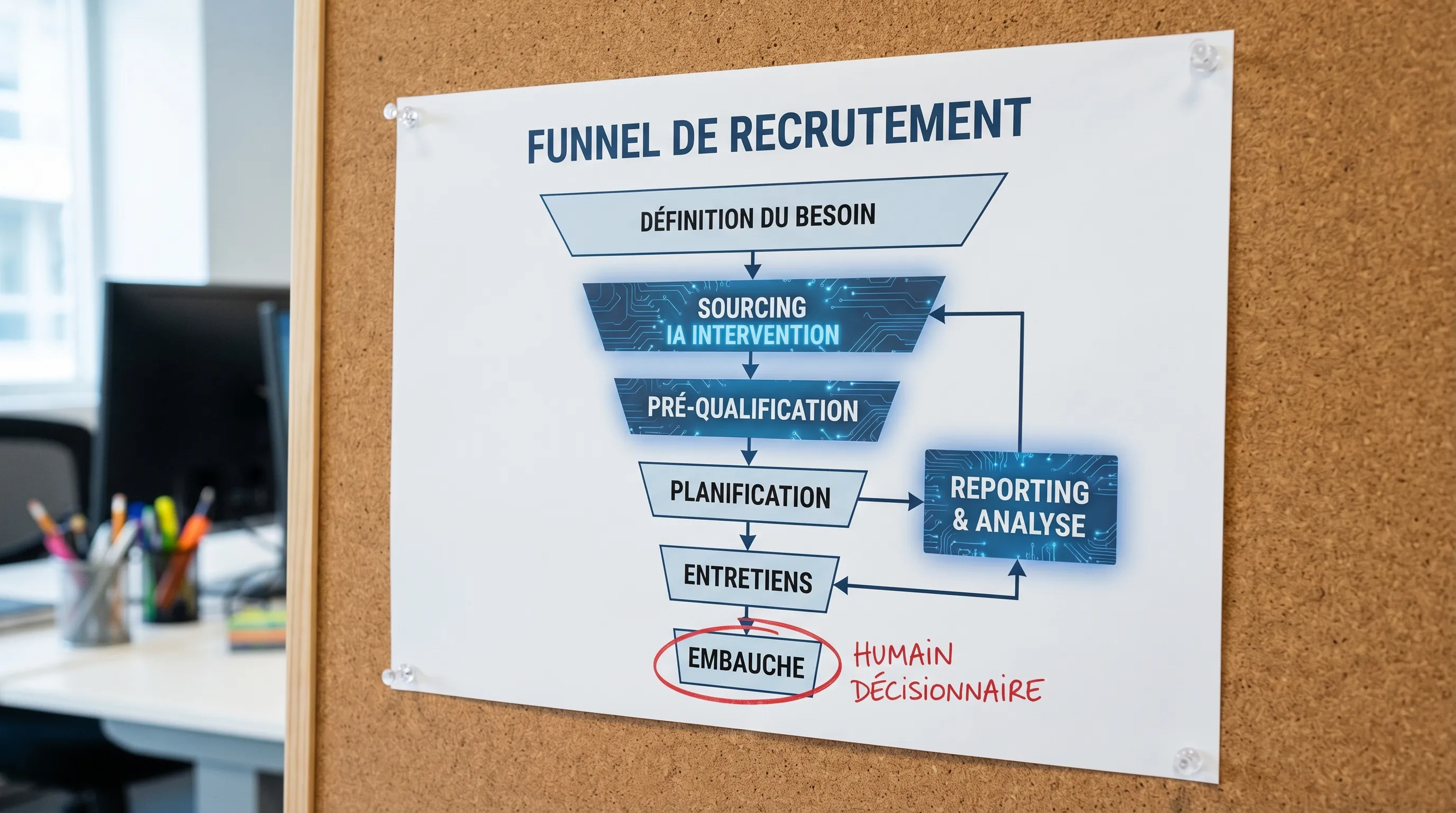
In most companies, AI intervenes in 5 areas of the cycle:
Understanding the need: formalizing the job description, criteria, success signals, manager/HR alignment.
the tool is integrated (ATS, calendar, messaging, HRIS), otherwise the gain dissipates.
Realistic gains: where AI truly improves performance
The most frequent benefits are not "magical". They come from a mix of standardization + speed + better information utilization, provided they are measured.
1) Reduction in time-to-hire
This is the most common gain, because AI compresses "non-productive" delays: writing, initial screening, scheduling, follow-ups, summaries.
For a growing organization, reducing time-to-hire has a direct effect on:
the capacity to deliver (incomplete team, slipping roadmap),
the workload on managers,
the candidate experience (losing candidates along the way).
2) Lower operational cost (cost-per-hire, but also "internal cost")
The visible cost (ads, agencies, tools) is only part of the total cost. A large part is hidden in:
In an HR context, a hallucination is not "funny". It can:
invent a skill,
distort an answer,
produce an overly confident summary.
Simple measure: require the tool to cite its sources (notes, ATS fields) or strictly stick to the provided elements.
5) Regulatory non-compliance (AI Act)
In Europe, AI systems used for employment and worker management are among the most regulated areas. The important thing for an SMB or scale-up to remember is that this generally implies:
a risk management approach,
documentation,
human supervision,
data requirements,
an ability to audit and explain.
For the reference text, see the regulation on Eur-Lex (AI Act): Regulation (EU) 2024/1689.
"Risks and controls" table (practical)
Risk
Concrete example
Business impact
Pragmatic controls
Discrimination
The model penalizes non-linear career paths
Legal, reputation, loss of talent
Test sets, bias audits, mandatory human review
Data leak
Resumes or interview notes reused out of scope
GDPR, trust, security
Minimization, redaction, subcontractor contract, least privilege access
Summary error
"Overly confident" summary that omits a critical point
Bad decision, internal disputes
Source of truth, citations, explicit validation, draft mode
Tool dependency
HR process "blocked" if the tool goes down
Operational disruption
Fallback plan, export, reversibility, runbook
Shadow AI
Managers use unauthorized tools
Data risk, inconsistency
Usage charter, training, easy official solution
The most profitable (and safest) use cases in SMBs and scale-ups
Profitability often depends on proper sequencing: starting with low-risk uses, then increasing ambition.
Assisted (but controlled) sourcing
AI can accelerate the search and personalization of messages, provided you:
standardize criteria,
trace sources,
avoid scraping useless data.
"Assisted", not "automatic", initial screening
The best compromise often consists of:
having an explanation produced (why this resume matches, on what criteria),
keeping human control,
instrumenting the error rate (false positives, false negatives).
Scheduling and coordination (quick win)
This is favorable ground: low risk, rapid impact, immediate time savings. It is also a good test to validate:
integration with your stack,
log quality,
the ability to handle exceptions.
Interview grid and question copilot
AI helps you produce coherent grids, oriented towards "evidence" (facts, situations, results), rather than vague questions.
Summaries and reporting, with traceability
Useful for:
feeding the ATS cleanly,
avoiding "gut feeling" decisions,
steering the recruitment funnel like a funnel (conversion per step, delays, drop-offs).
Simple method to deploy without putting yourself at risk (30-day plan)
The classic mistake is buying a tool and "seeing how it goes". A good start looks more like a mini-product: objective, KPIs, tests, safeguards.
Week 1: Framing (value, scope, rules)
Define:
a single use case (e.g., scheduling + follow-ups, or assisted screening for one role),
3 to 5 KPIs maximum,
authorized (and prohibited) data,
the level of human supervision.
Week 2: Connecting (minimal integrations)
Without integration, value is diluted. Priority to connectors:
ATS,
email/calendar,
document storage,
internal ticketing tool if needed (HR support).
Week 3: Testing (reproducible protocol)
Build a small set of real cases:
anonymized resumes if possible,
error scenarios,
edge cases.
The goal is to measure, not to be impressed.
Week 4: Steering (controlled deployment)
Deploy on a limited scope:
one team,
one type of role,
one channel.
Add a short ritual (weekly): error review, adjustments, go/no-go decision.
Buy, build, or assemble: how to decide quickly
In recruitment, the "right choice" depends mostly on data sensitivity and the expected level of integration.
Sensitive data, deep integrations, traceability, specific rules
Requires framing, run, and ownership
If you are hesitating, the least risky sequence is often: short opportunity audit + instrumented pilot, before any wide deployment.
Frequently Asked Questions
Can artificial intelligence in recruitment replace a recruiter? No. In practice, AI mostly replaces tasks (screening, scheduling, writing), not the responsibility of decision-making, nor contextualized evaluation.
What gains can be expected fastest with AI in recruitment? The fastest gains come from scheduling, follow-ups, ATS reporting, and the standardization of interview grids.
What are the most critical risks in HR AI? The major risks are discrimination, summary errors, data leaks, and over-automation (automation bias). They are managed with tests, traceability, and human supervision.
Should a DPIA be conducted for an AI recruitment tool? Often, it is relevant as soon as the processing is sensitive or high-risk. The decision depends on the use case and the level of automation. Have it validated by your DPO or legal counsel.
How to avoid "shadow AI" on the managers' side? By providing a simple official solution, training, and setting clear rules (prohibited data, authorized tools, traceability).
Need quick and actionable framing on AI in recruitment?
If you want to deploy AI in your HR processes without falling into the "impressive POC" that brings no sustainable gain, a structured approach helps enormously: choose the right use case, secure the data, instrument KPIs, and integrate the tool into the real workflow.
Impulse Lab supports SMBs and scale-ups with AI opportunity audits, adoption training, and custom development (automation, integration, internal platforms) when the context requires it.
Contact us via impulselab.ai to frame a short, measured, and reversible pilot.