Autonomous Agents: 8 Profitable Use Cases for SMEs in 2026
Intelligence artificielle
Stratégie IA
Gestion des risques IA
ROI
Automatisation
In 2026, **autonomous agents** are no longer a gimmick. For SMEs, profitability comes from a simple yet valuable capability: **chaining multi-tool actions** (CRM, helpdesk, ERP, Workspace, Slack) based on a bounded objective, with necessary validations.
In 2026, autonomous agents are no longer a gadget. In SMEs, they become profitable when they do something very simple yet very valuable: chaining multi-tool actions (CRM, helpdesk, ERP, Google Workspace, Slack/Teams) based on a bounded objective, with validations when necessary.
The classic trap is launching an "agent" that chats well but produces no measurable operational result. Conversely, the opportunity lies in targeting repetitive processes close to cash flow (support, follow-ups, sales, back-office), where the agent shaves off minutes, errors, or delays.
What makes an autonomous agent profitable in an SME (and what makes it dangerous)
An autonomous agent is neither a "response" chatbot nor an "assisted" copilot. It is a system that:
observes a context (data, documents, events),
plans a sequence,
executes actions via tools (API, RPA, internal forms),
logs what it does,
and knows when to stop (human escalation, degraded mode).
To frame things quickly, use this grid. It avoids 80% of POCs that end up as "cool demos".
Criteria
Question to ask
"Go" signal in SME
"No-go" signal
Frequency
How many times a week?
Daily or multi-weekly
Monthly, "when we think about it"
Actionability
Can the agent act (not just answer)?
API, templates, clear workflow
Manual actions without tools
Measurability
Is there a simple baseline?
Time, volume, error rate
Vague impact, no KPI
Risk
What is the cost of an error?
Reversible, low impact
Irreversible, critical legal issues
Source of truth
Does the agent have reliable data?
Clean KB/CRM/ERP
Dispersed, contradictory data
On the compliance side, the 2026 trend is clear: industrializing = documenting and controlling. The European framework (AI Act) reinforces requirements for risk management, traceability, and transparency depending on use cases. For a reliable overview, see the official overview from the European Commission and, regarding personal data, resources from the CNIL.
If you want a clear definition to align everyone (business, IT, management), you can also start with the Impulse Lab glossary entry: AI agent.
8 profitable autonomous agent use cases for SMEs in 2026
The cases below are intentionally "realistic SME" oriented: simple integrations, bounded scope, quick returns. Each case includes an objective, prerequisites, KPIs, and guardrails.
1) Support triage + pre-resolution (helpdesk)
Objective: Reduce handling time by automating understanding, categorization, ticket creation, and the first response, while preparing action for a human.
Why it’s profitable: Support concentrates volume, and every minute saved is immediately visible.
Realistic prerequisites:
an exploitable knowledge base (FAQ, internal docs) (often via RAG),
a helpdesk (Zendesk/Freshdesk/Intercom or equivalent),
simple categories and escalation rules.
KPIs to track:
average first response time,
rate of tickets "routed correctly" on the first try,
escalation rate (and why),
CSAT on tickets handled with an agent.
Guardrails: Source citations (RAG), refusal to answer out of scope, automatic escalation on keywords (security, payment, legal).
2) "Express Quote" Agent (pre-sales) with sales control
Objective: Generate a quote or structured proposal from a brief (email, form, call notes) by retrieving the right elements (pricing, options, constraints), then submit for validation.
Why it’s profitable: Accelerates commercial response speed and standardizes quality.
Realistic prerequisites:
an offer repository (doc, Notion, CRM, simple CPQ),
a validated quote template,
a validation step (sales manager, management).
KPIs to track:
lead → quote time,
rate of quotes sent within 24/48h,
human correction rate (how many modifications),
signature rate (compare by segment).
Guardrails: "Draft mode" by default, caps (never apply a discount without validation), hypothesis tracing.
3) Post-call sales follow-up agent (CRM) that creates tasks and updates the pipeline
Objective: After a call, the agent extracts decisions and next steps, updates the CRM, creates tasks, drafts the follow-up email, and schedules the reminder.
Why it’s profitable: This is a classic "small friction" that breaks CRM discipline. An agent restores hygiene effortlessly.
Realistic prerequisites:
a CRM (HubSpot, Pipedrive, Salesforce),
an expected report format (mandatory fields),
a data policy (what can be stored, what must be masked).
KPIs to track:
CRM completeness (key fields filled),
update delay after call,
"no next step" rate (must go down),
cycle duration on handled opportunities.
Guardrails: Validation before CRM writing if confidence level is low, masking sensitive data, logging.
4) "Soft" collection agent (finance) to reduce DSO
Objective: Detect overdue invoices, prepare a contextualized reminder (history, payment promise, conditions), propose a recovery plan, and generate actions (email, task, call).
Why it’s profitable: Directly linked to cash (DSO), often with quick gains without increasing pressure.
Realistic prerequisites:
access to invoicing tool/ERP (or export),
reminder rules (D+7, D+14, D+30),
client segmentation (strategic, normal, risk).
KPIs to track:
DSO (Days Sales Outstanding),
% overdue invoices,
time spent by finance on collections,
rate of disputes detected early.
Guardrails: Never send without verifying status (payment in progress, dispute), tone consistent with internal policy, approval on strategic accounts.
5) Purchasing / Restocking Agent (ops) that anticipates and prepares orders
Objective: Monitor stock and consumption, propose restocking, prepare purchase orders, and trigger validations.
accuracy of restocking proposals (forecast vs actual gap),
order creation and validation time.
Guardrails: Thresholds (max amount without validation), anomaly detection (order too high vs history), "suggestion" mode initially.
6) "Back-office" agent to qualify, route, and enrich incoming requests
Objective: Read incoming requests (form, email, chat), extract useful info, complete missing fields, enrich (sector, size, tech), then route to the right person.
Why it’s profitable: Saves administrative time and reduces leads lost due to slowness or poor routing.
Realistic prerequisites:
minimal qualification schema (3 to 8 fields),
routing rules,
connectors (CRM, email, ticketing tool).
KPIs to track:
handling time,
% requests routed correctly,
conversion rate by channel,
volume of "rollbacks" (wrong routing).
Guardrails: Do not invent data (enrichment must be sourced), explicitly mark what is "estimated", GDPR management (minimization, legal basis).
7) IT service desk level 0 agent (access, resets, standard requests) with approvals
Objective: Automate repetitive requests (reset, account creation, tool access) by applying rules (who has rights, who validates, what logs).
Why it’s profitable: High volume, significant hidden cost, and high perceived value by teams.
Realistic prerequisites:
standard request catalog,
directory/SSO (where possible),
approval workflow (manager, IT, security).
KPIs to track:
resolution time,
% requests handled without human intervention,
incidents linked to wrongly assigned rights (must remain close to zero),
internal satisfaction.
Guardrails: Principle of least privilege, double validation on sensitive rights, audit logs. On the application security side, keep in mind the risks of prompt injection and unintended actions (useful reference: OWASP Top 10 for LLM Applications).
8) "Weekly reporting" agent that consolidates KPIs and opens actions
Objective: Every week, the agent collects metrics (support, sales, marketing, ops), generates a standard report, detects anomalies (trend, break), and proposes a list of actions, or even opens tickets/tasks.
Why it’s profitable: SMEs lose time on manual reporting, and especially lose opportunities due to a lack of feedback loops.
expected output format (doc, email, Slack, Notion).
KPIs to track:
time spent on reporting,
rate of "useful" anomalies (those triggering an action),
reaction time on incidents (support, conversion, cash),
adoption (who reads, who acts).
Guardrails: Transparency on sources, no "invented causality", separation between observation (data) and recommendation (suggestion).
A common thread in these 8 cases: the agent must be "tooled", not just "talkative"
Profitability rarely comes from better conversation. It comes from an ability to execute within your tools, with reversible actions, validations, and traceability.
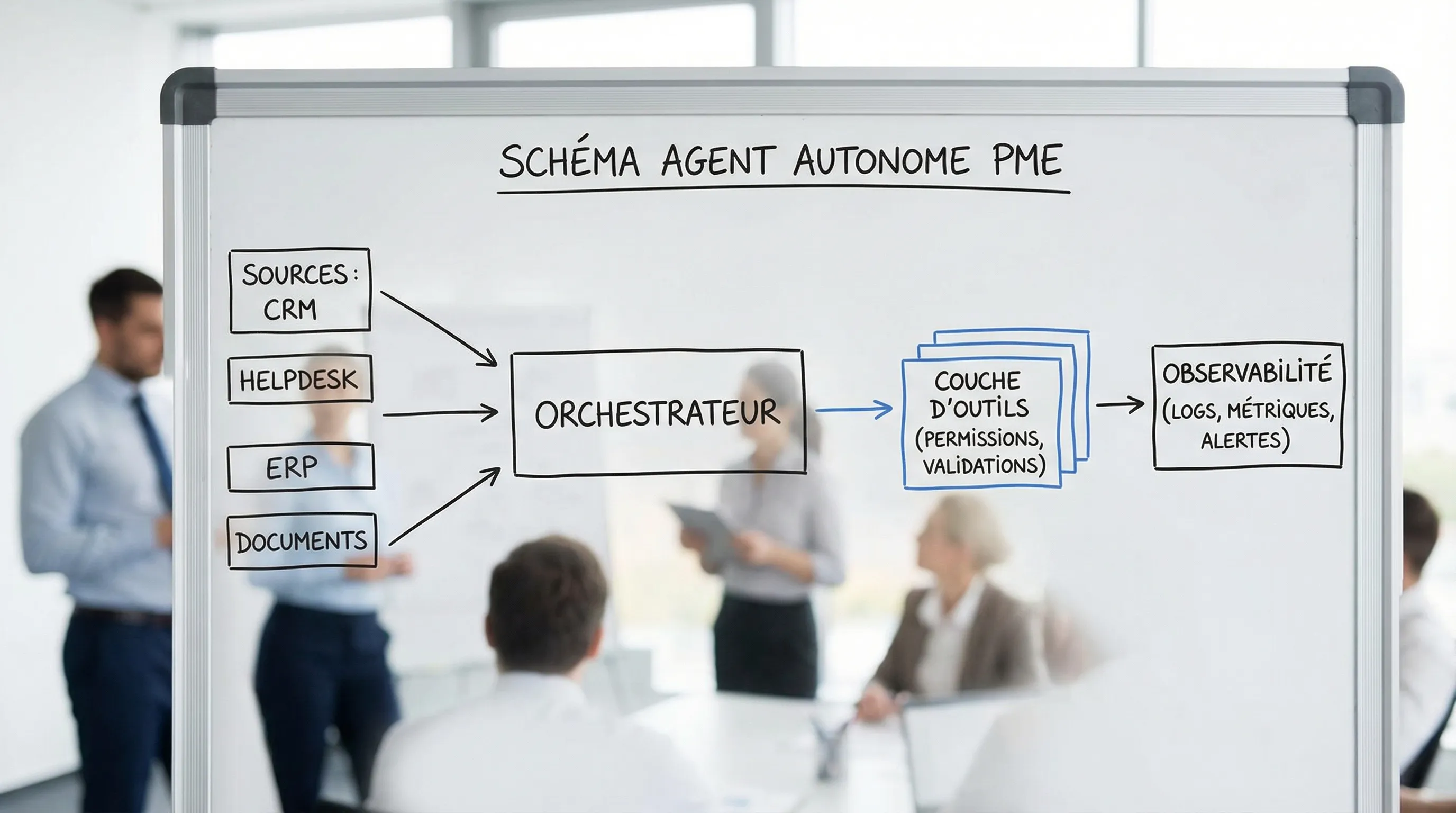
In practice, the building blocks that often recur are:
a context layer (often RAG) to anchor on true information,
a tool layer (APIs, connectors, automations) to act,
orchestration that manages state, retries, and errors,
Regarding standardized integrations, the MCP protocol becomes useful as soon as you connect multiple sources and want to avoid an accumulation of custom integrations that are difficult to maintain.
How to quickly calculate profitability (without a 30-page business case)
For an SME, a "sufficient" calculation often fits into 6 variables:
Variable
Example
Why it’s useful
Volume
400 tickets/month
Measures the automation surface
Baseline time
8 min/ticket
Factual starting point
Realistic gain
2 min/ticket
Testable hypothesis in pilot
Cost per minute
loaded cost / productivity
Translation into euros
Quality
error rate, CSAT
Avoids "toxic" gains
Run costs
API, monitoring, maintenance
Protects your margin
Then, you steer with a simple rule: no scale without a scorecard (quality, costs, incidents, adoption). If you need a complete framework to go from idea to V1 in production, you can complete this with the Impulse Lab article on autonomous agents in enterprise: guardrails and validation.
Starting in 30 days: the shortest path to a useful V1
Choose only 1 flow (not 10) with volume, actionability, and low risk.
Define a baseline (time, errors, delay, escalation rate) over 2 weeks.
Build an instrumented V1 (logs, metrics, cost per task) before any "staging".
Pilot in real conditions with a human in the loop, then increase autonomy in stages.
When to call an agency (and why it’s not just "developing a prompt")
A profitable autonomous agent is a miniature product: it requires scoping, architecture, security, and run management. This is exactly where SMEs lose time when they iterate solely "by feel".
Impulse Lab supports this type of deployment via:
AI opportunity audits to prioritize 2 profitable and definable use cases,
adoption training (roles, rules, best practices) to avoid shadow AI,
custom development and integration with existing tools, with a weekly delivery logic.
If you want to identify the 1 to 2 most profitable use cases for your SME (and the safest trajectory to put them into production), the simplest way is to start with a short, KPI-oriented audit: contact Impulse Lab.