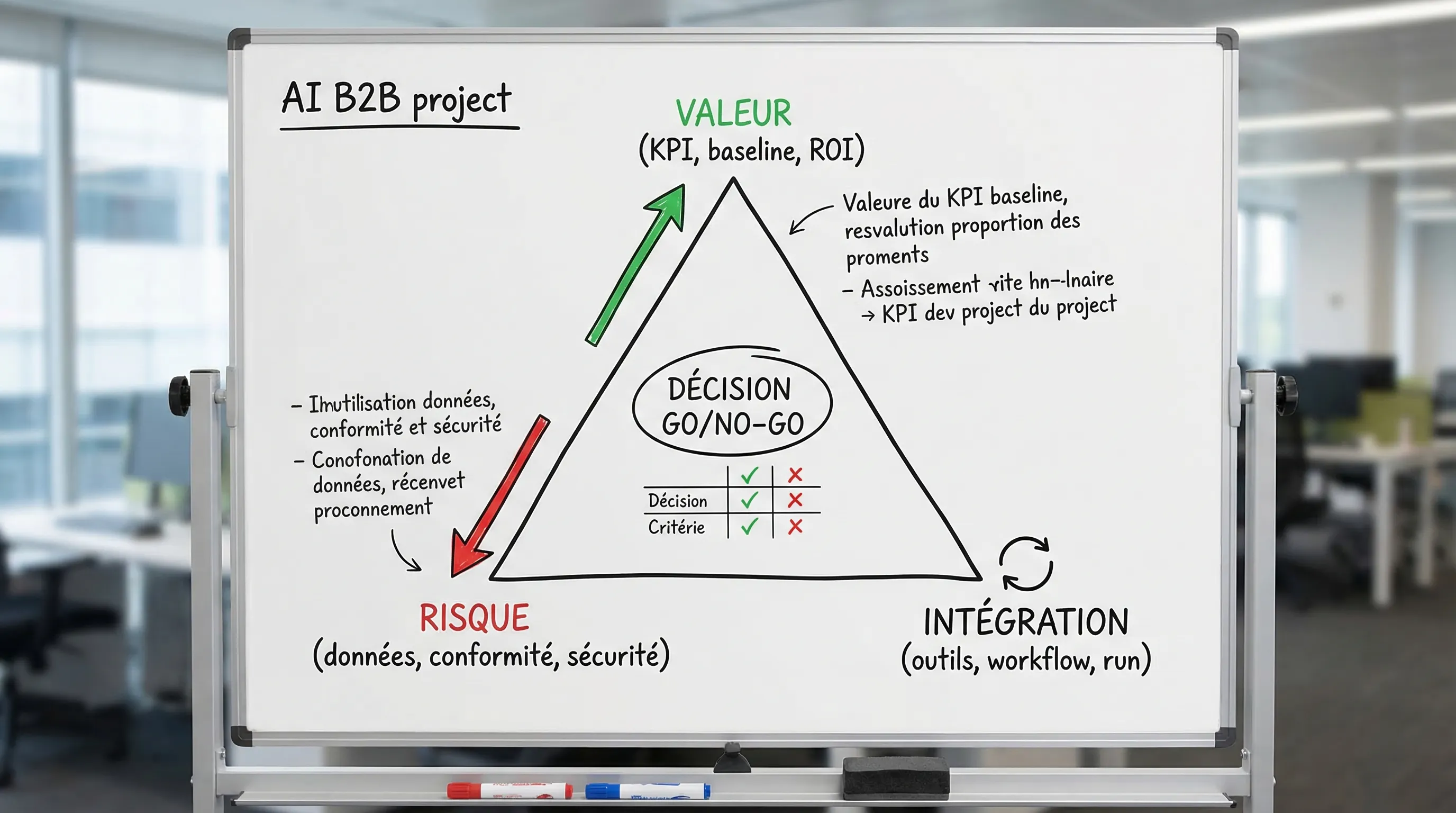
B2B AI Consulting: Framing Value, Risk, and Integration
Intelligence artificielle
Stratégie IA
Gestion des risques IA
ROI
Gestion de projet IA
Many B2B AI initiatives fail by confusing impressive demos with useful solutions. The role of **B2B AI consulting** isn't just choosing models, but framing the three factors that determine ROI: value, risk, and integration.
March 16, 2026·7 min read
Many B2B AI initiatives fail for a simple reason: confusing an impressive demo with a useful, actionable, and acceptable solution for the company. The role of B2B AI consulting is not to “choose the best model,” but to frame three things that determine ROI: value, risk, and integration.
Why B2B AI consulting is (really) a unique subject
In B2B, AI is not a gadget. It affects processes, data, obligations (GDPR, contracts, security), and above all, the teams who must use it daily. The difficulty is therefore not solely technical.
Three realities almost always recur:
Value is local: it depends on a specific workflow, volume, cost, sales cycle, or expected quality level.
Risk is asymmetric: an error in an internal email is rarely critical; an error in a quote, invoice, or regulatory response can be very costly.
Integration drives success: an AI not connected to the CRM, ERP, knowledge base, or helpdesk often produces... usage, but little impact.
The goal of a consulting mission is therefore to produce “executable” decisions, not opinions.
1) Framing Value: From Vague Need to Defensible KPI
Framing value consists of transforming “we want AI” into a quantified, measurable hypothesis linked to a specific part of the process.
The simplest test: “where is the KPI line?”
If you cannot draw a direct line between the use case and a KPI (or avoided cost), you are probably still at the intuition stage.
A solid framework answers these questions:
What job-to-be-done (task, decision, production) needs improvement?
Which indicator will move if it works?
What is the baseline today (time, volume, error rate, delay, conversion)?
What is a realistic target for the pilot (not in 2 years)?
Who is the owner on the business side, and what is the “moment of usage” in the workflow?
Example of value grid (to fill in a workshop)
Use Case
Main KPI
Baseline to measure
Pilot Target (4–8 weeks)
Where does it fit?
Tier 0 Support Triage
% tickets resolved without agent
Current rate + avg time
+10 to +20 points on scope
Helpdesk (Zendesk, Intercom…)
SDR/AE Copilot
Prep time / account
Minutes per account
-20 to -40% on top accounts
CRM + external sources
Internal Assistant (Knowledge)
Search time
Minutes per query
-30% on 20 typical queries
Drive, Notion, wiki
Doc Processing (invoices, contracts)
Error rate + delay
Rework + SLA
-X% errors, -Y% delay
ERP, DMS
This table is not “the final business case,” but it forces the right trade-offs: prioritizing what is frequent, measurable, and actionable.
In B2B, “it works” is not enough. It must be acceptable: for legal, IT, security, and sometimes your own clients (clauses, audits, subcontractors, data localization).
A pragmatic approach consists of classifying risks by families, then associating proportionate guardrails.
The 4 risk families to address during scoping
Data and confidentiality: what data enters the system, who has access, is there sensitive data?
Compliance: GDPR (minimization, purpose, sub-processing), and AI Act trajectory (risk-based approach) depending on your use cases.
Reliability and quality: hallucinations, unsourced answers, bias, out-of-distribution behavior.
What a B2B AI Consulting Mission Looks Like (Concretely)
An effective mission aims to produce a decision and an executable plan, generally in a few weeks, not quarters.
Deliverables that are “worth something”
Without imposing a single method, you should expect at minimum:
A use case register (with value, effort, risk scoring)
A prioritized shortlist (2 or 3 subjects maximum to start)
A pilot framework (KPI, baseline, test protocol, scope)
A minimal target architecture (sources, integrations, security, operations)
An adoption plan (roles, training, rules, support)
At Impulse Lab, this type of approach often corresponds to an AI Opportunity Audit before a measured pilot. If you want to see an example structure, the article Strategic AI Audit: Mapping Risks and Opportunities details the pillars and expected deliverables.
How to Evaluate a B2B AI Consulting Provider (Without Getting Trapped)
The 2026 market is mature on models, but still very uneven on industrialization. To sort quickly, look for proof on the three axes.
Positive Signals
Value: talks KPI, baseline, test protocol, and not just “prompt” or “agents”.
Risk: knows how to explain a GDPR approach, traceability, and guardrails (not “GDPR-washing”).
Integration: talks about your tools (CRM/helpdesk/ERP), rights, logs, the run.
Warning Signals
Generic demo without data or real workflow.
Refusal to scope a measurable pilot (or “unlimited POC”).
No operations plan (who monitors, who corrects, who maintains sources).
What is B2B AI consulting, exactly? Support to select, frame, and deploy AI use cases in business, with KPIs, risk management (GDPR, security, reliability), and integration with business tools.
What are the best use cases to start with in B2B? Those that are frequent, measurable, and close to an existing workflow (Tier 0 support, internal assistant on knowledge base, back-office automation, CRM copilot), with a clear baseline.
How to avoid the “demo” effect in AI? By imposing a test protocol on real scenarios, a before/after baseline, and minimal integration into the workflow (no copy-pasting), then a go/no-go scorecard.
Is the main risk in business hallucination? It is a major risk, but not the only one. Data risks (confidentiality), security (prompt injection, permissions), compliance (GDPR/AI Act), and operations (drift, costs) weigh just as heavily on success.
Is it necessary to develop a custom solution? No. Many subjects start with “buy” or assembly. Custom becomes relevant when integration, traceability, quality, or proprietary data are decisive.
How long to get a first credible result? Often a few weeks if the use case is well-bounded, sources are identified, and the aim is an instrumented pilot rather than a complete product.
Moving from Intention to a “Go/No-Go” Decision
If you are considering a B2B AI project, the most profitable starting point is rarely “choosing a tool.” It is to frame value, risk, and integration on 1 to 2 use cases, then launch a measured pilot.
Impulse Lab supports SMEs, scale-ups, and structuring organizations via AI opportunity audits, adoption training, and the development of custom web and AI solutions (with integration into existing tools). To discuss your context and get a pragmatic framework, you can start here: impulselab.ai.