If you are looking for a **ClickFunnels sales funnel** for B2B, you don't need 15 steps, 7 upsells, and 3 webinars. In B2B, the most profitable goal is often simpler: **getting a qualified appointment**, with a clear promise, minimal friction, and clean tracking...
February 26, 2026·8 min read
If you are looking for a ClickFunnels sales funnel for B2B, you don’t need 15 steps, 7 upsells, and 3 webinars. In B2B, the most profitable goal is often simpler: getting a qualified appointment, with a clear promise, minimal friction, and clean traceability (CRM, attribution, compliance).
This guide proposes a simple model, designed for SMEs and scale-ups starting to scale and wanting to structure a repeatable system.
Why a B2B funnel is not an e-commerce funnel
ClickFunnels is strongly associated with B2C (impulse offers, cart, order bump). In B2B, the sale is generally longer, with:
Multiple decision-makers.
More reassurance (proof, cases, ROI, security).
A different main conversion: appointment booking, diagnostic request, demo, or scoped quote request.
The consequence: your funnel must primarily optimize lead quality, not just volume.
The simple (and robust) B2B funnel model in ClickFunnels
The model below works particularly well if you sell a B2B service (audit, consulting, agency, integration, custom platform) or an assisted-sales SaaS.
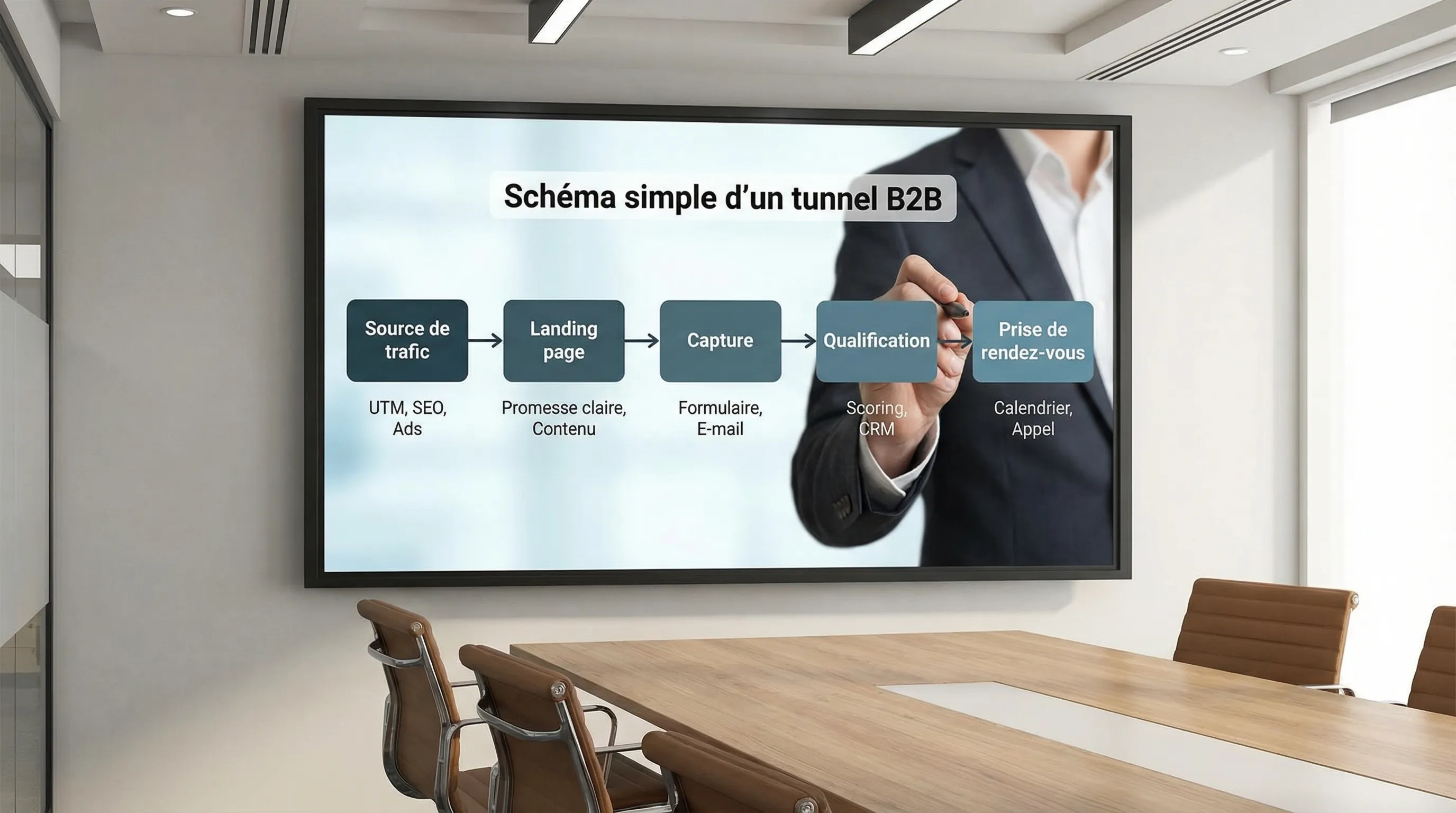
Overview in 5 steps
Arrival (qualified traffic)
Landing page (promise + proof)
Capture (contact + consent)
Qualification (questions + sorting)
Conversion (Appointment or scoped request)
This funnel is intentionally short. Complexity should live in the tooling (CRM, scoring, nurturing, follow-ups), not in 12 pages.
Dedicated pages per offer, clean UTMs, message consistent with source
Landing
Make understood and reassure
Value proposition, proof, cases, objections, unique CTA
Capture
Transform into lead
Short form, consent, clear confirmation
Qualification
Avoid bad leads
3 to 6 questions, simple routing logic, adapted next page
Conversion
Get key action
Appointment booking (calendar) or scoped request (brief)
Step 1: Traffic, a B2B rule (strict consistency)
The #1 conversion lever is the consistency between your source's promise (email, ads, SEO, LinkedIn post) and the page content.
Concretely: avoid sending everyone to a generic page. Instead, create a landing page per offer or segment (e.g., "AI Audit", "CRM Automation", "AI Support Agent").
If you structure your acquisition, you can rely on RevOps bases (MQL/SQL definitions, scoring, handoff). At Impulse Lab, the glossary can serve as a reference to align teams, for example on RevOps or on the notion of SQL (Sales Qualified Lead).
Step 2: ClickFunnels Landing Page (the B2B version that converts)
An effective B2B landing page answers 4 questions, in this order:
For whom? (Implicit ICP, sector, size, context)
What concrete result? (KPI, timeframe, deliverable)
Why believe you? (Proof, method, examples)
What next step? (Unique CTA)
The page pattern (very simple)
You can aim for a page with:
A clear hero: "Get X in Y days, without Z."
3 result-oriented benefits.
1 "How it works" block (3 steps maximum).
1 proof block (logos, mini-cases, testimonial, or figures if you can back them up).
1 short FAQ (objections).
1 repeated main CTA.
B2B Tip: if your offer is complex, prefer a "Diagnose" CTA rather than "Buy". Example: "Book a 20-minute diagnostic".
Step 3: Capture (fewer fields, more action)
In B2B, we tend to over-ask too early. Result: friction, lower conversion, and sometimes false data.
Practical recommendation:
If your goal is an appointment, ask for the minimum (name, professional email, company).
If you need to filter, move part of the qualification to the next step.
On the compliance side, if you drop measurement or retargeting cookies, you must manage consent (in France and EU). A reference resource is the CNIL cookie guide. (This point quickly becomes a blocker if you scale campaigns.)
Step 4: Qualification (the heart of the B2B funnel)
This is where your ClickFunnels sales funnel can become a real commercial structuring tool.
The goal is not to get a complete file, but to answer two questions:
Fit: does this prospect look like your ICP?
Intent: is the need real and active?
The 6 questions "max" (examples)
Choose 3 to 6 questions, depending on your sales cycle:
The minimum KPIs to track (otherwise you're flying blind)
A good B2B funnel is not judged only on the landing → lead conversion rate. It is judged on quality up to the pipeline.
KPI Table (minimalist, but sufficient)
Zone
KPI
Why it's critical
Acquisition
Cost per qualified visit (if paid) or qualified volume (if organic)
Verify that the source attracts the right audience
Landing
CTA click rate (or scroll depth)
Verify understanding of the promise
Capture
Visit → lead rate
Measure form friction
Qualification
Lead → qualified rate
Avoid clogging sales with noise
Conversion
Qualified → Appointment rate
Measure the strength of the entry offer
Sales
Appointment → opportunity rate, then → client
Validate that the funnel creates real pipeline
If you want to link these KPIs to more "financial" steering, you can rely on the notions of CAC (Customer Acquisition Cost) and MQL/SQL conversion.
Integrations: the point that moves ClickFunnels from "pages" to "system"
ClickFunnels can host the pages, but in B2B you almost always need to connect the rest.
Useful integrations (generic)
CRM to create/update contacts and opportunities (see the CRM sheet).
Calendar for appointment booking.
Emailing for nurturing.
Tracking analytics for attribution.
The classic trap: duplicated and inconsistent data. A simple rule helps a lot: define a "source of truth" (often the CRM) and push all important funnel actions there.
Frequent (and costly) errors on a B2B ClickFunnels funnel
Too many pages, not enough proof
In B2B, 1 clear page with a promise and proof often beats 5 vague pages.
Qualification too aggressive
If you put 12 fields right at the entrance, you get fewer leads and more erroneous data. Move the effort after a first micro-conversion.
No follow-up to the CRM
Without a clean CRM, you won't know if your funnel creates clients or just forms.
Uncontrolled "magic" automations
Automating without instrumentation is a shortcut to chaos. If you automate, define statuses, rules, and exceptions.
When to keep ClickFunnels, when to switch to custom
ClickFunnels is very useful for testing quickly. But if you scale, certain signals indicate that the architecture needs strengthening.
Signal
What it means
Recommended action
Many fragile integrations
Operational debt is rising
Stabilize via an integration layer (workflow, API)
Uncertain tracking (GDPR, consent)
Unreliable attribution
Clarify consent, standardized events, governance
Complex multi-offer funnel
Need for personalization and routing
Build a more structured platform
Need for AI (scoring, routing, assistant)
Need for a product, not just pages
Add an integrated and measured AI brick
Frequently Asked Questions
Is ClickFunnels suitable for B2B? Yes, especially for short funnels oriented towards appointments (diagnostic, demo, audit). The key is qualification and CRM integration, not the number of steps.
What is the best CTA for a B2B funnel? The most effective is often a low-risk entry offer: diagnostic, express audit, scoping session, or estimation. Avoid overly generic CTAs.
How many questions to put in qualification? Aim for 3 to 6 questions maximum. The goal is to filter fit and intent, not to replace the CRM or the discovery call.
Which KPIs to track in priority? Visit → lead, lead → qualified, qualified → Appointment, then Appointment → opportunity → client. Without the end of the chain, you potentially optimize the wrong signals.
How to avoid having "leads but no clients"? By aligning ICP, promise, qualification, and sales handoff. And by tracking conversions up to the pipeline in the CRM (not just forms).
Need a B2B funnel that creates pipeline, not just forms?
If you want to structure a ClickFunnels funnel (or equivalent) with clean integrations, useful automations, and KPIs tracked up to the CRM, Impulse Lab can help you frame, build, and make the system reliable.
Depending on your maturity, we intervene via:
Opportunity audit (quick wins and prioritization)
Development and integration (CRM, existing tools, automations)
Adoption training (so the funnel lives within the team)
Contact us via impulselab.ai to describe your offer, your sales cycle, and your goals, then leave with a concrete implementation plan.
Accelerating Product Sheet Creation with Artificial Intelligence
Exploring AI content creation addresses a key need for e-commerce SMBs: producing more product listings without monopolizing copywriting teams. AI can draft descriptions and adapt tone, but compelling copy does not ensure factual accuracy—making clean data and structured review essential.