AI moves fast, but you don't need to track every update. For SME or scale-up leaders, here are the models and tools that truly matter in early 2026, why they are relevant now, and how to choose them without wasting time or compromising your data.
janvier 03, 2026·6 min de lecture
Current AI moves fast and acronyms are piling up, but you don’t need to follow every announcement to make good decisions. If you run an SME or scale-up, here are the models and tools that really count in early 2026, why they are relevant now, and how to choose without wasting time or compromising your data.
Current AI Trends to Remember in 2026
Native multimodal, not as an add-on, is arriving everywhere; text, image, audio, vision, and real-time actions are converging.
More reliable long context; extended context windows are becoming usable in production with a better cost per useful token.
Credible open source in production; the Llama and Mistral families cover more and more business cases with a manageable TCO.
RAG goes industrial; companies are investing in indexing, evaluation, and monitoring rather than just generation.
Tooled agents and integration standards; the Model Context Protocol facilitates cleaner integrations between models and systems.
Governance and cost become number one criteria; data security, traceability, and total cost supersede the race for raw performance alone.
Models to Know in Early 2026
Generalist Multimodal LLMs, Cloud-Side
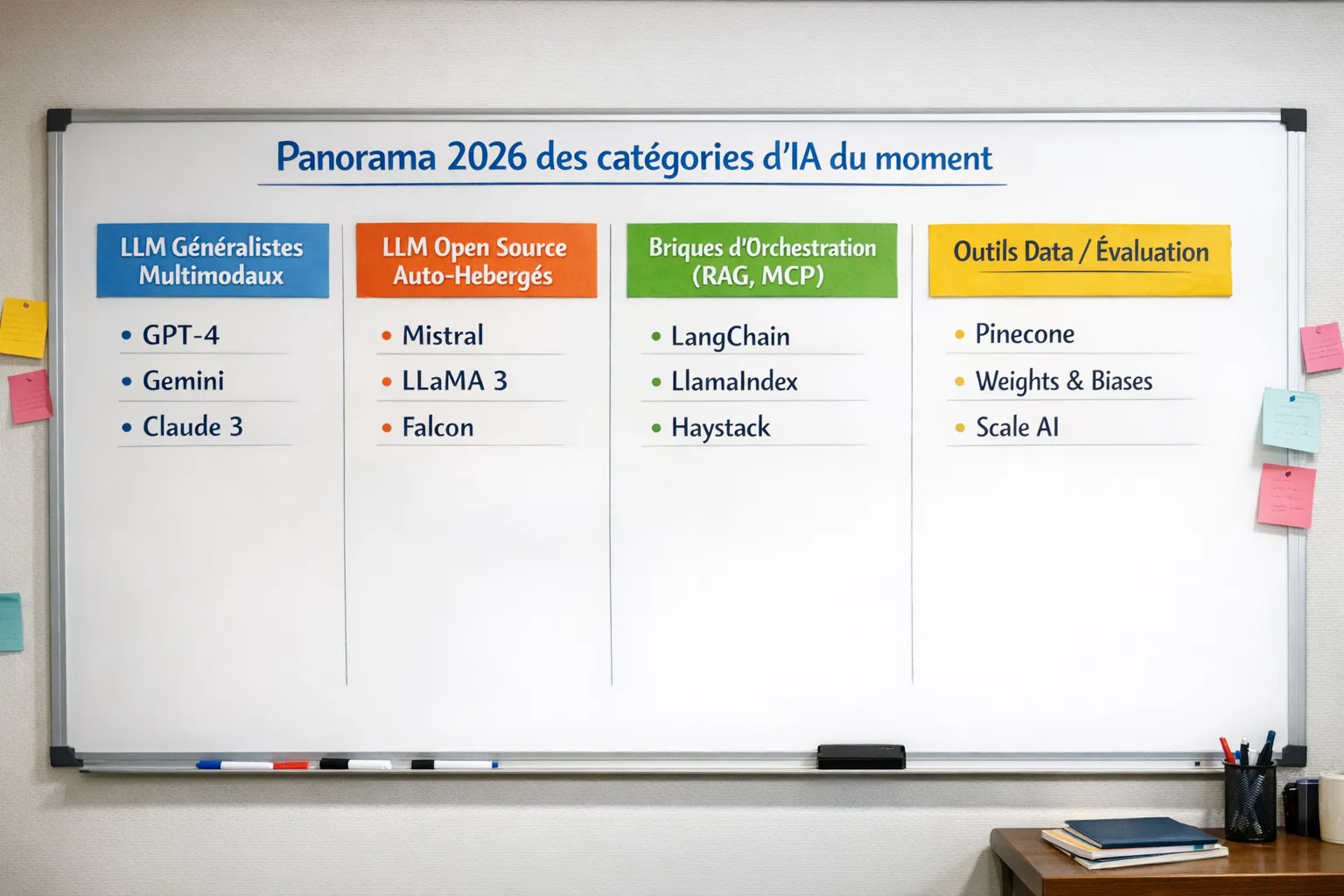
OpenAI GPT‑5 and GPT‑4o, versatile leaders for generation, tools, vision, and audio. See also our comparison, our field test.
Anthropic Claude Sonnet 4.5, renowned for its precise answers, writing style, guardrails, and long context.
Google Gemini 1.5 Pro and Flash, long context, good vision, and cost/latency ratio. Developer reference, Gemini 1.5 official documentation.
When choosing a cloud model, you pay for access to the highest level of quality, reliability, and surrounding tooling, with a fast time‑to‑value.
Open Source and Self-Hostable LLMs
Meta Llama 3.x, large ecosystem, accessible fine‑tuning, industrial support. Official presentation, Llama by Meta.
Mistral, Mixtral, and Codestral, efficiency, mixture‑of‑experts, and code variants. Documentation, Mistral AI docs.
These models allow you to keep your data in-house, optimize costs at scale, and finely adjust behaviors to your use cases.
Specialized Models to Keep on the Radar
Code, Codestral, Code Llama, completion and refactor assistants that are fast and integrable into the IDE.
Voice and meetings, Whisper and derivatives for precise multi‑speaker transcription, very useful for support and sales.
Vision and documents, multimodal models for structured extraction of invoices, contracts, and catalogs, relevant for back‑office automation.
Image and video generation, SDXL, SD3, and recent video engines for marketing, R&D, and product prototyping, to be framed regarding licenses and brand safety.
Express Summary of Flagship Models
Category
Models or Tools
Why Now
Key Use Cases
Generalist Cloud LLMs
GPT‑5, Claude Sonnet 4.5, Gemini 1.5 Pro
Quality, multimodal, mature tooling
Knowledge worker, support, internal assistants
Open Source LLMs
Llama 3.x, Mixtral
Cost control, data sovereignty, fine‑tuning
Internal FAQs, specialized business assistants
Code
Codestral, Code Llama
Developer productivity gains
Review, migrations, scaffolding
Voice
Whisper and suites
Decent precision and latency
Transcription, meeting summaries, support QA
Vision and Documents
Multimodal LLMs
Reliable extraction, long context
Back‑office, compliance, procurement
Image and Video
Diffusion and video engines
Marketing creative, rapid prototyping
Visual variants, storyboards
The Orchestration and Integration Bricks That Count
RAG, the foundation for connecting your documents and data to the model. Understand the basics with our glossary entry RAG, and architecture choices with our guide Robust RAG in production.
Agent protocols, the Model Context Protocol standardizes the connection of models to your tools, with easier governance of who accesses what.
Orchestration, LangChain and LlamaIndex remain references for chaining retrieval, generation, and post‑processing, while keeping pipeline readability.
Vector stores and search, Postgres with pgvector covers many needs at a predictable cost. For massive volumes or stricter SLAs, dedicated solutions like Qdrant, Weaviate, or Pinecone remain very solid.
Continuous evaluation, public leaderboards like LMSYS Chatbot Arena are useful as a benchmark, but implement your own test sets based on your content, tasks, and KPIs.
How to Choose Your Current AI Without Making Mistakes
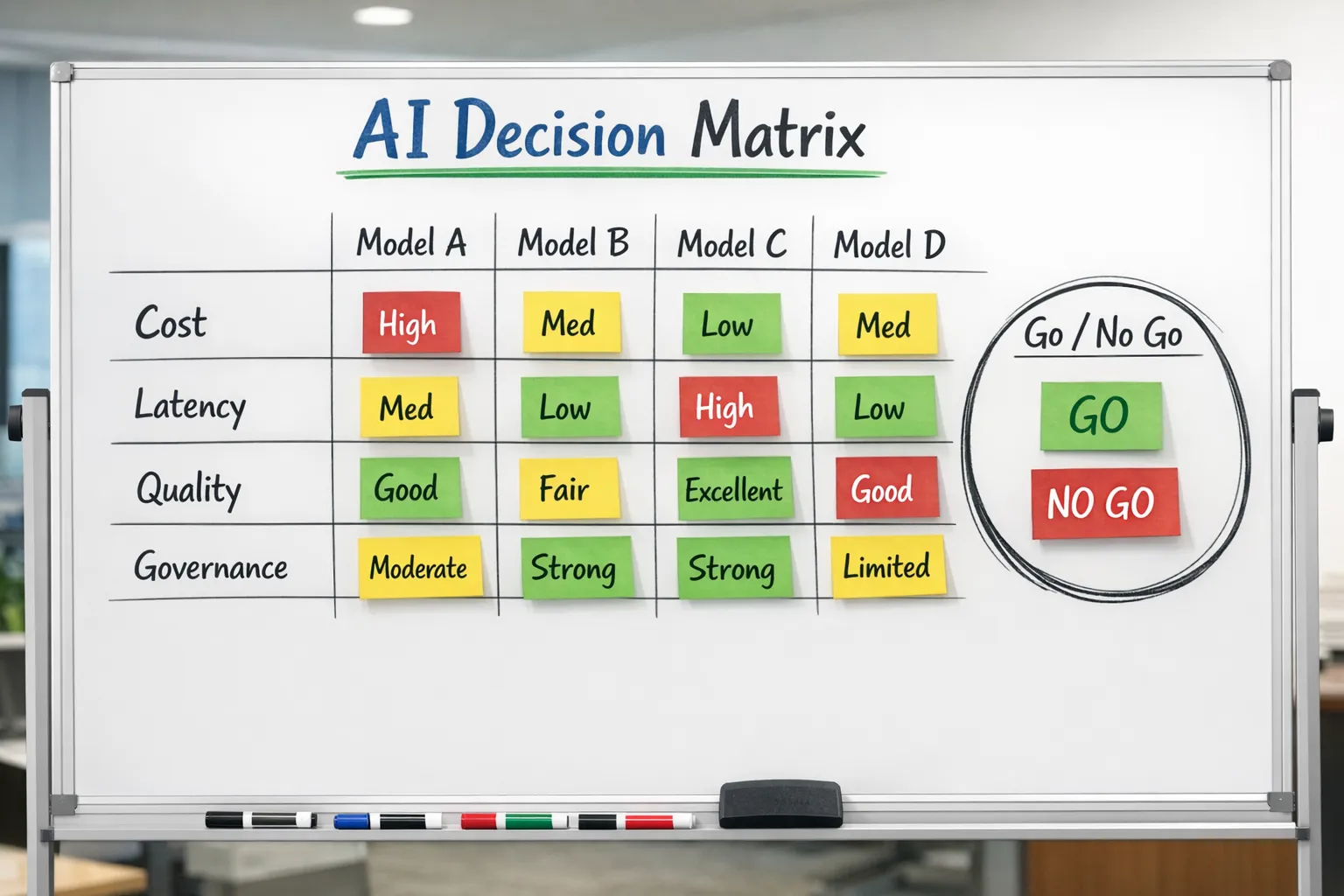
Before comparing generic benchmarks, start from your constraints and the business value sought. Use this quick decision grid.
Data and compliance, where data resides, what PII, GDPR requirements, export or retention, who has access.
Context and memory, long documents, ticket histories, number of attachments, update frequency.
Latence and experience, acceptable response time client-side and internal, real-time audio needs or not.
Total cost, cost per call and per session, infrastructure and observability costs, integration and maintenance effort.
Existing stack, databases and tools already in place, CRM, helpdesk, event bus, IAM.
Value measurement, business-oriented KPIs, time reduction, satisfaction, conversion, response quality.
Pragmatic tip, don't look for the absolute model, look for the simplest one that passes 80 percent of your cases with an acceptable cost and clear governance.
30-Day Plan to Test Without Risk
Week 1, scoping, select 1 to 2 measurable use cases, define 3 success KPIs, and prepare 20 to 50 annotated real examples.
Week 2, prototype, set up a minimal RAG with Postgres plus pgvector, try two models, one cloud and one light fine‑tuned open source.
Week 3, evaluation, create an automatic evaluation script, accuracy, source cited, response time, cost per interaction, then a human pass on a sample.
Week 4, restricted pilot, open to a small group of users, log everything, correct prompts, re-index if necessary, make a go, no go, or scale decision.
2026 Best Practices for Going to Production
Clearly separate retrieval, generation, and post‑processing, facilitate observability and debugging.
Avoid over-context, index cleanly, use metadata and reranking rather than flooding the model.
Trace sources, store citations and similarity scores for audit and user explanation.
Run at least two interchangeable models behind an internal interface, prepare for failover and cost negotiation.
Protect the tool layer, keep guardrails on potentially destructive actions, mandatory confirmations and logs.
Frequently Asked Questions
Do you absolutely need a state-of-the-art model to deliver value in 2026? Yes when nuance and multimodality are critical, but many cases win with an open source LLM, a well-tuned RAG, and clear UX.
Open source or cloud, which to choose? Choose open source for sovereignty and controlled recurring costs, cloud for time‑to‑value, quality, and advanced features. When in doubt, test one of each in your pilot.
Are public leaderboards enough to choose? No. They help filter, but only your tests on your data and your KPIs decide. Hence the importance of an evaluation protocol and a small pilot.
What mistakes are seen most often? Indexing too broadly, not logging decisions, confusing PoC and production, and forgetting KPIs from the start.
Which tools to prioritize if starting out? A versatile cloud LLM to prototype fast, Postgres plus pgvector for semantic search, a simple orchestration framework, and a basic evaluation dashboard.
To Go Further with Impulse Lab
If you want to prioritize the right use cases and secure your technological choices, we can accompany you: AI opportunity audit, RAG integration, adoption of agent standards, training and production rollout, with weekly iterations and client portal. Consult Impulse Lab to discuss your context.