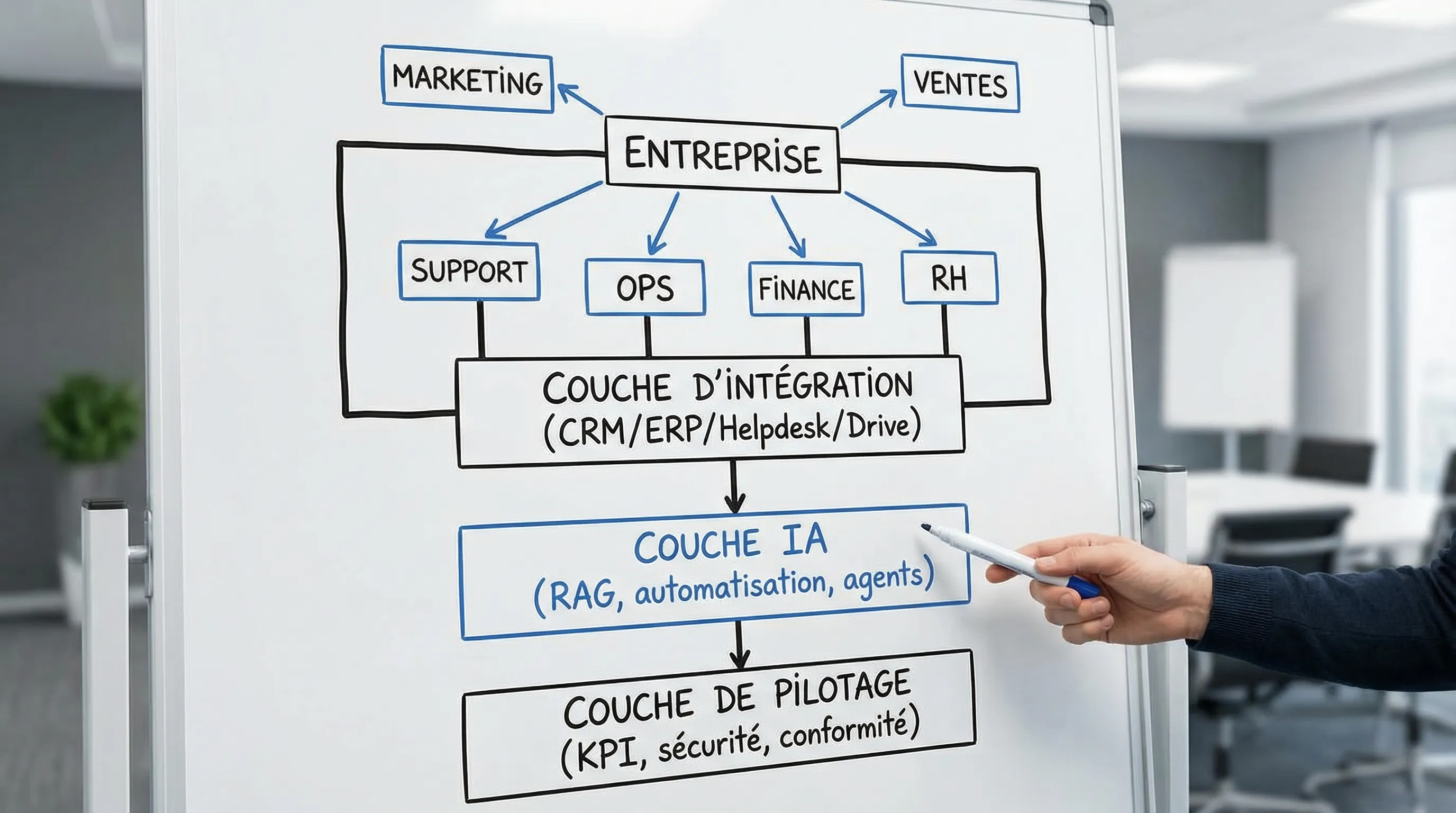
Digital Transformation with AI: A Concrete Plan by Function
Intelligence artificielle
Stratégie d'entreprise
Stratégie IA
AutomatisationS
Digital transformation with AI isn't just "adding ChatGPT." Successful companies choose practical use cases, integrate AI into existing tools (CRM, helpdesk, ERP), and measure impact with KPIs before scaling. This guide offers a concrete plan by function (Sales, Marketing, Ops, etc.).
March 01, 2026·9 min read
The digital transformation with AI isn't just about "adding ChatGPT" to the company. In 2026, companies that truly capture value do three things better than the others: they choose practical, field-level use cases, they integrate AI into existing tools (CRM, helpdesk, ERP, office suite), and they measure impact with KPIs before scaling.
This guide offers a concrete plan by function (management, marketing, sales, support, ops, finance, HR, IT, legal), with:
pragmatic use cases (quick wins then industrialization)
The principle to remember: "1 function = 1 frequent problem = 1 KPI"
Most failures come from scoping that is too broad: "automate support", "do AI in sales", "deploy agents". A successful digital transformation with AI starts, conversely, with a frequent, measurable problem connected to an existing process.
Examples of good starting points:
Marketing: produce 20 ad variations compliant with brand guidelines, reducing validation time.
Sales: qualify inbound leads faster with a summary and action recommendation in the CRM.
Finance: extract and verify invoice information, then generate an exception list.
Cross-functional Prerequisites (to validate before "doing AI")
Without these foundations, you risk multiplying demos without impact, or opening up risks (data, compliance, security) that are hard to fix later.
1) Simple Data Classification
Before any pilot, define a clear rule (e.g., green, orange, red):
Green: Public or non-sensitive data.
Orange: Internal data (procedures, non-public docs), sensitive but manageable with guardrails.
Red: Personal data, trade secrets, health, sensitive finance, etc.
This is a foundation for framing GDPR and procurement, without bureaucracy.
2) A Business Owner and a Baseline
Each use case must have:
an owner (business lead)
a baseline (time spent, error rate, backlog, conversion) measured over 2 to 4 weeks
Without a baseline, you will measure usage, not impact.
3) Minimal Integration with Existing Tools
An isolated AI creates extra tasks (copy-pasting, re-entry, double systems). Even a V1 must aim for a "minimum viable" level of integration: ticketing, CRM, document drive, ERP, internal tools.
4) A Lightweight Evaluation Protocol
You don't need a lab, but you need reproducible tests: 20 to 50 representative scenarios, and simple scoring (correct, acceptable, dangerous, off-topic). Impulse Lab detailed a testing protocol that works well in enterprise settings in this article: validating an AI idea with a simple protocol.
5) "Proportionate Risk" Guardrails
The regulatory framework is evolving, notably with the EU AI Act. Without getting into legalese, remember one rule: the more a system influences sensitive decisions (employment, credit, health, identity), the more you must reinforce traceability, human oversight, and documentation.
For a risk management framework, the NIST AI RMF often serves as a practical reference.
Concrete Plan by Function: Use Cases, Prerequisites, KPIs
The goal here is not to be exhaustive, but to propose realistic starting points for SMEs and scale-ups, with measurable success criteria.
Confusing "Perceived Time Savings" with "Measured Gains"
A copilot can give an impression of speed while creating hidden work (proofreading, correction, re-execution). Instrument from the start, even with 3 simple events.
Leaving AI Out of the Workflow
If the user has to copy-paste, you haven't transformed the process. You've added a tool. Value arrives when the AI reads and writes in the right place (CRM, helpdesk, ERP), with control.
Forgetting Knowledge Maintenance
Assistants based on internal documents depend on a living "source of truth". Plan for an owner, an update frequency, and a mechanism to flag missing info.
Addressing Security and Compliance at the End
Data, access, logs, and usage rules must be present from V1. For practical benchmarks regarding the French authority, the CNIL publishes useful resources on AI, personal data, and compliance.
Frequently Asked Questions
What is digital transformation with AI, concretely? It is the integration of AI capabilities (assistance, automation, agents, augmented search) into existing processes, with a business owner, KPIs, and security and compliance guardrails.
Which function should I start with for quick ROI? Start with the function where demand is most frequent and most standardizable (often support, sales, finance, ops). The best start is one where you can measure a KPI in 2 to 4 weeks.
Should we train teams first or launch a pilot? The two reinforce each other. Short training "at the point of use" helps frame and adopt, but a measured pilot reveals the real needs for integration, data, and governance.
Which KPIs should I choose to avoid vague AI projects? Choose 1 North Star KPI (processing time, conversion, errors, response time) and 2 to 4 support KPIs (quality, escalation, satisfaction, cost). If you are unsure, this Impulse Lab guide on measurement can help: AI KPIs and Measuring Impact.
When should we move from "copilot" to automation or agents? When your V1 proves stable value, source data is reliable, and you can frame actions (preview, permissions, idempotency, logs). Otherwise, you increase risk faster than ROI.
Moving from Plan to Execution with Impulse Lab
If you want to transform this functional plan into a prioritized, measured, and integrated backlog, Impulse Lab can assist you with:
an AI opportunity audit to identify quick wins and risks
the design and development of custom web and AI solutions (automation, integrations, platforms)
adoption training to make teams autonomous and aligned