Enterprise AI Audit: Report Template and ROI Scorecard
Intelligence artificielle
Stratégie IA
Audit IA
Gestion des risques IA
ROI
When a company launches an "AI project", it often buys two things at once: a promise of gains and a new class of risks (data, compliance, quality, variable costs). A useful **enterprise AI audit** must therefore produce a deliverable that speaks as much to the CEO/CFO as to the teams...
When a company launches an "AI project", it often buys two things at once: a promise of gains and a new class of risks (data, compliance, quality, variable costs). A useful enterprise AI audit must therefore produce a deliverable that speaks as much to the CEO/CFO as to the Ops and IT teams: a readable report, and an ROI scorecard that enables decision-making.
This guide provides you with a report template (copy-paste ready) and a pragmatic ROI scorecard to prioritize use cases, scope a pilot, and then decide on a Go/No-Go.
What is an AI audit report for (and why 1 page is not enough)
A good AI audit report does not serve to "prove that AI works". It serves to reduce uncertainty and make the decision executable.
Concretely, it must answer 5 questions, in this order:
What business problem are we solving (and with which KPI)?
What changes in the workflow (where does AI fit in, who does what)?
What data and integrations are necessary (and at what quality level)?
What risks (GDPR, AI Act, security, business errors) and what guardrails?
What realistic ROI (gains, total costs, payback) and what decision (pilot, industrialize, stop)?
If your audit is limited to a list of tools or a catalog of use cases, you will have "ideas", but not a plan.
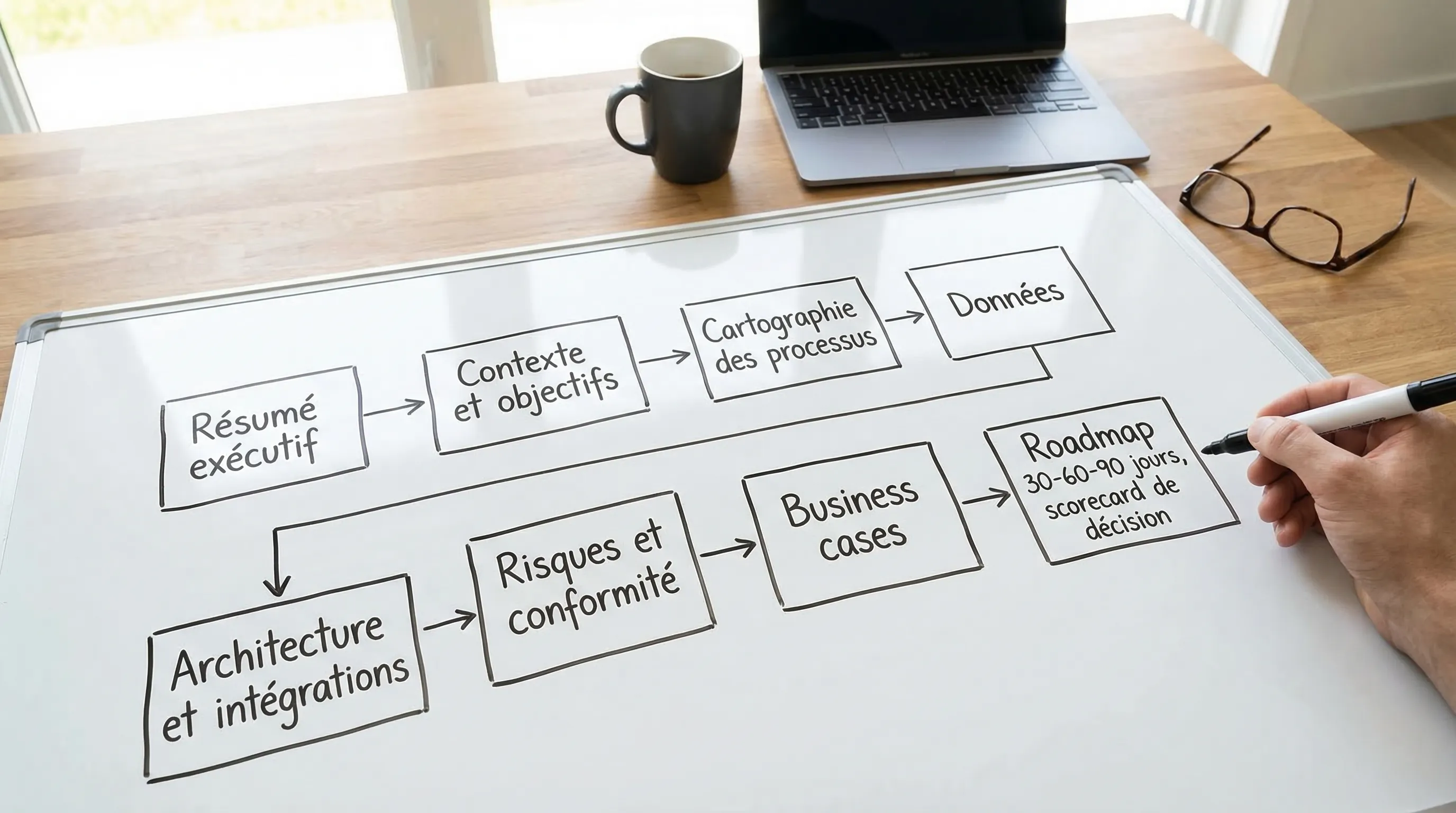
Enterprise AI Audit Report Model (Recommended Structure)
The structure below is designed for an SME, a scale-up, or a growing organization: complete enough to secure, short enough to be read.
Executive Summary (1 page)
Objective: Allow a decision-maker to say "yes" to a pilot, or "no" cleanly.
To include:
Context and business objective
2 to 5 shortlisted use cases
Recommendation (pilot, prerequisites to complete, topics to discard)
Indicative budget and timeline (in ranges if necessary)
Main risks and measures
Scope, Hypotheses, and Method
Objective: Avoid misunderstandings.
Organizational scope (teams, countries, channels)
Data scope (sources, sensitivity, rights)
Hypotheses (volumes, time, hourly cost, adoption rate)
Objective: Move from "demo" to an exploitable system.
Describe the architecture at a level useful for decision-making:
Where the AI lives (SaaS tool, API, on-prem, hybrid)
How context is injected (e.g., RAG, knowledge bases, rules)
How we act (ticket creation, CRM update, controlled drafting)
Observability (logs, metrics, costs)
If you use assistants connected to your documents, robustness depends heavily on RAG choices and continuous evaluation. You can go deeper with our guide on Robust RAG in production.
Risk Register and Guardrails
Objective: Make risk "manageable", not "acceptable by belief".
Test pack: N real scenarios + edge cases (sensitive data, out-of-scope requests)
Measures: processing time, escalation rate, agent satisfaction, incidents
The report must conclude with a decision: "industrialize", "iterate 2 weeks and re-test", or "stop".
Errors That Make an AI Audit Unusable
We often see these in companies that "test a lot" but industrialize little.
Confusing Usage with Impact
A tool can be used without improving the KPI. Your report must always return to the baseline and measurements.
Not Integrating into the Workflow
An unconnected AI (no CRM/helpdesk, no rules, no source of truth) produces "impressive" but costly and fragile results. Integration is often half the work.
Forgetting Operations
Without logs, without metrics, without ownership, you will have a "permanent prototype". The report must contain a minimum runbook (who maintains what, how often, with what alerts).
FAQ
What is an enterprise AI audit, concretely? An enterprise AI audit is a short process (often 2 to 4 weeks) that selects use cases, verifies data and risks, and produces a roadmap and an ROI scorecard to decide and execute.
What is the difference between an AI audit and a POC? The AI audit serves to frame, prioritize, and secure the decision (value, data, compliance, integration). The POC tests technical feasibility. A good audit avoids launching unmeasurable POCs.
How to avoid overestimating ROI? By imposing a baseline, applying a realistic adoption rate, counting run costs (maintenance, monitoring, training), and validating via an instrumented pilot.
Which KPIs to track in an AI ROI scorecard? Generally: cycle time, cost per action, error rate, escalation rate, weekly adoption, data incidents, and a main business KPI (conversion, CSAT, margin, NRR depending on the case).
Should the report talk about GDPR and the AI Act? Yes, even briefly. A credible enterprise AI audit must include a risk register, data sensitivity, potential sub-processing, and operational guardrails.
Need an "Execution-Oriented" AI Audit (with ROI Scorecard)?
Impulse Lab supports SMEs and scale-ups on AI opportunity audits, measured pilots, and then custom web and AI solutions integrated into your existing tools (with strong attention to adoption, compliance, and ROI measurement).
You can start with our strategic AI audit approach or contact us directly via impulselab.ai to frame your 2 to 3 most profitable use cases and deliver an instrumented V1 in short cycles.