How to Align Your Data and AI Teams on a Business Goal
Intelligence artificielle
Stratégie d'entreprise
Stratégie IA
Gestion de projet IA
Your data and AI teams can share tools without pursuing the same outcome. Discover how to align teams around clear business goals, measurable acceptance criteria, and explicit ownership.
November 12, 2026·9 min read
Your data and AI teams can share the same tools without pursuing the same outcome. The business expects faster request processing, the data team focuses on source reliability, and developers strive to improve model responses. Everyone makes progress, but no one really knows when the project will be useful enough to deploy.
Alignment comes down to making five elements explicit: the expected outcome, who owns it, the required data, the acceptance criteria, and the trade-off rules. For an SME or scale-up, this can fit into a concise document used every week to make decisions.
Start with the Work That Needs to Change, Not the Model
“Deploying an AI assistant” describes a solution, not a business objective. Before mobilizing teams, identify a specific task, its user, and the observable problem.
Let’s take a fictional example: a customer service department wants to cut down the time spent on simple inquiries. The desired change isn't just generating an answer. It requires finding the right procedure, drafting a reliable response, and enabling the agent to review and approve it quickly.
This description already highlights dependencies: an actionable knowledge base, clear handling guidelines, and seamless integration into the tools agents already use. It also allows you to compare AI against simpler improvements, such as better-organized response templates.
The first deliverable must describe a change in actual day-to-day work, not a technical feature list.
Formalize an Outcome Contract to Align Data and AI Teams
The outcome contract is a shared scoping document. It prevents each team from reinterpreting success through its own isolated metrics. The business lead, the data lead, and the technical lead must be able to sign off on it together.
Here is a fictional example. The thresholds illustrate a methodology; they are neither industry benchmarks nor performance guarantees.
Element
Agreement to Formalize
Scope
Simple order-tracking requests on a single channel
Baseline
Median active handling time of 12 minutes, measured across the selected scope
Target Outcome
Reach a median active handling time of 8 minutes during the pilot
Guardrails
Maintain current reopening rates and preserve mandatory human validation before sending
Expected Decision
Expand, adjust, or discontinue the initiative at the end of the pilot
Owner
A designated individual within customer service with the authority to approve the new workflow
The baseline measurement must be conducted before testing begins. Otherwise, teams risk comparing inquiries of varying complexity or mistaking a seasonal drop in volume for a real efficiency gain.
Be sure to define the observation period and exclusions as well. An exceptional logistics disruption, for example, should be flagged in the results rather than erased after the fact just because it skews the average.
Assign Decisions to Individuals, Not Departments
In a data and AI project, “the business signs off” or “the tech team will handle it” is not enough. Every critical decision needs an identifiable owner, even if one person wears multiple hats in a smaller organization.
The sponsor governs resources and priorities. They decide whether the problem is worth the investment and arbitrate when another initiative competes for the same resources.
The business process owner accepts operational change. They define what a usable answer looks like, coordinate user involvement, and are accountable for the results achieved in their department.
The data lead is accountable for data sources and their definitions. They identify systems of record, clarify business definitions, and coordinate issue resolution with the right stakeholders.
The technical lead is accountable for solution reliability and operations. They design the architecture, highlight limitations, and prepare for production support, including outages and edge cases with uncertain model responses.
Security, privacy, and compliance matters must also have a designated point of contact. The Data Protection Officer (DPO), where applicable, is consulted on personal data protection issues according to their role.
Finally, specify who has the authority to pause the pilot and under what conditions. A data leak or the absence of the planned human review step should not wait for the next steering committee to be addressed.
Turn Requirements into Shared Tests
For data and AI teams, disagreements are much easier to resolve when grounded in observable examples. Saying “the response must be relevant” is too vague. Saying “the response uses the current standard procedure and does not invent any delivery timeframe” can be directly tested.
Ensure Data Reflects Real-World Work
The business and data leads must collaborate to assemble a representative sample of requests: common cases, costly edge cases, incomplete files, and situations requiring human escalation.
Verify data provenance, freshness, access rights, and representativeness. A dataset can be technically clean while predominantly reflecting legacy customers, even though the pilot targets a new market segment.
To explore this aspect further without mixing it up with organizational alignment, follow a structured framework to prepare your data before an AI project.
Separate Technical Performance from Business Acceptance
A response that is technically accurate can still be completely unusable: too verbose, poorly placed within the user workflow, or more time-consuming to verify than to write from scratch. Testing must therefore cover both the generated content and its day-to-day adoption by the agent.
Set aside an evaluation dataset strictly isolated from the examples used to fine-tune or prompt the solution. Additionally, document critical blockers versus acceptable minor errors.
This shared reference framework prevents data and AI teams from renegotiating success criteria after every demo. For personal data considerations, the CNIL resources on artificial intelligence provide a helpful framework for assessing planned data processing.
Run a Weekly Review Designed to Drive Decisions
A progress meeting will not align teams if it simply boils down to listing completed tasks. The review must start from real-world observations and culminate in a decision that moves the data and AI project forward.
Share performance data within the agreed scope, highlight representative errors, and surface blockers requiring trade-offs. A demo can be helpful, but it cannot replace the results of shared validation tests.
Three questions are enough to guide the discussion:
Is user performance improving against the target metric without compromising guardrails?
What obstacle is currently limiting results: data, the model/solution, integration, or the business process?
What decision are we making, with which owner, and by what deadline?
Keep track of decisions in a brief log: observed issue, chosen approach, rationale, and review date. This prevents teams from rehashing the same debates every time a new stakeholder joins the project.
If the business cannot provide the required sample cases, this is not just a technical task on hold. It is a critical dependency that must trigger an update to the timeline or project scope. The weekly review exists precisely to make these trade-offs visible.
Anticipate Disagreements Before They Stall the Project
Alignment does not eliminate friction. Instead, it provides a structured process to resolve disagreements rather than letting the most vocal or available stakeholder win by default.
When the Business Demands 100% Reliability
Shift abstract discussions about perfection toward impact analysis. A poor categorization suggestion does not carry the same risk as sending an erroneous instruction directly to a customer.
Identify scenarios where the solution can assist the user, those where it should abstain, and those requiring mandatory human approval. If errors remain too critical, narrow the scope instead of hiding underlying issues behind an acceptable average.
When Engineering Asks for More Data
Demand a clear link between the requested data and a concrete observed failure. Which specific case is failing today? What information is missing? How will adding it measurably improve the outcome?
This discipline prevents the project from spiraling into an endless data collection effort. Sometimes, an explicit business rule or an updated procedure solves the issue much more effectively.
When a New Request Feels Urgent
Any scope expansion must expose its true cost: additional testing, access permissions, integration work, and user training. The sponsor can then deliberately choose to replace an existing priority, allocate extra resources, or postpone the request.
A data and AI disagreement thus turns into a documented trade-off regarding scope, risk, or resources, rather than a political dispute between departments.
Turn Going into Production into a Collective Decision
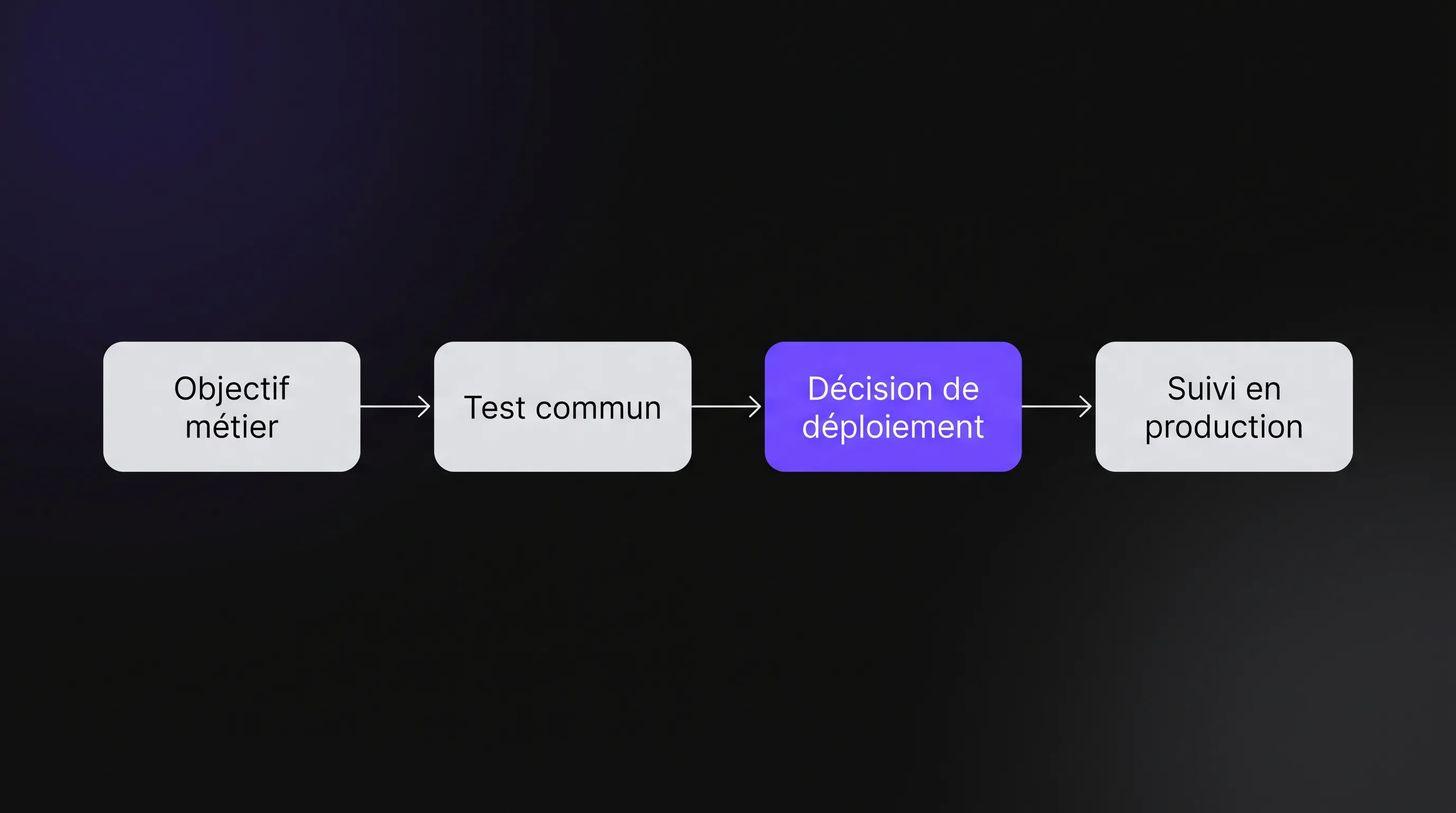
A pilot must not conclude with "the demo works." It must lead to an evidence-based decision: deploy, extend a specific test, or shut it down. All three outcomes are valid as long as they are grounded in the agreed criteria.
Prior to deployment, verify who owns incident management, ensure a rollback plan is in place, and confirm that users understand the system's operational boundaries. A solution without clear ownership post-launch remains an operational liability.
User adoption must also be actively monitored. If agents bypass the assistant, uncover the root cause: slow latency, difficult-to-edit responses, or a lack of trust. Login counts alone will never tell you whether the tool is genuinely useful.
Finally, data and AI responsibilities must remain active post-launch. An altered documentation source, a new category of inquiry, or model updates can quickly degrade results. Clarify who monitors these shifts and who has the authority to trigger a formal re-evaluation.
Going into production transfers ongoing accountability, not just a software tool. That continuity is what keeps teams aligned long after the project team disbands.
Frequently Asked Questions
Do SMEs need to set up a dedicated AI team? Not necessarily. Start by assigning business, data, and technical responsibilities to named individuals. A dedicated team becomes relevant only when project volume and operational demands warrant it.
Who should arbitrate between better model performance and faster deployment? The business process owner and the sponsor decide based on established acceptance criteria and documented risks. Security requirements and compliance obligations cannot be compromised to hit an arbitrary deadline.
What should we do if technical metrics improve but business results stagnate? Analyze the end-to-end journey: verification overhead, UX integration, manual corrections, and actual adoption. Data and AI coordination must address the complete workflow, not just the quality of the generated output. A better model cannot compensate for poor insertion into real work.
Scope Your Next Project with Impulse Lab
Before selecting a tool, gather key decision-makers around a single use case and draft your first outcome contract. If the scope, dependencies, or success criteria remain unclear, an AI opportunity audit with Impulse Lab can help you establish clear priorities before developing and integrating a custom solution.