Training managers to **validate AI outputs** is not about spotting text that "sounds off." An answer can be clear and persuasive yet contain errors or false promises. Here is how to build practical validation skills.
October 06, 2026·11 min read
Training managers to validate AI outputs is not about teaching them to spot text that "sounds off." A response can be clear, persuasive, and yet contain an erroneous figure, overlook an exception, or promise something your company cannot deliver. The actual skill to develop is more specific: verifying that an output is sufficiently reliable for its intended use, then deciding whether to accept, correct, or block it.
For an SME or scale-up, this training must remain practical. Here is a framework based on real-world business scenarios, a shared review methodology, and an evaluation that measures actual skills rather than just participant satisfaction.
What a Manager Actually Needs to Know How to Validate
An AI "output" could be meeting minutes, a customer response, a sales analysis, or a recommendation. The manager is not validating the model as a whole. They are validating a specific output, within a specific context.
A summary may be fine for prepping an internal meeting, but insufficient for communicating a contractual decision. The right question is therefore not just "Is it accurate?", but also "Can we use this result for this specific action, given its potential consequences?".
The training must enable managers to distinguish between three things: verifiable facts, interpretations, and decisions that commit the company. They must also recognize their boundaries: a sales manager does not become qualified to validate a legal analysis just because they know how to use the tool.
A brief primer on how language models work for executives helps teams understand why confident phrasing is not proof of accuracy. There is no need, however, to turn the program into a machine learning course.
The European regulatory framework further underscores the value of this approach: Article 4 of the EU Artificial Intelligence Act outlines measures to ensure a sufficient level of AI literacy among relevant personnel, taking into account their background and the operational context. This provision has been applicable since February 2, 2025. On its own, it does not mandate manual review of every single output.
Tailoring Review to Actual Risk
Reviewing everything with the same rigor creates bottlenecks. Conversely, a quick glance is not enough for an output that could trigger a payment or alter a customer commitment.
Before training, categorize a few common use cases according to their potential impact. The table below serves as an adaptable starting point, not a formal regulatory classification.
Use Case
Risk to Evaluate
Review to Teach
Rewriting internal text without sensitive data
Meaning distortion, omission
Compare against the original intent and source text
Preparing a customer response
False information, unauthorized commitment
Verify facts, applicable terms, and promises made
Producing quantitative analysis
Calculation errors, incorrect scope
Independent recalculation and input data checks
Preparing binding HR, legal, or financial decisions
Impact on individuals or the business
Review by a qualified specialist, according to standard procedures and compliance requirements
The operational rule of thumb is simple: the higher and more irreversible the potential impact, the more thorough and specialized the validation must be.
Clearly define who has the authority to halt the process. A manager tasked with reviewing an output must have the power to reject its use, request source documentation, or escalate to a specialist. A mandatory sign-off with no real option to block is meaningless oversight.
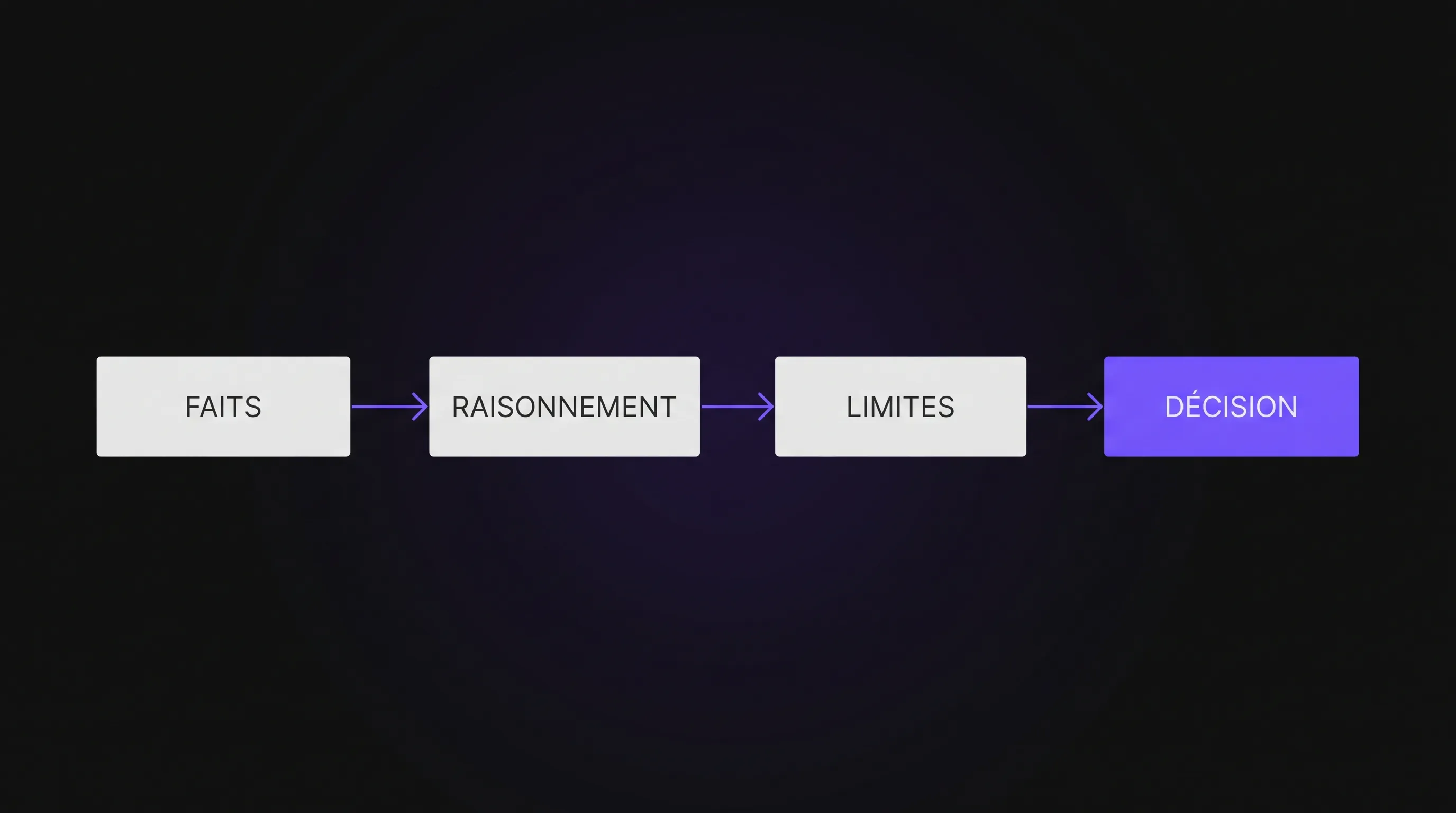
Provide managers with a consistent sequence rather than an endless checklist of precautions. Four steps are sufficient to structure the review: check the facts, test the reasoning, verify usage boundaries, and make a decision. The depth of each step then depends on the level of risk.
Verify Facts Against Original Sources
The manager begins by identifying claims that matter: dates, amounts, names, commercial terms, or document citations. They verify them against genuinely available sources, rather than relying solely on the AI's response.
Any reference cited in the text must be opened and checked. Does the document actually exist? Does it genuinely state what is claimed? Is it still in effect? An outdated price list can be authentic yet completely invalid for an active quote.
Look out for omissions as well. A summary might capture the main points accurately while omitting a critical exception. For meeting minutes, the review focuses notably on decisions, owners, and deadlines, but also on unresolved disagreements.
Asking the same AI "Are you sure?" is not an independent check. While it can help prepare checks, confirmation must come from reference documents, recalculations, or a qualified person.
Test the Reasoning and Figures
An output can start with accurate data and still arrive at an unjustified conclusion. Training must therefore separate fact-checking from logic testing.
Consider a fictional training case: two quotes display €12,000 and €8,000 excluding tax, respectively. The AI summary claims a total of €24,000 excluding tax and states that the €22,000 budget is exceeded. The manager must recalculate the total, confirm it is €20,000, and revise the budgetary conclusion. Correcting only the figure would leave a flawed recommendation in the document.
For business analysis, also ask whether timeframes, units, and cohorts are comparable. Revenue growth does not automatically prove an improvement in margins.
The key habit to teach is tangible: trace the input data, recalculate key figures with an appropriate tool, and examine the core assumptions underpinning the conclusion.
Check Data, Tone, and Commitments
A factually correct output may still be unfit to send. It could expose confidential information, include unnecessary personal data, or strike a tone poorly suited to client communication.
The manager must therefore check the recipient, the stated purpose, and the authorized scope. Information accessible in an internal folder is not automatically shareable externally.
Commitments warrant special attention: discounts, refunds, delivery timelines, service levels, or admissions of liability. The AI must never invent a promise simply to produce a more pleasing answer.
For people-related use cases, closely examine the criteria applied. A recommendation can appear neutral on the surface while relying on irrelevant or biased factors. These situations require domain expertise and established business controls, not just a casual read-through.
Decide and Keep a Proportionate Audit Trail
At the end of the review, the manager makes an explicit call: approve, correct and re-check, request additional information, or reject. A correction should not be confused with final approval.
The record can remain lightweight. For high-stakes outputs, note what was checked, the sources consulted, any edits made, and who authorized final use. Retain the validated version in accordance with your organization's retention policies.
Avoid unnecessarily copying sensitive data into review logs. The goal is to make the decision traceable, not to multiply data copies.
Finally, define criteria for rejection in advance. A missing key source, an unverified calculation, or an unauthorized commitment should immediately prompt an escalation rather than a default approval.
Structuring Training Across Two Workshops
Here is an effective framework: two 75-minute workshops spaced a few days apart, followed by a period of supported practice. Adjust the duration based on task complexity. The priority is to spend more time on actual validation exercises than on tool walk-throughs.
Workshop 1: Learning to Spot Flaws
Assemble a sample scenario with instructions, source documents, and several generated outputs. Use scenarios representative of day-to-day operations, using fictional or thoroughly anonymized data.
Include an acceptable response, an obviously flawed response, and a highly polished response with a subtle defect—such as an outdated commercial term, a missing deadline, or a conclusion that goes beyond the available data.
Participants review each response individually first, recording their decision and rationale. Group discussion follows, preventing individuals from simply echoing group consensus.
The facilitator contrasts the reviews with the source material and highlights the planted errors. The goal is not to catch managers out, but to give them hands-on experience of the difference between fluent writing and business reliability.
Conclude by having everyone identify two or three red flags that should trigger a deeper review in their daily work. These flags serve as benchmarks for the second workshop.
Workshop 2: Making Decisions Under Constraints
The second workshop simulates real working conditions: a deliverable is due before a meeting or client dispatch. Time is limited, but participants retain the authority to request clarification or withhold sign-off.
Present two cases with different impact levels. Rewriting an internal memo provides practice in proportionate review. Reviewing a commercial proposal tests calculations, contractual terms, and signature authority limits.
Ask managers to deliver either an actionable version or a reasoned decision to block. They must document the verification steps taken, not simply say "I proofread it." If they modify a data point, they must also verify the dependent conclusions.
The debrief focuses on review choices: which checks were essential, which were redundant, and which were missed? A participant who properly flags and blocks an unverifiable output may have handled the case far better than someone who quickly delivers a polished reply.
Following the workshop, have managers apply the framework to a few live cases with support from an internal lead. This transition helps refine guidelines before broader rollout.
Assessing Competence, Not Just Attendance
A multiple-choice quiz on hallucinations does not prove that a manager knows how to review a customer proposal. Assessment must be based on a new task that differs from previously solved exercises.
Prepare an observable evaluation rubric and share it with participants. Here is an example to adapt to your needs:
Skill Assessed
Expected Evidence
Identify critical claims
Identifies the key facts upon which the decision rests
Verify information
Consults relevant sources and flags missing information
Check calculations and logic
Recalculates essential figures and corrects downstream conclusions
Respect authorized scope
Identifies non-shareable data and commitments exceeding delegated authority
Decide and escalate
Justifies decisions to accept, edit, or escalate
For exercises with known critical errors, you can set the full detection of these issues and an appropriate decision as the passing benchmark. Note that this pedagogical threshold does not guarantee zero errors in production.
If someone struggles, offer a targeted follow-up exercise rather than simply repeating the lecture. A manager who spots factual errors may still need work on catching subtle omissions or understanding delegated authority boundaries.
Also evaluate the operational environment: if sources are inaccessible or responsibilities are ambiguous, training alone cannot fix organizational shortcomings.
Embedding Validation into Daily Workflows
Skills decay if everyday tools and performance metrics incentivize approving without checking. Integrate review checkpoints into existing workflows—precisely when an output turns into an outbound document, an adopted recommendation, or an executed action.
A lightweight kit might include:
A use-case guide specifying the expected output, primary sources, and top red flags.
A concise checklist outlining the four review steps and the required level of scrutiny.
An escalation path clarifying whom to contact for domain, legal, or technical issues.
A decision log scaled to the action's business impact, without duplicating sensitive information.
During the first few weeks, review a sample of validations alongside managers. Identify recurring errors and checks that prove difficult to execute. If the same anomaly keeps surfacing, the solution may involve updating reference documents, tweaking prompts, or improving technical integrations rather than demanding greater vigilance.
Track simple metrics: defects found post-release, reasons for rejection, rework rates, and review time per task. Sign-off rates alone can be misleading: an increasing rate could mean quality is improving—or that oversight is slipping.
Any major update to models, source data, or underlying processes should trigger a review of training exercises and validation standards. This keeps training tightly aligned with operational reality.
Frequently Asked Questions
Should managers review every AI output? No. Review depth should correspond to the specific use case and its potential impact. A human-in-the-loop step may be necessary for certain processes, but it does not replace standard business controls or regulatory obligations. Clearly identify which actions require formal sign-off before execution.
Can another AI be used to verify the first one? Yes, as an aid for spotting inconsistencies, but not as definitive proof. Two models can easily replicate the same error. Critical claims must be validated against authoritative sources, independent calculations, or subject-matter expertise.
What if a manager lacks the expertise to review an output? They should recognize this limitation and escalate the item to a qualified specialist. Knowing when to escalate is a core part of validation. Training should clarify the exact boundaries within which each manager is authorized to sign off.
How do we prevent validation from slowing the entire team down? By reserving in-depth reviews for high-impact outputs, making source materials readily accessible, and eliminating redundant checks. Measure review time against the cost of prevented errors, rather than in isolation.
Designing a Framework Tailored to Your Managers
Start by selecting a high-frequency use case, gathering its reference documentation, and crafting test scenarios with a business lead. This provides a practical foundation to train and assess your first cohort of managers.
To structure this process, Impulse Lab offers AI opportunity audits and adoption training programs. The most effective starting point is your actual workflow: what the AI produces, what could go wrong, and who holds the authority to approve its use.