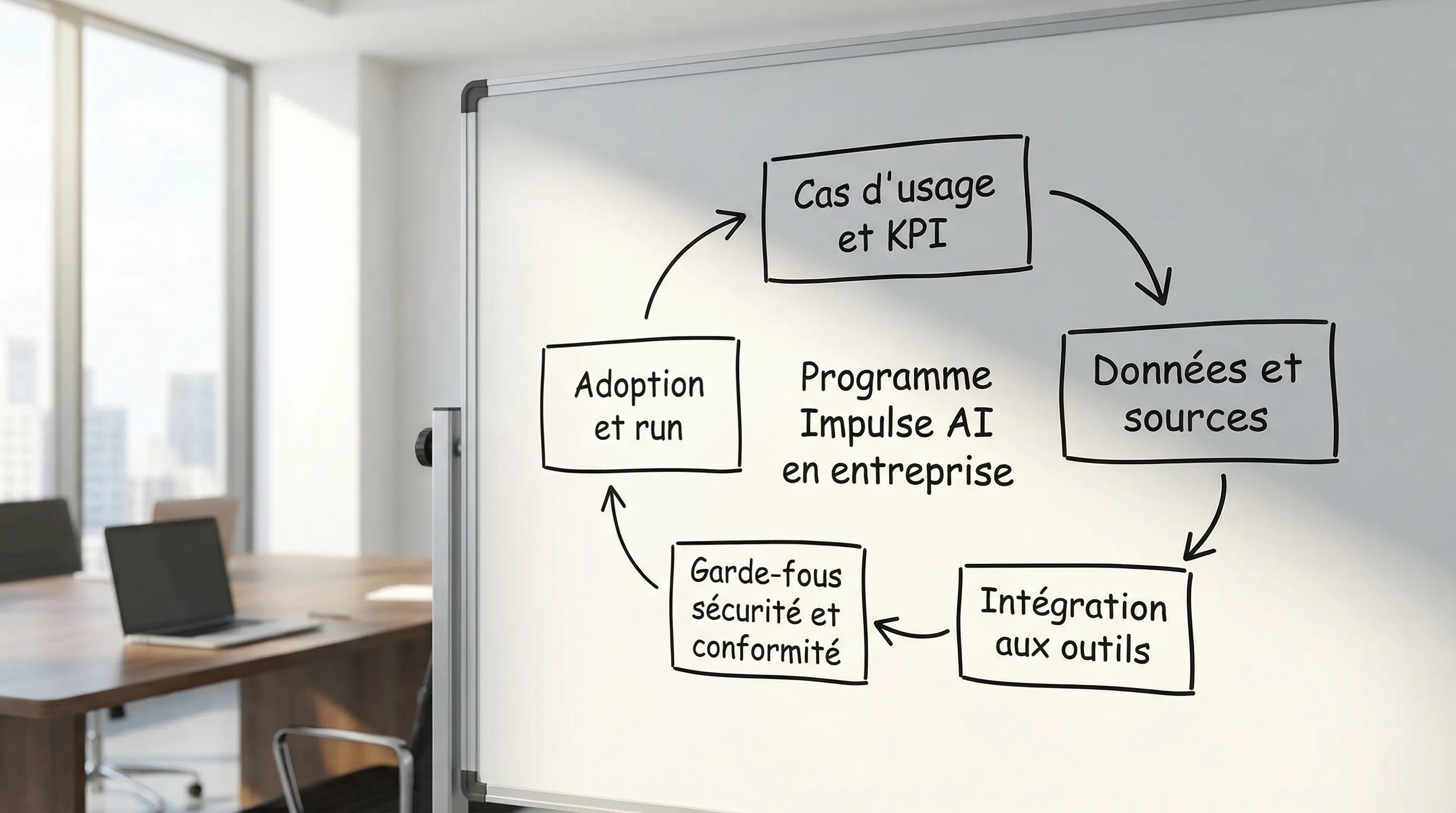
Impulse AI: What the Term Covers in a Corporate Context
Intelligence artificielle
Stratégie d'entreprise
Stratégie IA
Gouvernance IA
Gestion de projet IA
When a manager speaks of **"Impulse AI"**, they rarely describe a specific technology. It is usually a shortcut for: "we want a quick, useful impulse to turn AI into concrete results." However, this term can cover vastly different realities, from simple tools to full programs.
When an executive or manager speaks of "Impulse AI" in a company, they almost never describe a specific technology. In most cases, it is a shortcut for saying: "we want a quick and useful impulse to transform AI into concrete results." The problem is that this term can cover very different realities, from a simple tool subscription to a complete program (data, integration, security, adoption, KPIs).
The goal of this article is simple: to clarify what "Impulse AI" should cover in a corporate context if you want to avoid POCs that impress in demos but change nothing in daily operations.
"Impulse AI": One Term, Three Frequent Uses
In practice, we encounter three interpretations.
1) A name (brand, initiative, team)
Some organizations use "Impulse AI" as an internal name for a transformation project (e.g., "Impulse AI 2026"), a task force, or an innovation unit. Here, the term describes a steering framework rather than a solution.
2) An objective: accelerating the production of use cases
The most operational meaning is this: "Impulse AI" = moving from intention to an integrated AI flow (and measured) in a few weeks.
This implies treating AI as a product: a scope, an owner, users, expected quality, a cost, a run.
3) A misuse of language: "we tested ChatGPT, so we're doing AI"
This is the riskiest version: confusing individual tool usage with organizational capability.
Testing generic assistants can be useful, but it is not a strategy: without controlled data, without integration, without rules, without KPIs, you often get "shadow AI" (unvalidated tools, personal accounts, copied data, unverifiable results).
What "Impulse AI" Should Cover, If You Aim for Value
To make sense in a company, "Impulse AI" must cover a minimal scope, both business and technical.
The Core: Use Cases, KPIs, and "Job-to-be-done"
A useful AI impulse starts with a framing that answers three questions:
What frequent and costly problem do we want to reduce (time, errors, friction, delays)?
Which KPI moves if the problem is truly solved?
Where does AI fit into the existing workflow (at the right moment, with the right context)?
Without KPIs and without workflow, AI becomes a gadget. With KPIs + workflow, it becomes a capability.
The Foundations: Data, Sources of Truth, and Access Rights
In the majority of corporate AI projects, the "magic" comes less from the model than from the context: documents, CRM, tickets, procedures, product catalog, emails, etc.
If your sources are incomplete, obsolete, or inaccessible, the AI invents, makes mistakes, or slows down.
A good "Impulse AI" framework includes:
An inventory of useful sources (and their quality).
A contextualization approach (often via RAG when you want answers anchored in your documents). Impulse Lab has a clear glossary sheet on the subject: RAG (Retrieval-Augmented Generation).
Access right rules aligned with your practices (who can see what, and why).
The Difference Between "AI Tool" and "AI That Produces a Result": Integration
A useful AI impulse is a connected AI.
Connected to your tools and capable of:
reading a context (CRM, knowledge base, tickets, drive),
producing an actionable output (answer, summary, classification),
and sometimes triggering an action (creating a task, proposing a reply, routing a ticket), with control.
Concretely, this translates into design choices: data minimization, retention policies, logging, controls against prompt injection, and an adapted validation level (human-in-the-loop for sensitive subjects).
Adoption: Training, Team Rules, and Run
Even an excellent AI solution fails if it is not adopted.
"Impulse AI" therefore also covers:
Simple rules (what data we paste, what tools are allowed, what uses are forbidden).
Targeted training by role (support, sales, ops, managers), oriented towards use cases.
A minimal run: who maintains the sources, who monitors quality, who arbitrates evolutions.
Ops and Back-office: document extraction and classification, controls, semi-automated workflows.
Marketing: production assistance, multi-channel adaptation, analysis, brand-safe QA.
Product and IT: debug assistance, test generation, internal doc search.
If your need looks like "a bot", it is better to clarify the expected level of autonomy (assistant, agent, automation). This page helps to frame it: AI Bot: Definition, Uses, and Limits for SMEs.
How to Measure "Impulse AI": A Minimal Dashboard
An AI impulse is judged on observable effects, not impressions. A minimal table can suffice, provided it is linked to the workflow.
Value Lever
Examples of KPIs (simple, defensible)
Recommended Starting Measurement
Productivity
Time per task, volume processed per person, useful automation rate
Timing over 1 to 2 weeks
Quality
Error rate, rework, escalations, compliance
Sampling + quality review
Speed
Processing delay, time-to-first-response, cycle time
The essential part: define a baseline before deploying, then compare on an equivalent scope (same types of requests, same seasonality, same team if possible).
What a Realistic "Impulse AI" Journey Looks Like (Without Complexity)
Even when ambition is high, starting must remain simple. In practice, a good journey often looks like:
Opportunity Audit: select 1 to 3 frequent use cases, close to cash, compatible with data and risk. (At Impulse Lab, this is the entry point "strategic AI audit": mapping risks and opportunities).
Instrumented Prototype: quickly validate value on real scenarios, not on a demo.
Integrated Pilot: connect to tools, set guardrails, train users.
Decision: go to production, iterate, or stop (with explicit criteria).
This journey avoids the most costly trap: "we have a POC, so we have a solution".
Why "Impulse AI" Is Often Confused with "AI Agents"
Since 2025-2026, many teams associate AI impulse with agents (systems capable of planning and executing actions). It makes sense: an agent can produce a direct effect (create a task, classify a ticket, launch an action in a tool).
But in a company, an agent is only useful if its autonomy is regulated and controlled. Otherwise, it becomes a source of risk and cost.
If your "Impulse AI" includes agents, the minimum is to write an agent contract, foresee guardrails, and a validation protocol. Two useful resources:
On impulselab.ai, the claimed approach is precisely that of a useful "Impulse AI": audit, training, integration, and custom development to transform AI into measurable gains, with an iteration logic (weekly delivery) and strong attention to integration into existing tools.
If your challenge is to clarify what "Impulse AI" should cover for you (scope, use cases, KPIs, risks, minimal architecture), the most rational starting point is often an opportunity audit, followed by an instrumented pilot.
AI at Work: 10 Tasks to Delegate Without Losing Control
AI at work is useful when it removes friction, not when it replaces business judgment. For SMEs and scale-ups, the right question isn't "what can AI do for me?", but rather: "what tasks can I delegate to it to save time while keeping control?"