Moltbook: Reviews, Pricing, and Best Alternatives in 2026
Stratégie d'entreprise
Productivité
Automatisations
Optimisation
Choosing a tool like **Moltbook** in 2026 isn't just about reading two reviews and checking a monthly price. For an SMB or scale-up, the real issue is almost always the same: does the tool integrate with your workflows, respect your constraints (data, security, compliance), and bring a measurable gain?
March 25, 2026·9 min read
Choosing a tool like Moltbook in 2026 comes down to more than reading two reviews and looking at a monthly price. For an SMB or scale-up, the real issue is almost always the same: does the tool integrate with your workflows, respect your constraints (data, security, compliance), and bring a measurable gain, without creating new debt (yet another tool, scattered knowledge, low adoption)?
This article helps you structure a useful opinion on Moltbook, interpret its price without falling for hidden costs, and choose credible alternatives if Moltbook doesn't fit your context.
Moltbook: What question are you really trying to answer?
When someone searches for “Moltbook reviews” or “Moltbook pricing”, the intention is rarely “is the interface pretty?”. In practice, decision-makers and ops/product teams are looking to decide between three options:
Keep the existing system and exploit it better.
Adopt Moltbook (or an equivalent tool) and standardize.
Build/assemble a more integrated solution (often when integration and governance become the real need).
Before even comparing Moltbook to others, clarify the “job-to-be-done”:
Without this clarification, any “review” of Moltbook will be incomplete, because the same tool can be excellent for one use case and terrible for another.
Moltbook in 2026: 8 points to verify before trusting a “review”
Si you are evaluating Moltbook for professional use, here are the criteria that make the difference (and that online reviews rarely cover).
1) Is your use case “tool-friendly” or “process-first”?
Some needs are solved very well by a standard SaaS. Others primarily require a clear process and governance rules (who writes, who validates, when do we archive, which source is authoritative).
If you don’t have these minimal rules, you risk “succeeding” in the Moltbook implementation, then failing on adoption.
2) Where is the “source of truth”?
Many tools become yet another layer on top of Google Drive, Slack, Notion, a CRM, a helpdesk, etc. The key question: Will Moltbook replace a source, or simply index it?
In 2026, projects that last have a simple rule: critical information must not have three versions in three tools.
3) Rights management and separation of spaces
For a growing SMB, the organization changes quickly (teams, contractors, subsidiaries). The “small” details become big problems:
Role management (read, edit, admin, guests).
Partitioning (teams, clients, projects).
Logging (who did what).
If Moltbook doesn't cover your access model, your final verdict should be negative, even if the tool is pleasant.
4) Integrations: the test to perform, not the pitch to believe
Marketing pages often list “integrations”. In a useful review of Moltbook, we don't note “integrations = yes/no”, we verify:
Is it native, or via a third-party connector?
What granularity (read-only, write, webhooks, events)?
What rights and limits (quotas, latency, errors)?
If your usage depends on integrations (CRM, support, billing, SSO), do a real test on a complete workflow, not a demo.
5) Data, GDPR, and contractual clauses
Without speculating on Moltbook's architecture, you must ask for (or find) concrete elements:
DPA (Data Processing Agreement), sub-processors, data localization.
In Europe, your “review + price” reflection must integrate risk. The CNIL remains a good entry point for framing GDPR reflexes on the corporate side.
6) AI Compliance (if the tool offers AI functions)
In 2026, compliance is no longer limited to GDPR. If Moltbook embeds AI functions (assistant, augmented search, generation), you must verify the impacts: data sent to models, training policies, logging, access control.
On the European framework side, the reference text is the EU AI Act (see EUR-Lex for official versions). The practical point: you must know what data circulates, where, and with what guarantees.
7) Reversibility: export, APIs, formats
A useful Moltbook review answers: “if we stop in 18 months, what do we get back?”.
Complete export (content + metadata + permissions if possible).
Usable formats.
Stable APIs.
Reversibility is often the most underestimated factor in the real “price”.
8) Adoption: the field truth
The best feature is the one that is used. To evaluate Moltbook, define a “proof of adoption” right from the pilot:
10 users, 2 teams, 2 weeks.
3 real workflows.
A simple metric (time saved, errors reduced, response time, quality of handoffs).
How to build a reliable opinion on Moltbook (60-minute method)
Public reviews are useful, but biased (different profiles, different context, or sponsored reviews). To produce your own opinion, use this mini-protocol.
Step 1: Write 5 representative scenarios
Examples of scenarios, to be adapted:
Create a page/process, have it validated, version it.
Search for critical info in less than 30 seconds.
Handle an exception (missing information, contradiction, access denied).
Connect an existing tool (even in “light” mode).
Export a complete space.
Step 2: Demand “proof” and not promises
Here is a simple grid to structure your review of Moltbook:
Criterion
Question to settle
Proof expected in trial/pilot
Adoption
Do teams use it without being chased?
Real usage over 2 weeks, qualitative feedback
Governance
Who writes, who validates, who archives?
Roles, permissions, reproducible workflow
Integrations
Does the workflow work end-to-end?
Test on a real case (read + write if necessary)
Data
Where does data go, for how long, who accesses it?
DPA, retention policies, export options
Reversibility
Can we exit cleanly?
Export + usable formats, API/documentation
TCO
How much does it really cost over 12 months?
Price + integration costs + run + training
Moltbook: Pricing in 2026, how to read it (without guessing)
Without direct access to Moltbook's official grid at the time you read this article, the only reliable advice is: check the price on the Moltbook site and ask for a quote if necessary.
However, we can help you read any SaaS pricing “2026 style”, because the traps are constant.
The displayed price is not the total cost
In growing organizations, the real cost almost always includes:
Run (monitoring, rights management, process evolution).
Questions to ask to get the “real price”
For Moltbook, ask the publisher these questions (or look for the info in the terms):
Does the plan include SSO/SAML, audit logs, and fine-grained permission management?
How are limits managed (storage, history, number of spaces, AI volume)?
What is the cost for guests or external contractors?
Are there support or onboarding fees?
What retention and export options are included?
Here is a practical table to estimate a budget without lying to yourself:
Item
Often forgotten?
Typical impact
Migration (content, tags, rights)
Yes
1 to 4 weeks depending on volume
Integrations (CRM, support, SSO)
Yes
Determines real adoption
Governance (rules, owners)
Yes
Reduces chaos and duplication
Training and templates
Yes
Accelerates value from month 1
Variable AI costs
Yes
Can explode without guardrails
Best alternatives to Moltbook in 2026 (depending on your scenario)
Since we don't assume exactly what Moltbook does in your organization, the right comparison is by need. Here is a shortlist of alternatives, widely adopted, with their typical strengths.
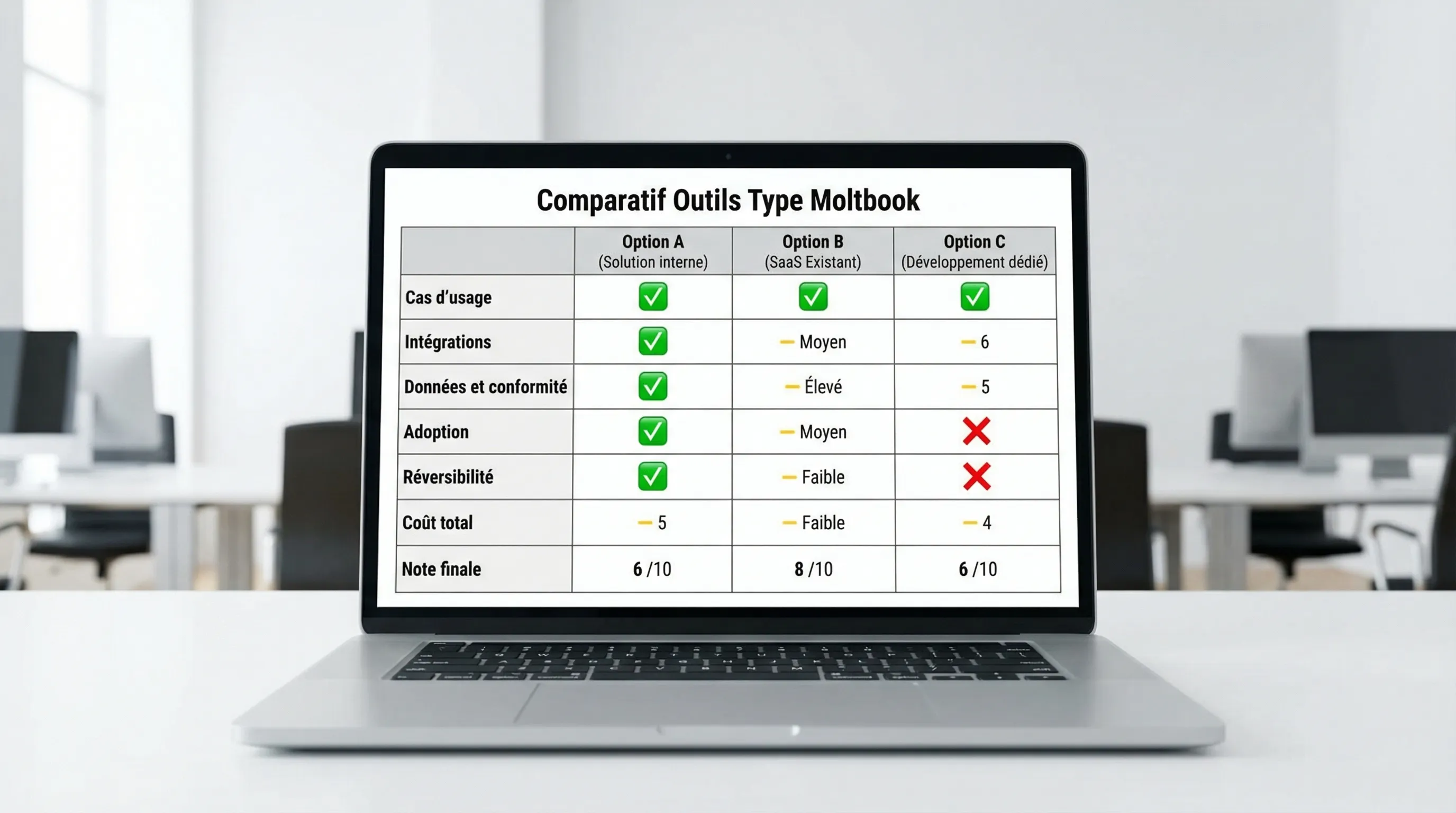
The key point: the “best alternatives” are not universal. They only become better than Moltbook if they align with your use case and your constraints.
When Moltbook is often a bad idea (warning signals)
You can save time by spotting these signals, regardless of the tool:
You need actionable workflows across multiple tools (CRM, billing, support) and the tool remains too “documentary”.
Your organization requires SSO, audit, strict governance, and these options are over budget.
You cannot clarify the source of truth, so you are going to create a duplicate.
The tool is adopted by one team, but rejected by another, which breaks standardization.
In these cases, a more adapted alternative may suffice. Sometimes, you mostly need to assemble (integrate several bricks) or develop a more specific platform.
If no alternative fits: the “custom” option (often more rational than it looks)
When the problem is integration, traceability, or compliance, the “price” of a SaaS is no longer the right indicator. The real cost is that of operational friction.
This is typically where support like that of Impulse Lab becomes relevant: starting from an opportunity audit (processes, data, risks, stack), then delivering an integrated and measured V1 (automation, connectors, web platform, or AI depending on the need).
To properly frame a tool vs. custom choice, you can also rely on our resources:
Is Moltbook suitable for a growing SMB? Yes, if your needs are clear (source of truth, governance, minimal integrations) and if you pilot adoption with a short field test. Otherwise, you risk just adding another tool.
Where can I find Moltbook's price in 2026? The only reliable place is the official Moltbook pricing page (and, depending on the case, a quote). Then, calculate the total cost (migration, integrations, options, run).
What are the best alternatives to Moltbook? This depends on your scenario: Notion/Coda (versatile), Confluence/Slite (wiki), Airtable (structured ops), ClickUp (execution), Obsidian (notes/knowledge).
How to evaluate Moltbook without wasting weeks? Run a 2-week pilot on 3 real workflows, with a proof grid (adoption, integrations, rights, export, TCO). Public reviews come second.
When should a custom solution be considered rather than a tool like Moltbook? When value depends primarily on integration with the IS, traceability, rights, or strong compliance requirements, and market tools force you to bypass your processes.
Need a “field” opinion on Moltbook, based on your workflows and constraints?
If you are hesitating between Moltbook and an alternative, the fastest way to decide is to transform the question into a reproducible test: 5 scenarios, simple KPIs, a security check, and a TCO calculation over 12 months.
Impulse Lab can help you frame this test, audit automation opportunities, and, if needed, deliver an integrated solution (web and AI) with weekly iterations. Discover the agency at impulselab.ai or contact us for a quick scoping.
AI Services: Audit, Integration, or Custom Development?
Choosing an **AI service** isn't about buying the latest tech. For an SME, scale-up, or growing business, the right choice hinges on three questions: is your problem well-defined, can your current tools connect, and does the expected ROI justify custom work?