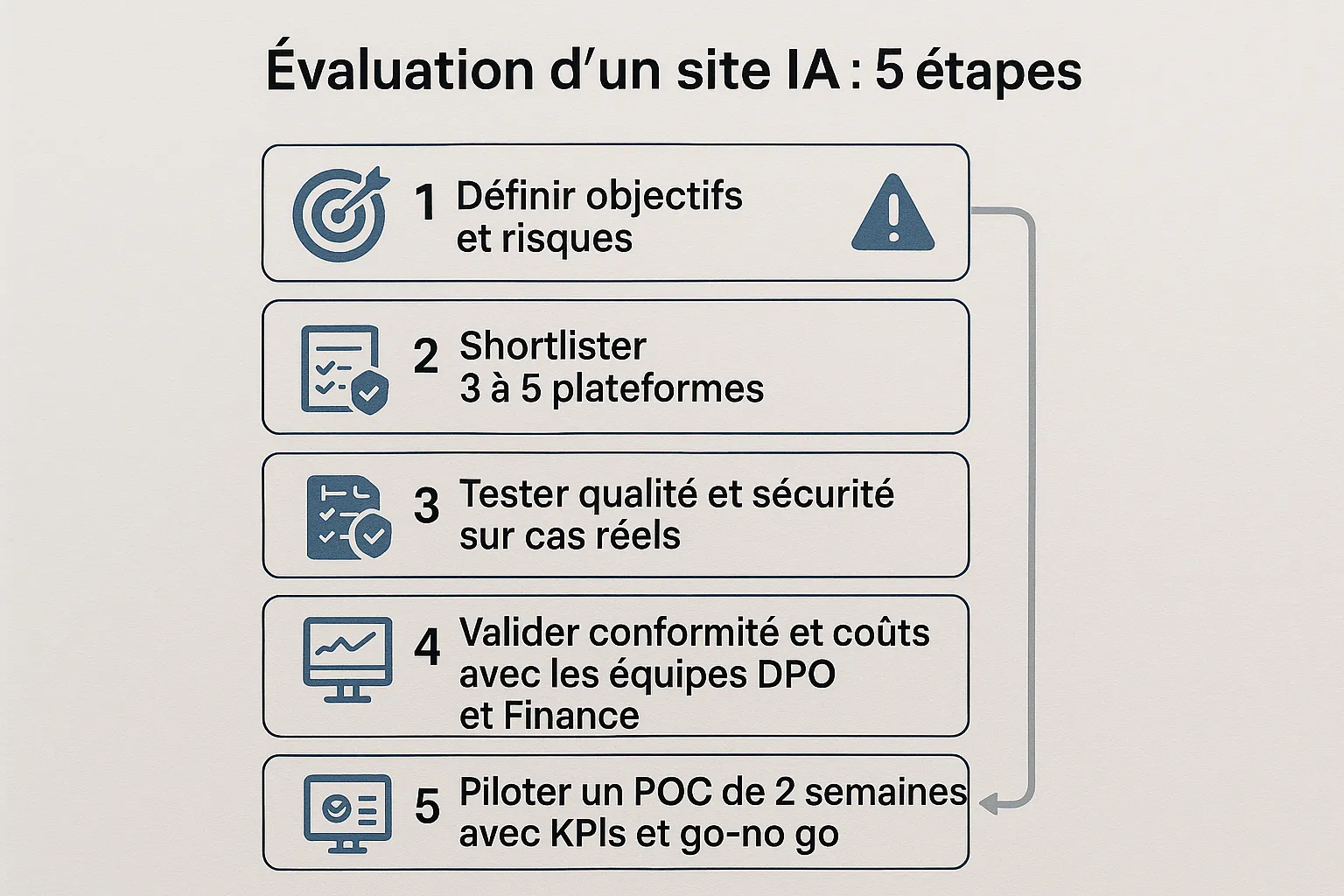
AI sites are multiplying, promising spectacular productivity gains. Amidst hallucinations, data leaks, and uncertain compliance, distinguishing a reliable platform from a fad is a strategic issue. Here is a practical, actionable guide to evaluating the quality of an AI site before enterprise adoption.
December 13, 2025·6 min read
AI sites are multiplying, all promising spectacular productivity gains. Between hallucinations, data leaks, and uncertain compliance, distinguishing a reliable platform from a mere fad has become a strategic issue. Here is a practical, actionable guide to evaluating the quality of an AI site before adopting it in an enterprise setting.
What "Reliable" Means for an AI Site
A reliable AI site isn't limited to producing plausible answers. It must combine, in a measurable way, several key dimensions.
Accuracy and consistency of results on your use cases
Robustness against ambiguous or malicious inputs
Security, confidentiality, and GDPR compliance
Governance, traceability, and auditability of actions
Performance, availability, and cost predictability
Product maturity, support, and vendor viability
360 Evaluation Grid, with Proofs to Request
Criteria
Why it's key
How to verify
Proofs to request
Output Quality
Reduce errors and rework
Test on 20 to 50 realistic cases, measure accuracy and hallucination rate
Internal eval sets, annotated examples
Robustness
Resilience in real conditions
Adversarial prompts, noisy inputs, mixed languages
Red teaming policy, active guardrails
Security
Protect data and brand image
SSO, RBAC, encryption, logging
SOC 2 Type II or ISO 27001, security policy
Confidentiality
Avoid training on your data
Non-retention settings, data region
DPA, GDPR clauses, retention duration
Compliance
Anticipate EU obligations
Transparency, risk management
References to the European AI Act
Traceability
Investigate and fix fast
Audit logs, model versioning
Exportable logs, release notes
Performance
Fluid and stable experience
p95 latency, error rate, quotas
EEAT Tip: ask for annotated examples and evaluation protocols. A vendor that measures, publishes, and accepts comparison is generally more reliable.
A 60-Minute Trial Protocol
Define 3 critical scenarios, then simple acceptance criteria, e.g., minimum accuracy of 85 percent and zero PII in logs.
Prepare 30 test inputs, including 5 adversarial prompts. Use synthetic data to avoid any leaks.
Run the tests; for each output, measure accuracy, completeness, source citation, and time the latency.
Check guardrails, out-of-policy prompts, injection, personal data requests.
Export logs, audit for PII presence, model versioning, and metadata.
Calculate a simple quality x robustness x security score, then compare to your adoption threshold.
Security and Compliance: The Non-Negotiables
Data and training: demand non-retention by default for content sent to the model, unless you voluntarily activate a learning mode on your data.
Localization and processors: identify processing regions and critical sub-processors, check transfer clauses outside the EU.
Access and control: SAML SSO or OAuth, granular roles, exportable audit logs, key rotation.
European AI Act: adopted in 2024, introduces progressive obligations based on risk level. Even for low-risk productivity usage, anticipate transparency, risk management, and documentation requirements.
Quick checkpoint: does the vendor have an up-to-date Trust Center, a public incident status, a downloadable DPA, and a security contact with a responsible disclosure policy?
Governance and Traceability Applied to AI
Pin the model version: replay your tests after every release and keep release notes.
Log all sensitive actions: prompts, outputs, files, parameters, and identities.
Human-in-the-loop where errors are costly: double validation for external publications and auto-sending of PII.
Content provenance: prefer signed or declared outputs, e.g., C2PA type standards where relevant.
Integrations and Onboarding: Signals of Reliability
A useful AI site fits into your work tools. Check the quality of connectors, permission management by resource, and the ease of client account onboarding. Controlled onboarding reduces errors and support needs. As an illustration, dedicated solutions like Client Onboarding Software for agencies show how to centralize multi-platform connections in a single journey, with branding and access controls, limiting friction and risks.
Public Clues to Scrutinize
Clear and up-to-date documentation, maintained examples and SDKs
Public roadmap or changelog with a consistent release rhythm
Dedicated security page, GDPR policies, DPA, published certificates
Status page with incidents and SLA, active community and customer feedback
Minimal Ready-to-Use Scorecard
Dimension
Weight
Recommended Threshold
Practical Measure
Quality on real cases
30
≥ 85 percent
Average accuracy
Robustness and guardrails
20
0 critical incidents
Adversarial failure rate
Security and compliance
25
GDPR compliant, complete logs
Security checklist
Performance and costs
15
p95 ≤ 2 s, active budgets
Latency and alerts
Support and viability
10
SLA and monthly releases
SLA and changelog
Scoring: multiply each grade by its weight then divide by 100. Set a global adoption threshold, e.g., 80.
Common Mistakes to Avoid
Relying on a marketing demo rather than your real cases.
Forgetting non-retention and training on your data by default.
Underestimating variable costs and quota limits.
Ignoring governance and auditing; impossible to explain an incident afterwards.
Confusing GDPR compliance and AI Act compliance; they are complementary frameworks.
Build vs. Buy, and When to Go Custom
If no solution satisfies your key criteria, or if your workflows are very specific, custom-made may be necessary. An AI platform built around your processes gives better control over data, costs, and governance, with integrations tailored to your tools.
Concrete impulse: at Impulse Lab, we conduct AI opportunity audits, design custom web and AI platforms, automate processes, and integrate your existing tools. Our team delivers useful increments every week, follows you via a dedicated client portal, and trains you for smooth adoption.
FAQ
Does a good score on public benchmarks guarantee reliability in production? No, always evaluate on your use cases with data close to reality and adversarial tests.
How to measure hallucination risk quickly? Create a set of 20 factual questions for which you know the answers, evaluate accuracy, justification, and source citation, and note serious errors.
Is GDPR enough to adopt an AI site in Europe? GDPR covers data protection. The AI Act introduces specific requirements for AI, such as risk management, transparency, and technical documentation.
Should I prioritize open source or proprietary models? Both approaches are valid. Open source can offer more control and sovereignty; proprietary can bring superior performance and dedicated support. Evaluate based on your priorities.
Should I always disable training on my data? By default, yes, especially during the evaluation phase. You can activate learning on approved sets once governance is in place.
Ready to evaluate your AI sites methodically, or launch a scoped POC? Ask for an AI opportunity audit and a concrete adoption plan with Impulse Lab. Contact us here; we deliver measurable progress every week and manage end-to-end integration. Talk to Impulse Lab.