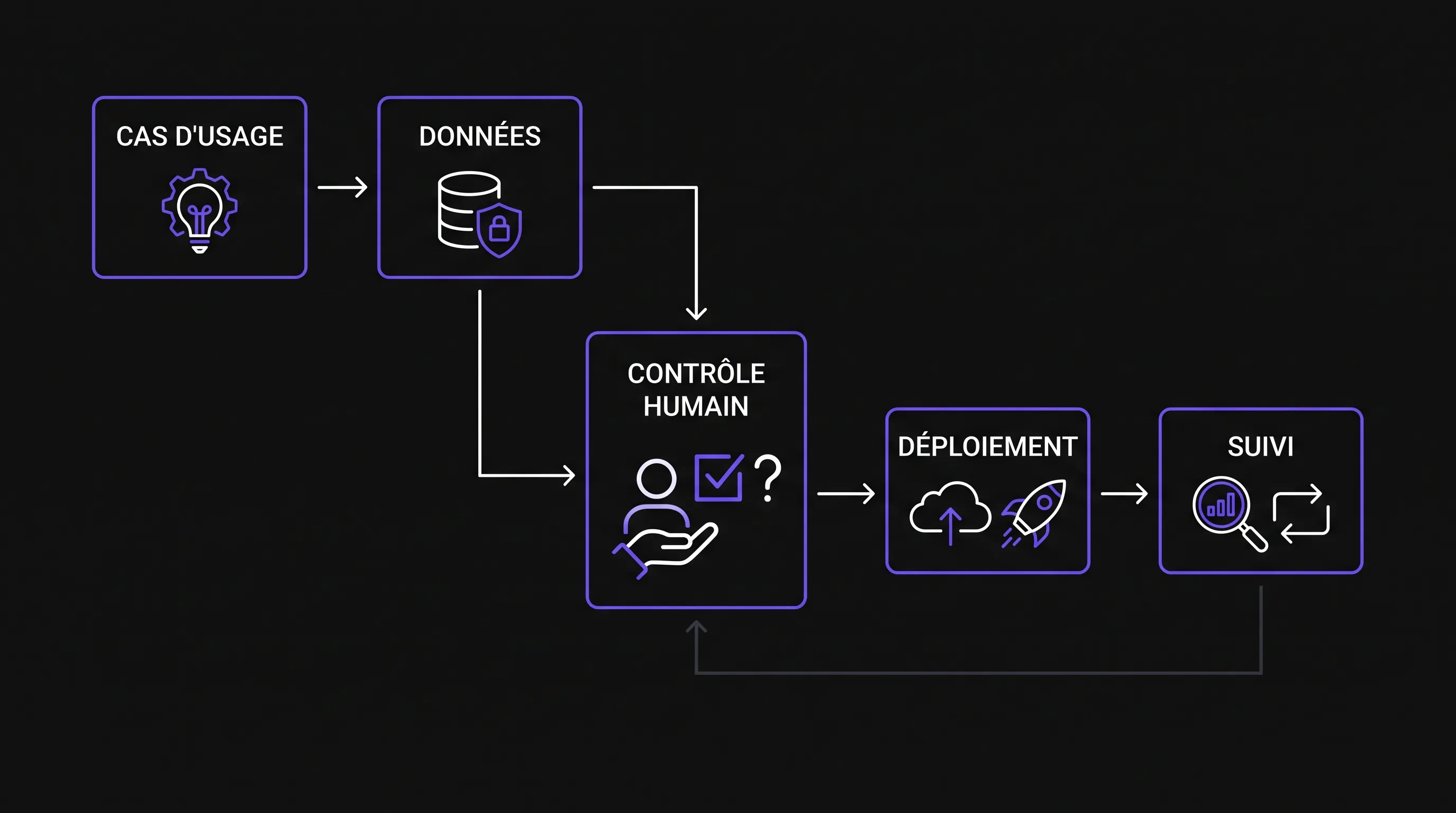
Responsible AI is not a luxury reserved for large enterprises. For an SME, it is a practical way to use AI without losing control over data, decisions, or costs. In 2026, leaders must balance risk management, team guidelines, and measurable business value.
Responsible artificial intelligence is not a luxury reserved for large corporations. For an SME, it is a practical way to leverage AI without losing control over data, decisions, costs, or customer relationships. In 2026, business leaders no longer simply ask whether AI can automate a task. They need to know who is using it, with what data, within what framework, with what risks, and for what measurable value. This approach avoids two common pitfalls: blocking all usage out of fear of making mistakes, or letting teams multiply tools without common rules.
The right framework does not need to be cumbersome. An SME can move fast if it categorizes its use cases, protects sensitive data, defines clear responsibilities, and trains teams on good practices. This guide offers an operational methodology designed for business leaders, department heads, and teams looking to move from scattered experimentation to reliable adoption.
Why Responsible AI Is Becoming an Executive Priority
AI has become easy to test, but harder to control. An employee can summarize a contract, draft a customer response, analyze a file, or write a script in minutes. The time savings are real, but so is the risk if personal, confidential, or strategic data is pasted into unvetted tools.
The regulatory landscape reinforces this requirement. The European Artificial Intelligence Act (AI Act) came into force in 2024 with phased obligations. In 2026, European companies must already take transparency, risk management, and user training seriously. The European AI Act framework specifically distinguishes prohibited practices, high-risk systems, transparency obligations, and general-purpose AI models.
In this context, responsible artificial intelligence serves as a management methodology. It is not about slowing down innovation, but about avoiding improvised decisions that build up technical, legal, or organizational debt.
Defining Risk Levels Before Buying or Building
The first mistake is treating all AI use cases equally. Generating an idea for a LinkedIn post does not involve the same stakes as automating candidate pre-screening, producing a credit recommendation, or analyzing healthcare data. An SME saves time by adopting a simple risk grid before selecting a tool or launching development.
A responsible AI initiative begins with a very practical question: what happens if the tool is wrong? If the error is easy to catch, reversible, and has no significant impact, the framework can remain light. If the error affects an individual, a fundamental right, a critical business decision, or confidential data, controls must be strengthened.
Legal review, data audit, explainable criteria, formal human validation
Critical
Automated decision with significant effect on an individual
Legal expertise, impact assessment, full documentation, enhanced oversight
This classification is not a theoretical exercise. It helps decide which projects can launch quickly, which require a prior audit, and which should not be initiated without external expertise.
Principles to Apply Within an SME
An effective framework rests on a few principles that everyone understands. It must be clear enough to guide teams, concise enough to be read, and practical enough to be applied across day-to-day tools.
The starting point is data. The CNIL's AI resources highlight the importance of GDPR fundamentals: clear purpose, data minimization, informing data subjects, security, and controlled retention periods. Even when an SME uses a third-party tool, it remains responsible for whatever data it inputs.
Principle
What It Means in Practice
Warning Sign
Clear Purpose
The use case addresses a specific business objective
The team tests the tool without a defined problem
Data Minimization
Only necessary information is sent
Entire files are copied out of convenience
Human Oversight
A human validates important outputs
AI triggers an action without review
Transparency
Users know when AI is involved
Customers or employees believe they are interacting solely with a human
Traceability
Key decisions and versions are documented
No one knows which tool generated which result
Security
Access, exports, and integrations are controlled
Personal accounts are used to process company data
These principles become valuable when integrated into existing business routines: project reviews, new tool validations, employee onboarding, sales procedures, or quality control.
Setting Up Lightweight Governance Without Bureaucracy
An SME does not need a twenty-person AI committee. It needs an owner for each use case, a technical or data lead, a business owner capable of validating outputs, and a checkpoint for legal or security issues. Responsible AI governance must streamline decisions without hindering execution.
The simplest approach is to establish an AI registry. This registry can start in a spreadsheet. It catalogs the tool, use case, data involved, risk level, owner, validations performed, and review frequency. It is often the most cost-effective document you can create, as it brings "shadow AI" into the light—the unapproved uses that emerge when teams move faster than the organization.
Role
Main Responsibility
Example Decision
Leader or Sponsor
Set risk appetite and priorities
Authorize or reject a sensitive use case
Business Owner
Define requirements and validate output quality
Approve an assistant for customer support
Technical Lead
Check integrations, security, and feasibility
Decide between SaaS, automation, or custom development
Data or Compliance Lead
Audit GDPR, sensitive data, and documentation
Require a Data Protection Impact Assessment (DPIA) for HR use
The most effective rules are often the simplest. An SME can prohibit sending sensitive data to unapproved tools, establish a whitelist of authorized software, create validated prompt templates, and mandate human review for external content or high-impact decisions.
To embed responsible AI into daily work, treat prompts as operational instructions. A good prompt defines the assigned role, context, authorized sources, output format, and boundaries. It also specifies what the tool must not do: fabricate information, make a final decision, use non-provided data, or conceal uncertainty.
Human validation cannot be vague. Merely telling a team to check the output is insufficient. You must define what is being verified: factual accuracy, business relevance, brand tone, legal compliance, absence of confidential data, or absence of obvious bias. For critical use cases, maintain an audit trail of validation.
Prioritizing the Right Use Cases
Responsible AI is not just cautious AI. It is also useful AI. If your SME spends time governing a use case that creates virtually no value, the project will falter. The best candidates combine a clear operational pain point, sufficient volume, accessible data, and manageable risk.
Before deploying, ask each team to describe their problem in plain language: which task takes too long, which error occurs frequently, which data is hard to exploit, or which decision lacks reliable information. Then, evaluate use cases across three criteria: expected value, feasibility, and risk level.
To avoid spreading efforts too thin, start with a maximum of three use cases. You can rely on a dedicated framework to prioritize profitable AI use cases, applying the responsible framework only to selected projects. This discipline prevents governance from turning into bureaucracy for ideas that will never see production.
A 30-Day Action Plan to Get Started
Transitioning to responsible AI can be accomplished in a month if the goal is to establish a solid baseline rather than an overcomplicated system. The objective is to produce a few clear rules, an AI registry, and a first measurable pilot.
Week 1: Map existing usage. Ask teams what tools they use, for what tasks, with what data, and with what results. Do not start with penalties. If you want honest answers, the goal must be empowerment and control, not surveillance.
Week 2: Classify risks and define approved tools. Identify data prohibited from public tools, use cases requiring validation, and projects requiring legal or technical review. This is also the right time to establish team usage rules, especially if individuals have already formed their own habits.
Week 3: Launch a targeted pilot. Select a use case with clear value—such as meeting summaries, support ticket assistance, or data extraction from recurring documents. Define a simple KPI: time saved, error rate, turnaround time, internal satisfaction, or perceived quality.
Week 4: Document and decide. If the pilot succeeds, formalize guidelines, prompts, validation processes, and boundaries. If it does not, document why: insufficient data, excessive costs, poor integration, excessive risk, or low adoption. A well-documented failure paves the way for future success.
Common Mistakes to Avoid
The first mistake is confusing a tool with a strategy. Purchasing a license does not build AI capability. Without a defined use case, clean data, and a business owner, the tool will remain an expensive novelty or an unmonitored risk.
The second mistake is over-legalizing every topic. Risks must be taken seriously, but a three-page policy that no one reads provides no real protection compared to a practical framework integrated into daily workflows. The key is to match the level of control to the level of risk.
The third mistake is neglecting training. The AI Act emphasizes AI literacy for anyone deploying or overseeing AI systems. Beyond compliance, training teams mitigates poor practices: pasting sensitive data, blindly accepting unsourced outputs, automating decisions prematurely, or ignoring model limitations.
Finally, do not merely measure adoption—measure business outcomes. If an assistant is used daily but increases manual corrections, it is not delivering value. If an automation cuts processing time but produces costly errors, it must be re-evaluated.
FAQ
Is an SME truly affected by the AI Act? Yes, as soon as it develops, integrates, or deploys AI systems in a professional context. The level of obligation depends on the company's role, the type of use case, and the associated risk level.
What is the difference between ethical AI and responsible AI? Ethical AI often refers to overarching values and principles. Responsible AI incorporates operational mechanisms: roles, controls, documentation, training, security, and measurable outcomes.
Do you need to appoint an AI lead in a small company? Yes, but this role can be held by an existing team member. The goal is having a clear point of decision-making, not necessarily creating a brand-new position.
Can you use ChatGPT or another public tool with client data? Not without a clear framework. You must verify the tool's terms of service, privacy configurations, data sensitivity, user consent, and applicable GDPR requirements.
What is the first document you should create? An AI registry is typically the best starting point. It provides visibility into the tools in use, data processed, risks, owners, and validations.
Building a Useful AI Framework, Not Just a Compliant One
Responsible AI becomes a competitive advantage when it enables an organization to move faster with greater confidence. For an SME, the goal is not to enforce enterprise-scale bureaucracy, but to build a proportionate framework: well-chosen use cases, protected data, explainable decisions, and well-trained teams.
If you want to audit your AI opportunities, automate processes, or develop a custom solution without taking on unnecessary risk, Impulse Lab can help you scope the right use cases, structure adoption, and turn AI into operational value.