AI Copilot or AI Agent: Which Format for Which Process?
Intelligence artificielle
Stratégie IA
Productivité
Automatisation
Should you equip teams with an AI copilot or deploy an autonomous AI agent? Discover the operational differences, decision criteria, and real-world use cases to choose the right AI format for your business processes.
September 27, 2026·11 min read
The question of "AI copilot or AI agent" quickly arises as soon as an SME or scale-up begins to scale its artificial intelligence use cases. Should you equip teams with an assistant that speeds up their work, or delegate an entire slice of a process to a system capable of acting autonomously? The answer depends less on the model's technical prowess than on the risk, volume, data maturity, and degree of responsibility you are willing to transfer.
The trap lies in wanting an autonomous agent everywhere simply because the term sounds more advanced. In many processes, an AI copilot creates more value, faster, and with less friction. In other cases, keeping a human in the middle becomes a bottleneck, and a well-scoped AI agent makes it possible to scale without piling up manual tasks.
AI Copilot vs. AI Agent: The Real Operational Difference
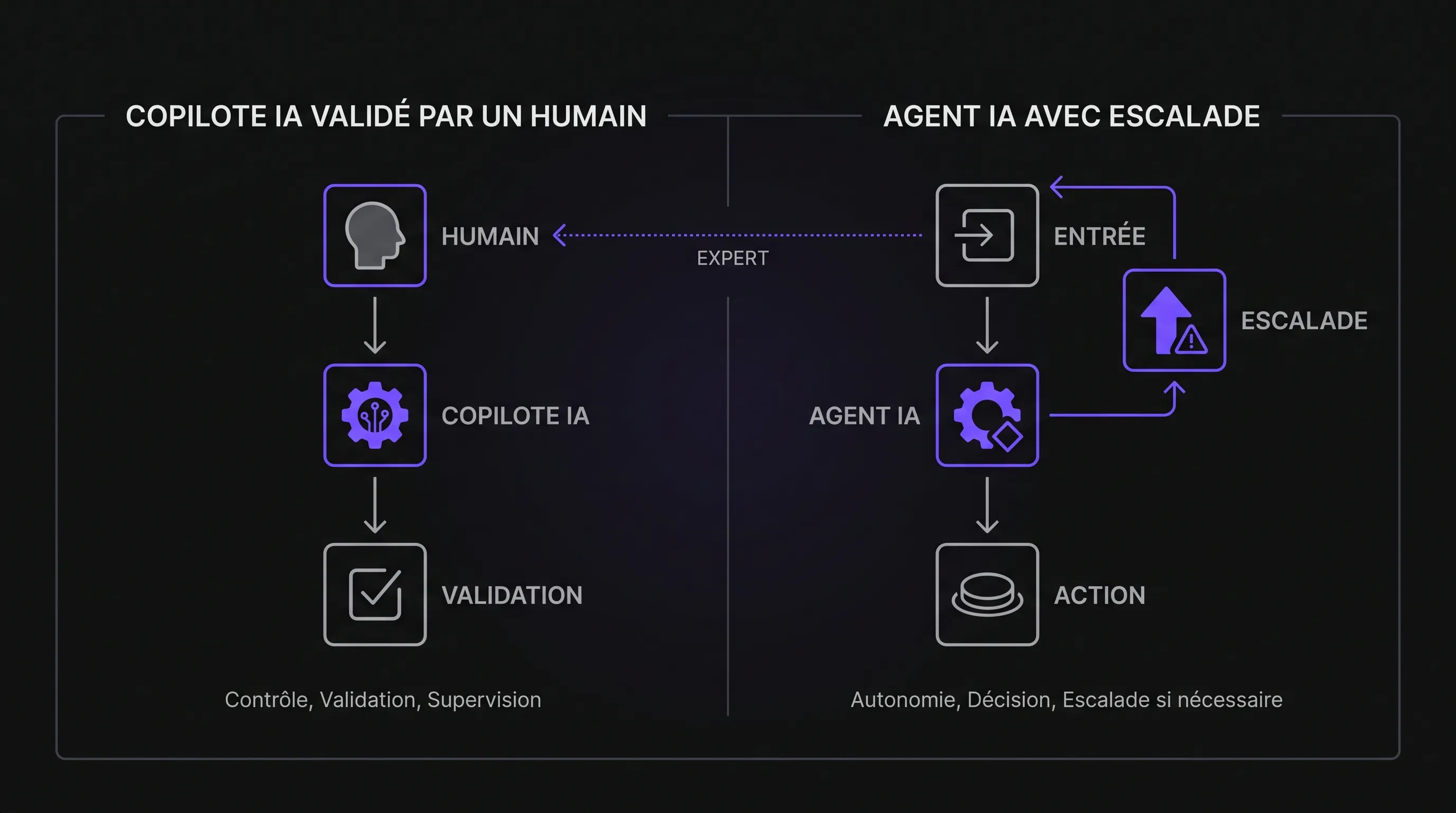
An AI copilot assists an employee at their workstation. It suggests, summarizes, drafts, analyzes, or recommends, but the human retains final decision-making authority. This is the right format when business judgment, client relationships, or contextual interpretation remain critical.
An AI agent takes ownership of a mission defined by a goal, tools, and action rules. It can execute multiple steps sequentially, query data, call an API, update a business tool, or escalate an edge case. To establish the basics, the definition of an AI agent helps distinguish a simple chatbot from a system capable of observing, deciding, and acting within a given scope.
The AI Copilot Augments Human Capacity
A copilot is most relevant when a process involves substantial nuance. It assists a sales rep in preparing for a meeting, a support manager in crafting a response, an executive in synthesizing a report, or a product team in turning user feedback into actionable improvements.
Its value typically stems from three effects: reducing preparation time, improving deliverable quality, and standardizing best practices. The copilot does not eliminate the business role; it makes it more effective. It is also an excellent entry point for adoption because teams retain control and immediately see the productivity gain.
The AI Agent Automates Bounded Responsibilities
An AI agent becomes valuable when a process is repetitive, sufficiently structured, and connected to existing tools. It does not merely generate an answer—it executes a sequence. For example, qualifying an inbound inquiry, retrieving information from the CRM, creating a task, sending a notification, and logging the outcome.
The critical boundary is delegation. If the system can act without human validation at every step, you must establish permissions, thresholds, logs, and escalation mechanisms. NIST, in its AI Risk Management Framework, emphasizes the need to map, measure, govern, and manage risks in AI systems. This principle applies directly to production AI agents.
Criteria for Choosing the Right Format
The right trade-off cannot be made based on an impressive demo. It must stem from the actual process: frequency, exceptions, data quality, error criticality, and available integration levels. A single business function might require a copilot for certain tasks and an AI agent for others.
Decision Criterion
Leaning Toward AI Copilot
Leaning Toward AI Agent
Error criticality
Sensitive decision, customer impact, or legal risk
Connectable CRM, ERP, helpdesk, or internal databases
Internal adoption
Need to reassure and upskill teams
Team already prepared to delegate part of execution
A practical litmus test is to look at what a junior team member would do with clear operating procedures. If they can execute the task with minimal ambiguity, an AI agent can be considered. If the task requires reading between the lines, negotiating, or arbitrating between competing priorities, a copilot is usually far more robust.
Which Format for Sales and Marketing Processes?
Sales processes blend human relationships, CRM data, and repetitive tasks. An AI copilot is generally the best initial choice for meeting prep, drafting personalized emails, summarizing meeting notes, or analyzing account history.
An AI agent becomes useful for low-ambiguity actions: enriching prospect records, detecting duplicates, creating follow-up tasks, or routing leads to the right team. In such cases, rules regarding consent, outreach frequency, and alignment with sales strategy must be put in place.
For marketing, a copilot is well suited for ideation, copywriting variations, and creative briefs. An AI agent can oversee competitive intelligence, categorize weak signals, or assemble recurring reports—provided it does not publish external content autonomously without human sign-off.
Customer Support: Copilot for Quality, Agent for Tier 1
Customer support is one of the areas where the copilot and AI agent pairing works best. A copilot helps support agents respond faster, look up internal policies, summarize lengthy tickets, or suggest clearer phrasing.
An AI agent can handle Tier-1 requests whenever the intent is clearly identified: order status, address changes, ticket creation, document requests, or automated categorization. It must promptly escalate emotional, complex, or high-value commercial cases.
The right metric is not just the automation rate. Customer satisfaction (CSAT), reopen rates, resolution times, and the volume of relevant escalations must also be tracked. An agent that swiftly closes the wrong tickets creates no value; it merely shifts the problem elsewhere.
Finance, Operations, and Back-Office: The AI Agent Under Control
Back-office workflows are prime candidates for business process automation because they are regular, documented, and tied to internal systems. Invoice reconciliation, data extraction, document classification, administrative reminders, and completeness checks can all be entrusted to a supervised AI agent.
The degree of autonomy depends on the impact of the action. Preparing an accounting reconciliation can be automated. Initiating a payment requires human approval—at least until confidence thresholds, controls, and audit logs are fully battle-tested.
A copilot remains valuable for managerial analysis: explaining margin variances, annotating dashboards, drafting briefing notes, or assisting a manager in synthesizing multiple data sources. Whenever a decision commits the company, AI should illuminate rather than decide alone.
HR, Legal, and Quality: Keeping Humans Where They Matter
In human resources, an AI copilot is ideal for job descriptions, interview summaries, onboarding roadmaps, or fielding internal inquiries. It helps formalize, align, and save time, but it should never substitute for human judgment on sensitive decisions.
An AI agent can trigger administrative milestones: generating an onboarding checklist, provisioning equipment, dispatching training reminders, or verifying file completeness. Hiring, performance appraisal, and disciplinary decisions remain processes where human sign-off is mandatory.
For legal and quality departments, a copilot is the natural format for analyzing clauses, preparing document reviews, or referencing procedures. An AI agent can manage deadline tracking, evidence gathering, or opening non-compliance tickets, provided its role remains strictly within defined guardrails.
Product, IT, and Web Development: From Copilot to Automated Workflows
Within product and engineering teams, an AI copilot accelerates specification writing, ticket analysis, test generation, log reviews, and technical documentation. For teams structuring custom web development or bespoke AI platforms, this is often the most effective launchpad.
The AI agent can then automate more technical workflows: creating a ticket from an incident, running a test suite, validating a deployment checklist, or updating a knowledge base. Irreversible actions, such as critical production releases, demand strict guardrails and unambiguous approval.
Decision Matrix by Process Type
This matrix serves as an initial framework. It does not replace an AI audit, but it helps prioritize use cases without getting swayed purely by trends.
Process
Recommended Format
Rationale
Primary Guardrail
Sales meeting prep
AI Copilot
Client context and human relationship are critical
Validation by the sales rep
CRM record updates
AI Agent
Repetitive, verifiable task
Audit log of modifications
Complex support inquiry
AI Copilot
Nuance, emotion, exceptions
Support rep owns the response
Simple support ticket
AI Agent
Clear intent and stable rules
Automatic escalation upon doubt
PO-to-invoice matching
Supervised AI Agent
Structured data and high volume
Confidence threshold & human spot-checks
Monthly performance analysis
AI Copilot
Business interpretation required
Managerial review
Administrative onboarding
AI Agent
Recurring checklist and defined steps
Restricted access rights
The best choice is not always binary. A process can start with a copilot and progressively transition to an AI agent for its most stable segments. This phased approach prevents automating an ill-defined workflow prematurely.
Combining Copilot and AI Agent Without Adding Organizational Overhead
In many organizations, the optimal model is hybrid. The copilot captures business know-how, assists teams in standardizing their criteria, and highlights repetitive friction points. The AI agent then takes over tasks where rules have become crystal clear.
Level of Autonomy
Format
Example
Ideal Timing
Assistance
Copilot
Draft a response, summarize a file
Launch and adoption phase
Recommendation
Advanced Copilot
Suggest the next best action
Partially standardized process
Validated Execution
Supervised Agent
Prepare an action, then request approval
Moderate risk
Autonomous Execution
AI Agent
Process a simple request end-to-end
Stable, controlled process
This progression directly addresses a fundamental question: what level of autonomy can you safely allow in production? To dive deeper, Impulse Lab outlines the key criteria for deciding on the right level of autonomy in production, specifically around decisions, actions, escalation, and observability.
Technical Prerequisites to Verify Before Deciding
An AI agent requires a much more structured environment than a copilot. It must access the right tools with the appropriate permissions without bypassing internal governance. If your data is fragmented, permissions are poorly defined, or APIs are absent, starting with a copilot is often far more realistic.
Before launching a project, verify five core fundamentals:
The process has a clearly identified input, output, and business owner.
Required data is accessible, reliable, and up to date.
Potential actions by the AI are bounded by explicit permissions.
Decisions and actions can be tracked in an auditable log.
A human can seamlessly take over when an edge case falls outside the scope.
The architectural choice then depends on the need: a simple API call, RAG-augmented retrieval, a tool-connected agent, or a custom AI platform. Reviewing API, RAG, and agent patterns helps structure this decision without over-engineering the solution.
Common Pitfalls When Choosing a Format
The first mistake is confusing autonomy with value. A highly autonomous AI agent deployed on a broken process only accelerates mistakes. Conversely, a well-integrated copilot embedded in a high-stakes workflow can deliver immediate, durable gains.
The second mistake is neglecting change management. Employees do not adopt a tool because it is technically advanced; they adopt it because it integrates seamlessly into their daily routine, removes real friction, and respects their operational responsibility.
The third mistake is solely tracking time saved. For a copilot, you must also measure quality, consistency, and team satisfaction. For an AI agent, track success rates, escalations, corrected errors, and overall end-to-end cycle times.
When Should You Conduct an AI Audit?
An AI audit becomes relevant as soon as you have multiple use case ideas but lack clear prioritization. It helps map processes, identify realistic ROI, separate copilot candidates from AI agent opportunities, and specify technical prerequisites.
For an SME or scale-up, this is often the fastest route to avoiding costly missteps. The audit clarifies where AI should assist, where it should automate, and where it is wiser to wait until data or tooling matures.
Impulse Lab supports this journey through AI opportunity audits, process automation, systems integration, and bespoke web and AI software engineering. The goal is never to sprinkle AI everywhere, but to turn high-impact processes into measurable business value.
FAQ
Is an AI agent inherently more advanced than an AI copilot? No. An AI agent delegates more execution, but that does not make it universally better. A copilot can generate far more value in complex, sensitive, or context-heavy processes.
When should you start with an AI copilot? Start with a copilot when business rules are not yet fully standardized, when human oversight is mandatory for final decisions, or when the primary objective is to enhance the quality and velocity of human work.
When does an AI agent become cost-effective? An AI agent becomes profitable when task volume is high, workflow steps are predictable, data is easily accessible, and errors can be detected, corrected, or escalated quickly.
Can both be used within the same process? Yes. In fact, it is common practice. A copilot can support human experts on complex cases, while an AI agent handles routine requests, updates tooling, or pre-fetches context.
Do you need to connect AI to CRM, ERP, or internal tools right away? Not always. For a copilot, lightweight integration is often enough initially. For an AI agent, robust connections, granular permissions, and logging quickly become non-negotiable.
Moving from Format Selection to Execution
If you are hesitating between an AI copilot and an AI agent, start with the process rather than the technology. Pinpoint high-volume tasks, sensitive decision gates, available data, and areas where human accountability must remain front and center.
To frame your opportunities and select the right AI format, get in touch with Impulse Lab. A structured audit will help prioritize your use cases, design the right architecture, and translate AI into tangible operational value.