Rewriting Text with AI Without Betraying Your Brand
Intelligence artificielle
Stratégie IA
Marketing
Gouvernance IA
Behind searches for 'AI text rewriting' lies a concrete need to update pages, simplify emails, or align copy. While AI speeds this up, fluent phrasing can erase your brand personality or exaggerate promises. Here is how to frame rewriting and maintain control.
October 14, 2026·9 min read
Behind searches like "AI text rewriting", there is often a concrete need: updating a sales page, simplifying an email, or harmonizing content written by multiple people. AI can speed up this work. But fluent phrasing can also erase your personality, exaggerate a promise, or make your company interchangeable with its competitors.
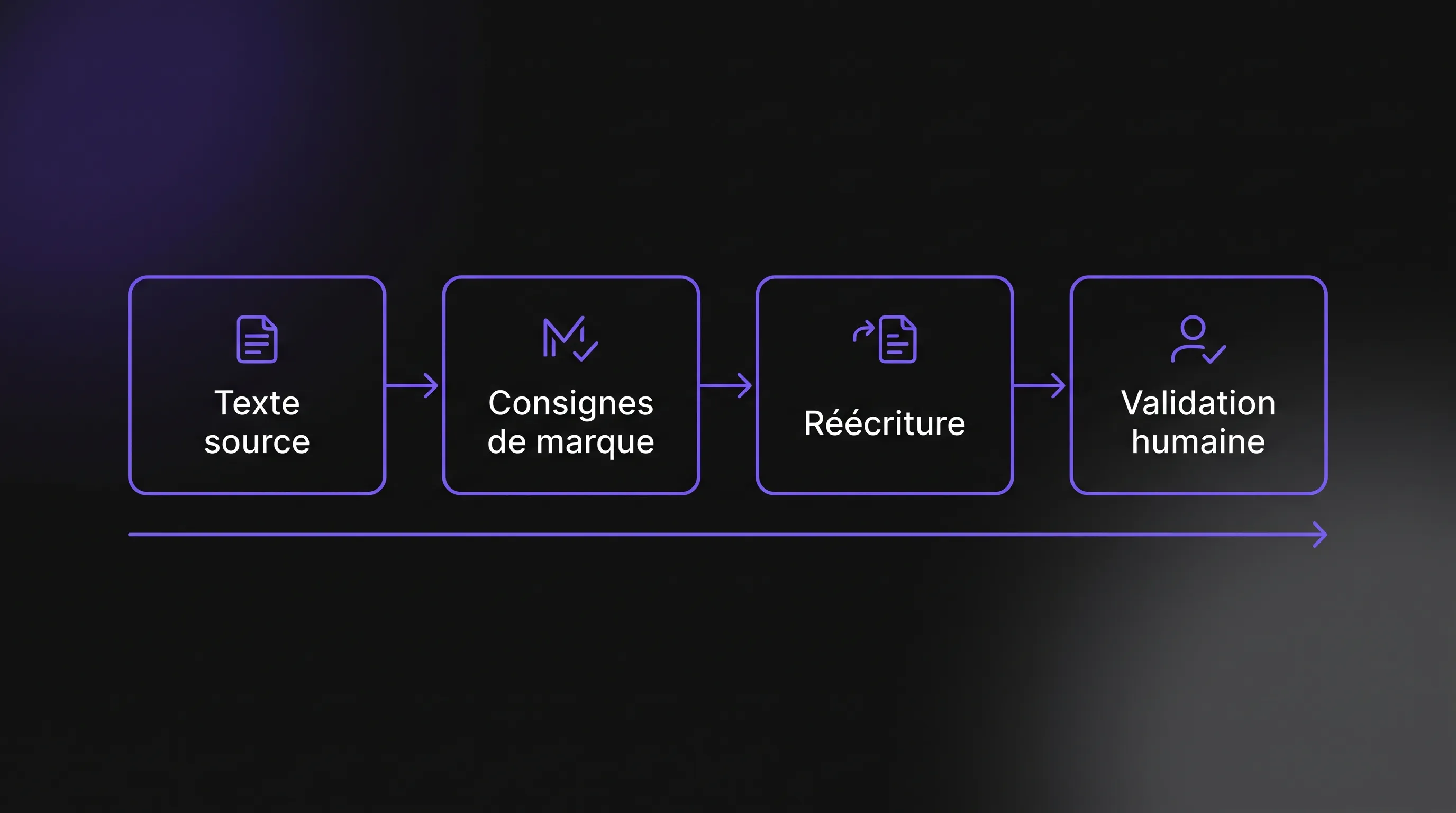
The right goal is not to make the text sound more impressive. It is to make it clearer without altering what your brand says, promises, and stands behind. Here is how to frame rewriting, provide effective guidelines, and review the output before publishing.
What Your Brand Risks Losing in a Rewrite
A brand voice isn't just about using informal or formal pronouns, a few catchphrases, or a "professional yet warm" tone. It reflects how you talk to customers: your level of proximity, your approach to proof, and the boundaries you openly acknowledge.
A company might, for example, prefer to explain its constraints rather than promise an "effortless" experience. Another might opt for straightforward wording without technical jargon. These differences must survive the rewrite.
Without specific instructions, the model can replace this distinctiveness with generic boilerplate. Here are the pitfalls to watch out for:
Dimension
Potential Drift
Guideline to Give
Promise
A goal turns into a guaranteed outcome
Preserve the original degree of certainty
Customer relationship
A sober tone becomes overly informal
Define the expected level of proximity
Vocabulary
Industry terms turn into vague buzzwords
Preserve terms necessary for comprehension
Positioning
A targeted offer appears suitable for everyone
Maintain the target audience and exclusions
This table can serve as a starting point for a concise brand guide. It doesn't replace your editorial decisions; it helps make them explicit.
"AI text rewriting": Framing the Rewrite Before Launching the Tool
The quality of a rewrite depends largely on what you permit the model to change. "Improve this text" gives the model overly broad discretion. "Simplify sentences without modifying the offer's terms" establishes a verifiable task.
Separate Substance from Form
Before submitting content, identify its untouchable elements: figures, deadlines, pricing, product names, eligibility criteria, and service limits. The model may adjust their presentation, but never their meaning.
Also specify what it can rework: sentence length, repetitions, order of explanations, or level of jargon. This separation prevents a stylistic rewrite from turning into a new value proposition.
To rewrite text with artificial intelligence, provide reference facts rather than relying on its background knowledge. A language model does not automatically verify your company's commitments. Our guide on how AI works for executives helps explain this limitation.
Describe Brand Voice with Observable Rules
Replace abstract adjectives with concrete rules. "Accessible" can mean: explain every technical term the first time it appears. "Direct" can mean: start with actionable information, omitting introductory fluff. "Humble" can mean: never add superlatives or guarantees absent from the source text.
Include two or three excerpts that your team considers representative. Choose approved texts, not just the most recent ones. Specify what they illustrate: a way of presenting limitations, sentence structure, or how you address the reader.
Examples provide direction. Rules establish boundaries.
A Reusable Prompt to Preserve Tone and Commitments
A good rewrite prompt specifies context, invariants, and output format. Adapt the template below for each channel. A support email and a sales page don't serve the same purpose, even when sharing the same brand voice.
Task: Rewrite the source text to make it clearer and easier to read. It is aimed at [audience] and will be published on [channel]. The desired reader action is [action].
Brand voice: We use [formal/informal address]. Our tone is [concrete description]. We favor [vocabulary and structural guidelines]. We avoid [forbidden expressions, stylistic quirks, and phrasing].
Non-negotiables: Preserve the exact meaning of facts, figures, deadlines, terms, caveats, and commitments. Do not add benefits, testimonials, outcomes, or guarantees. Do not invent missing information.
Permitted edits: Simplify sentences, eliminate unnecessary repetition, and reorganize explanations if it improves clarity. Retain all details essential to the reader's decision.
References: Here are two approved excerpts illustrating our voice: [excerpts and explanation of what they demonstrate].
Source text: [text to rewrite].
Expected output: Provide a rewritten version, followed by a summary of major edits. Flag any ambiguities or details requiring verification separately. If an instruction forces a change in meaning, highlight the conflict rather than resolving it by inventing details.
Artificial intelligence can generate convincing text while offering an incomplete explanation of its changes. The requested change log therefore facilitates review, but does not guarantee accuracy.
Also avoid stacking contradictory constraints: "very concise," "comprehensive," "warm," and "strictly factual" can create tension. Set clear priorities—such as prioritizing factual fidelity over brevity.
Example: An Elegant Rewrite That Alters the Promise
Consider a fictional example of a company providing B2B software. Its brand favors straightforward language and precise commitments.
Source text: "For all support requests, we reply within two business days. Complex cases require a diagnosis before we can estimate the resolution time."
Rewrite to reject: "Enjoy responsive support: our experts resolve your issues within 48 hours to guarantee uninterrupted operations."
The second version sounds punchier and more commercial. Yet it introduces several major shifts: a reply becomes a resolution, two business days become 48 hours, and a continuity guarantee appears out of nowhere. It also adds an unverified characterization of the team ("our experts").
Faithful rewrite: "Facing an issue? We reply within two business days. If the case is complex, we first perform a diagnosis to estimate the resolution time."
This version shortens sentences while preserving service boundaries. The tone is more conversational without turning overly familiar or overpromising.
In this example, the challenge of AI text rewriting is not choosing the most enticing variant. It lies in finding the one that improves readability without shifting the commitment.
The same scrutiny applies to trial terms, refund policies, and stated results. Caveats are not expendable details to cut for brevity: they are essential to meaning.
Review in Two Passes: Don't Let Fluency Fool You
Reviewing only the generated version invites oversight. Keep the source text alongside it and separate substantive checks from stylistic review.
First Pass: Check the Meaning
Compare figures, units, dates, and conditions. Examine verbs carefully: "can reduce" is not the same as "reduces," "supports" does not mean "takes care of," and "reply" is not "resolution."
Next, look for omissions. A shorter sentence may have dropped an exception, an eligible audience, or a required step. For texts binding the company, have these points validated by the subject-matter owner, not just the publisher.
Second Pass: Check the Voice
Ask yourself whether your team would actually say these sentences. Does the vocabulary match your customer conversations? Does the text acknowledge the same limitations as your other content? Does the phrasing convey a specific idea, or could it fit any competitor?
With AI, a well-written text is not necessarily the right text for your brand. Correct phrases that ring hollow rather than systematically requesting a full regeneration. Targeted edits are much easier to review and control.
Scaling from Individual Usage to a Team Framework
For a small business or scale-up, risks multiply when everyone uses their own prompts. Content may look fine in isolation, yet appear disjointed across the website, emails, and sales collateral.
Centralize a single source of truth for guidelines, approved examples, and the standard prompt. Designate an owner responsible for updating these documents based on recurring post-generation edits.
Test on a Small Batch Before Scaling Up
Select a representative set of content: a few emails, a service page, and a customer-facing document, for example. This pilot should cover diverse scenarios, not just the easiest copy.
Measure the total time to final approval, not just generation speed. Track how many versions are approved without major edits, semantic errors flagged, and recurring tonal adjustments. These metrics reveal whether the tool genuinely cuts down work or merely shifts it onto the review process.
AI text rewriting becomes far more valuable when feedback loops into your prompt guidelines. If the team consistently removes the same superlatives, add an explicit restriction. If caveats disappear, provide an example showing how to keep them.
Whenever you change models or prompts, re-run the benchmark test set. This lets you compare output quality against a consistent baseline.
Adapt the Workflow to Risk and Data Sensitivity
An internal draft and a page detailing contractual commitments require very different levels of review. Maintain strict human oversight for commercial promises, sensitive communications, and regulated content.
Before feeding text into an AI service, check the terms regarding data retention, potential model training, and access controls. Strip out any personal or confidential data not strictly needed for the task. The CNIL resources on artificial intelligence provide a useful framework for evaluating these considerations.
Integrating AI into your existing toolchain can simplify prompt sharing and approval workflows. However, it does not remove the need to clearly define who reviews the output and which types of content are permitted in the pipeline.
Frequently Asked Questions
Can you ask AI to mimic your brand voice perfectly? You can provide examples and rules to guide rewriting, but consistency is never guaranteed. It must be verified across multiple formats and scenarios. A handful of examples cannot capture every nuance of your brand's voice.
Should you always rewrite the entire text? No. If the core message and structure are sound, request targeted tweaks: simplify a single paragraph, eliminate repetition, or clarify a sentence. The more focused the modification, the easier it is to review.
Does AI text rewriting automatically improve SEO? No. Smoother phrasing does not guarantee search relevance or higher rankings. Focus on retaining valuable information, industry-specific terms, and direct answers to reader intent without keyword stuffing.
Structure Your Rewriting Before Automating It
Before rolling out a tool to your entire team, formalize your brand voice, non-negotiables, and review workflows. This gives you a clear foundation to decide what truly benefits from automation.
Impulse Lab supports companies in adopting AI through opportunity audits, training, and custom solutions. An initial consultation can help frame your editorial process and identify high-value integrations—without trading publication quality for raw production speed.