Strategic AI Audit: Mapping Risks and Opportunities
Intelligence artificielle
Stratégie IA
Confidentialité des données
Audit IA
Executives want quick AI wins but fear risks and tool fragmentation. A strategic AI audit brings order, identifying value creation and destruction, then aligns a realistic roadmap with compliance guardrails. Learn how to map risks and opportunities for measurable ROI.
décembre 28, 2025·8 min de lecture
Executives want quick wins with AI but hesitate due to risks, buzzwords, and tool fragmentation. A strategic AI audit brings order, reveals where AI creates value and where it destroys it, then aligns a realistic roadmap with compliance guardrails. Here is how to map your risks and opportunities in a few weeks to go from idea to measurable ROI.
What is a strategic AI audit, concretely
An AI audit is not a simple inventory of tools. It is a cross-functional assessment of your company that connects your processes, data, tech stack, and regulatory constraints to prioritized and measurable AI use cases. Expected result, in 2 to 4 weeks depending on size and complexity: a clear vision of what to do, in what order, with what risks, and what success indicators.
Who is this for
SMEs and scale-ups wanting quick wins but lacking clarity on priorities.
Growing teams whose processes are becoming complex and whose data is scattered.
Management subject to compliance requirements (GDPR, upcoming AI Act) wanting a solid framework before deploying AI solutions at scale.
The 5 pillars evaluated during the audit
Processes and opportunities: identification of tasks with high cognitive load or repetition, mapping of friction points and current costs.
Data and quality: source availability, governance, GDPR compliance, retention and anonymization policies.
Stack and integrations: CRM, ERP, business tools, APIs, connectors, technical debt, and maintainability.
Risks and compliance: classification according to the AI Act, bias management, security, traceability, human supervision.
Organization and adoption: skills, appetite for change, training, executive sponsorship, and continuous improvement rituals.
For technical business alignment, we gladly cross-reference RevOps scopes (Sales, Marketing, CS alignment) discussed here in the RevOps glossary and data levers like Lead Scoring modernized by AI.
Proven methodology (2 to 4 weeks)
Step
Objective
Deliverables
Typical Duration
Framing
Alignment of objectives, constraints, scope
Objectives canvas, value hypotheses, planning
0.5 days
Discovery
Targeted interviews and task observation
Process mapping, volumetrics, time spent
3 to 5 days
Data & stack
Evaluation of sources and integrations
Data map, quality diagnostic, GDPR risks
2 to 4 days
Risks
Classification and controls
Risk register, control plan, roles
1 to 2 days
Opportunity scoring
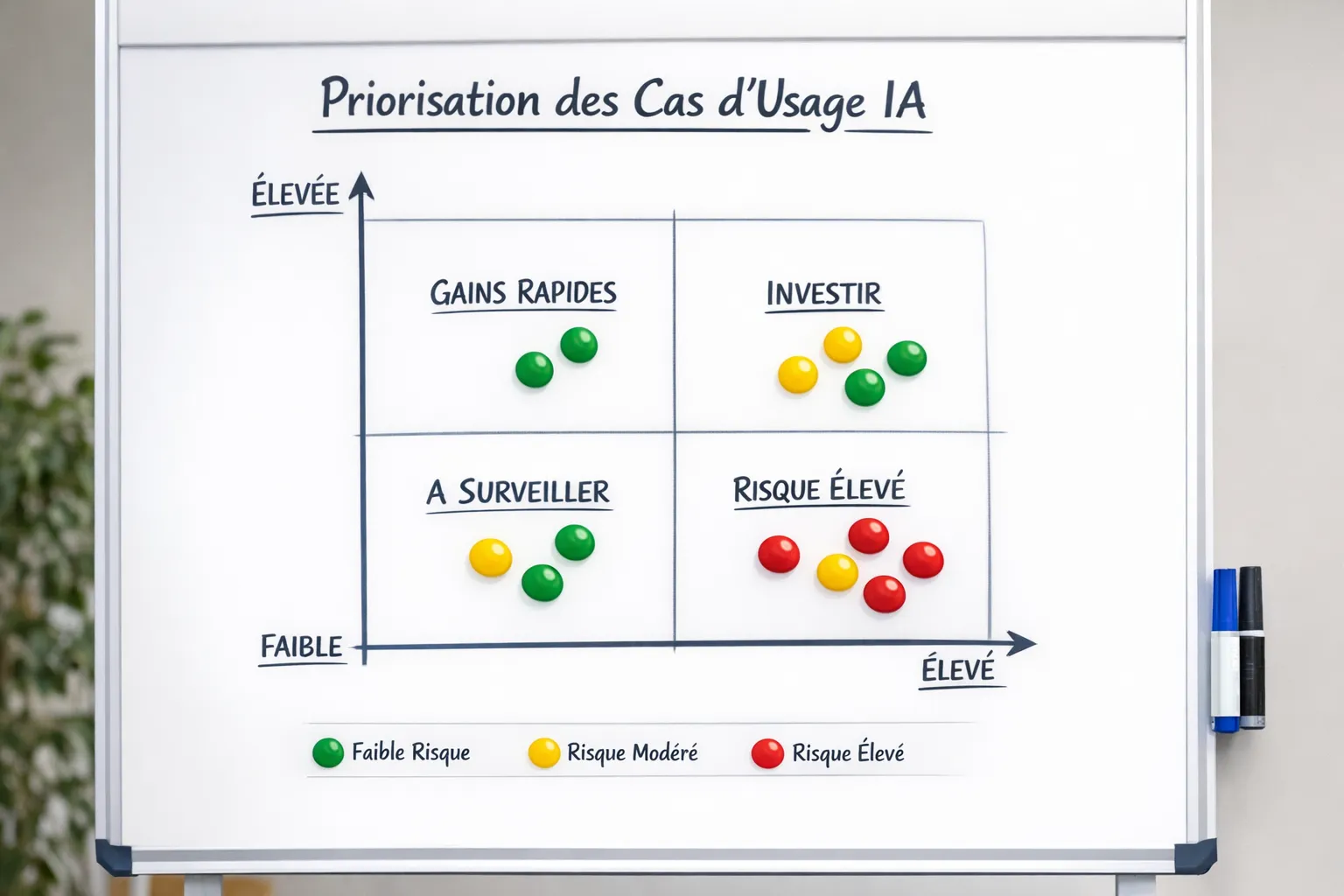
Prioritization by value/effort/risk
Heatmap, business cases, 90-day roadmap
1 to 2 days
Restitution
Executive summary and execution plan
Decision deck and operational backlog
0.5 days
At Impulse Lab, progress is paced by weekly check-ins and a dedicated client portal to centralize deliverables, comments, and decisions, which facilitates team involvement and adherence to deadlines.
Mapping risks, without dramatizing or minimizing
The goal is not to prevent action, but to act consciously. We combine three complementary frameworks for a common language between business, legal, and technical teams:
NIST AI RMF: Govern, Map, Measure, Manage functions, an excellent foundation for governance and risk assessment (NIST AI RMF).
AI Act: classification of systems as limited, specific, or high risk, graduated obligations, and expected documentation (AI Act, European Commission).
CNIL recommendations on AI and data protection, particularly useful for French SMEs (CNIL and AI).
Typical Risk
Materiality Index
Recommended Reduction Measures
Sensitive data leak via prompts or integrations
High if client or HR data
Data minimization, PII masking, environment separation, access logs
Prompt injection and secret exfiltration
Medium to High depending on case
Sanitization, output policies, scanners and tests according to OWASP Top 10 LLM
Bias and discrimination
Variable depending on use case
Test sets, human reviews, documentation of limits, decision logging
Unforeseen variable costs
Frequent in pilot phase
Budget caps, consumption monitoring, caching and reuse strategies
GDPR and AI Act compliance
High if profiling or automated decision
Processing register, DPIA if necessary, clear information, human-in-the-loop
This grid is adapted to your context and integrated into an auditable risk register with owners, controls, deadlines, and tracking indicators.
Uncovering real opportunities, not gadgets
We target use cases where value is measurable and complexity is reasonable. Some frequent examples in SMEs and scale-ups:
Without metrics, no ROI. The audit proposes a KPI framework per use case, a baseline, and a target objective. Useful references: our framework on AI KPIs and, for customer support, chatbot KPIs.
Example of a mini business case, support assistant:
Hypotheses: 1,800 monthly tickets, human cost per ticket €5.50, average time 9 minutes.
Target: 35 percent of tickets handled automatically with 90 percent satisfaction.
Estimated gross gain: 1,800 x 35 percent x €5.50, i.e., approximately €3,465 per month.
Costs: licenses and integration €1,200 per month (order of magnitude), initial training 2 days.
Simple ROI: approximately 2.9 times over 12 months, excluding ancillary benefits (SLA, NPS, team reallocation).
The same approach applies to sales cases, for example lead qualification where impact includes pipeline velocity and conversion rate, or financial operations (reduction of errors and closing times).
Tangible deliverables at the end of the audit
Executive summary with trade-offs and major risks.
Process mapping and opportunity heatmap by value, effort, and risk.
Risk register and control plan, adapted to AI Act and GDPR requirements.
Prioritized 90-day backlog, plus a 12-month trajectory with decision milestones.
KPI tracking templates and steering dashboard.
Architecture and tooling recommendations, make or buy scenarios.
Adoption plan, roles, rituals, and training needs.
Preparing your audit, the client-side checklist
Read access to key tools (CRM, ticketing, document drive, ERP), or anonymized exports.
Recent activity data, volumetrics, and time spent per task.
Existing documentation (processes, security policies, GDPR register if present).
Key contacts by domain (support, sales, finance, HR, IT) and availability for 30-minute interviews.
Main legal or contractual constraints with your own clients.
Governance and compliance, the essentials to remember in 2025
The AI Act enters into force in stages. It is better to anticipate the classification of use cases and expected documentation (system sheets, training data, performance evaluation).
GDPR remains central. Inform individuals, define a legal basis, minimize data, audit subcontractors, maintain a processing register.
Security and resilience specific to models, input and output controls, detection of prompt injection attacks, and API key policy. A useful overview can be found in the OWASP Top 10 LLM.
For a clear regulatory overview, consult the official AI Act website and the recommendations of the CNIL.
Typical results after a 3-week audit
A B2B scale-up of 80 people, high volume of tickets and DEMO requests. After 15 interviews and the analysis of 6 systems:
8 use cases selected, including 3 quick wins (support assistant, lead enrichment, call synthesis) with deliverables ready for pilot within 30 days.
Quantified potential gains: approximately 420 hours saved per month and 8 to 12 percent additional pipeline velocity expected after deployment.
Formalized risk register, prompt policies, and document access control plan.
90-day roadmap, including two sequenced pilots, then generalization conditioned on meeting KPIs.
Figures vary by context, but the structure and decisions become significantly simpler and auditable.
Why entrust your audit to Impulse Lab
Product and engineering team, focused on business value as much as technology.
End-to-end approach, from audit to prototypes, then integration into your tools.
Weekly deliveries, continuous team involvement, and dedicated client portal.
Training and adoption support, to secure the transition to production.
Clean and secure integrations, see our AI API guide and our robust RAG article.
Next steps
If you are an SME or scale-up with intensive Sales, Support, or Finance processes, start with 3 high-potential, low-risk cases.
Request a 30-minute framing session to qualify scope and available data.
Prepare your activity volumes and documentary sources; the audit is generally planned within 2 to 4 weeks.
Ready to see clearly on AI, without wasting time or taking unnecessary risks, and to transform your ideas into measurable results? Book a discussion with the Impulse Lab team today at impulselab.ai.