Transformer AI: Understanding the Architecture Without the Jargon
Intelligence artificielle
Stratégie IA
Architecture IA
Transformers are at the heart of most modern generative AI. They power large language models, writing assistants, augmented search engines, and tools for translation, summarization, document analysis, and code generation.
July 16, 2026·14 min read
Transformers are at the heart of most modern generative AI. They power large language models, writing assistants, augmented search engines, and certain tools for translation, summarization, document analysis, and code generation.
Yet, as soon as we talk about Transformer architecture, the vocabulary quickly becomes intimidating: tokens, embeddings, self-attention, layers, attention heads, pre-training, fine-tuning. Good news: to understand what these models can do, where they excel, and where they fail, you don't need to become a deep learning researcher.
The goal of this article is simple: to explain Transformer AI the way you would explain the organization of a very fast team that reads, compares, prioritizes, and produces a response. No equations. No unnecessary jargon. With enough precision to make better business decisions.
Why do we talk so much about Transformers in AI?
Before Transformers, language models often read text in a more sequential manner. Simply put, they advanced word by word, with a limited memory of what had been said before. This worked for certain tasks but became less effective as soon as sentences were long, the context was rich, or distant information in a document needed to be connected.
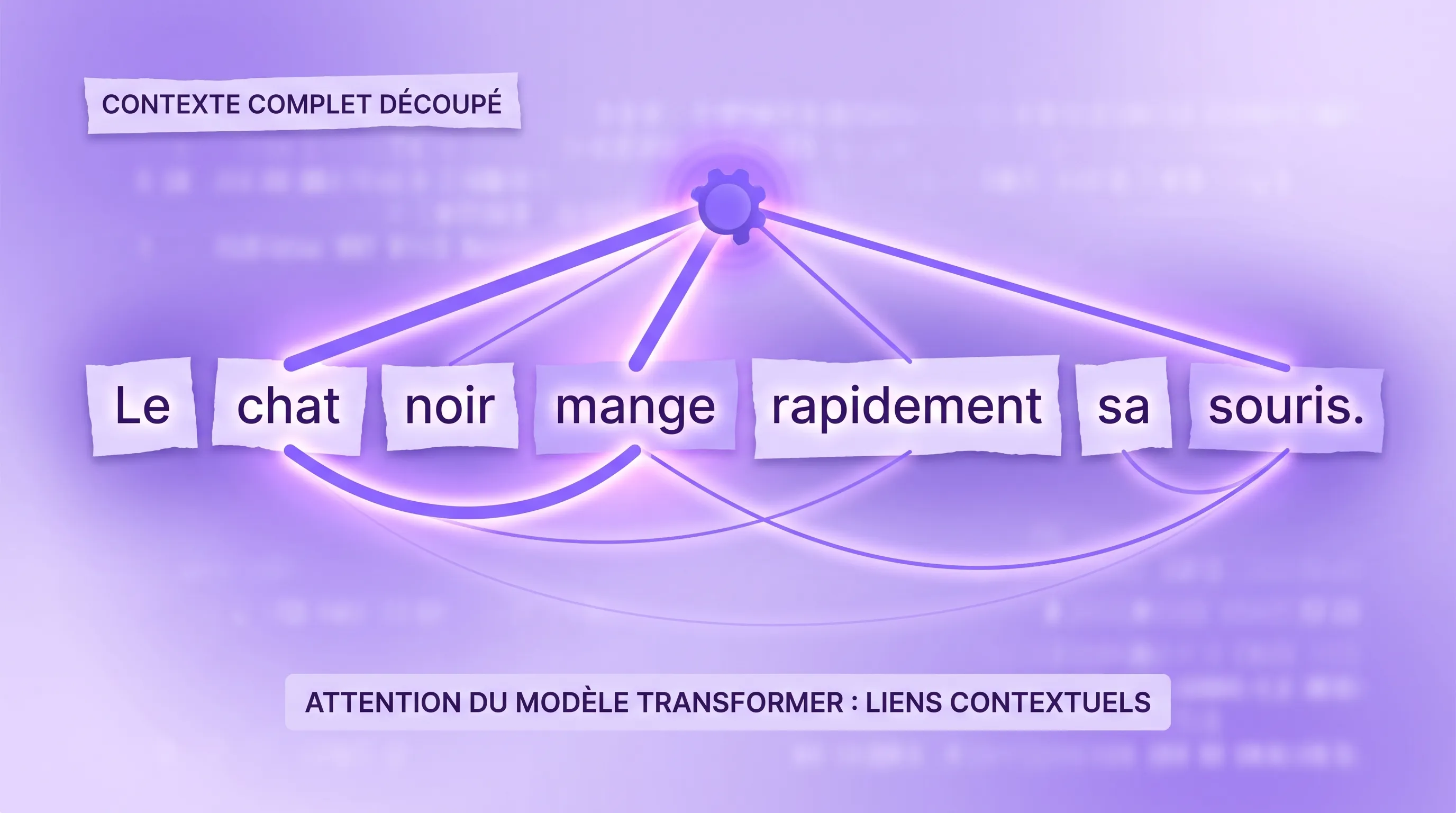
The Transformer, introduced in 2017 in the scientific paper Attention Is All You Need, changed the approach. Its core idea: instead of reading only from left to right while keeping an approximate memory, the model can look at multiple parts of the text at the same time and decide which elements are the most important to understand what comes next.
It is this ability to spot useful relationships within a context that explains much of the recent progress. For example, in the sentence "The executive asked the accountant to check the quote because it seemed too high," the word "it" refers to the quote, not the accountant. A useful model must detect this link. The attention mechanism serves precisely this purpose: weighting the important elements.
For an executive or an operational team, the point is not to know all the technical variants. The essential thing is to understand that Transformers are powerful because they manipulate context. This is also their limit: if the context is bad, incomplete, ambiguous, or poorly controlled, the answer can be convincing but false.
The core idea: attention
The word "attention" is the best entry point to understand a Transformer AI.
Imagine an employee reading a customer email. To reply correctly, they don't treat every word with the same importance. They spot the customer's name, the product concerned, the date, the problem, the urgency, and the history. They largely ignore pleasantries, unless they contain an important nuance.
A Transformer does something comparable, but on a massive scale. It transforms the text into small pieces, then calculates the links between these pieces. Some links matter a lot, others hardly at all.
Take this request: "Summarize this contract and flag the clauses that could pose a problem for an SME." The model must understand several elements at once:
The requested task: summarize and flag risks.
The document concerned: a contract.
The point of view: an SME, not a large corporation with a full legal team.
The expected result: a useful synthesis, not an exhaustive legal analysis.
Attention helps the model link these dimensions together. It does not guarantee that the answer is legally reliable, but it allows the model to produce an output that is relevant to the request.
This is why Transformers are so effective for language tasks: they don't just string words together. They learn relationships between words, sentences, ideas, intentions, and formats.
The pieces of the Transformer architecture, explained simply
A Transformer architecture can seem complex, but it can be summarized in a few building blocks. Here are the main ones.
Element
Simple explanation
Why it matters
Token
Small piece of text processed by the model
The model doesn't read exactly like a human; it chops up the text
Embedding
Numerical representation of a token
Allows the model to manipulate meaning in the form of calculations
Attention
Mechanism that links tokens together
Helps understand context and dependencies
Layer
Processing step repeated multiple times
The more layers there are, the more the model can build complex representations
Prediction
Choice of the next probable token
This is the basic principle of generative text models
Context
Information provided to the model in the prompt
Strongly determines the quality and reliability of the response
Tokens: text chopped into pieces
A model does not receive your sentences directly the way a human reads them. It cuts them into units called tokens. A token can be a whole word, a part of a word, a punctuation mark, or a frequent fragment.
For example, a phrase like "automate customer support" can be cut into several tokens. This step is invisible to the user, but it has practical consequences. The longer a document is, the more tokens it consumes. The clearer an instruction is, the less the model has to guess what you want.
This is also why context limits exist. When a tool indicates that it accepts a certain volume of text, it is generally talking about tokens, not pages in the human sense.
Embeddings: giving meaning a position
Once the text is chopped up, the model converts each token into a numerical representation. This is called an embedding.
The idea can be understood with a map. On a geographical map, two nearby cities often share common characteristics. In the numerical space of a model, related concepts also tend to be positioned closely together. "Invoice," "payment," "deadline," and "reminder" will be closer to each other than "invoice" and "mountain."
These representations are not dictionary definitions. They are learned from vast amounts of text. The model observes regularities: which words appear together, in what contexts, with what structures.
Self-attention: comparing each piece with the others
Self-attention is the heart of the Transformer. It allows each token to take into account the other tokens in the context.
If you give the model a meeting note, it can link a decision made at the beginning of the text with an action mentioned at the end. It can understand that a pronoun refers to a person mentioned earlier. It can spot that a budget constraint alters the interpretation of a recommendation.
Self-attention is not human comprehension. It is a sophisticated statistical system that identifies useful dependencies. But in many practical cases, this capability is enough to produce highly useful summaries, rephrasings, classifications, or drafts.
Layers: improving understanding step by step
A Transformer does not do everything in a single pass. It stacks multiple processing layers. Each layer refines the representation of the text.
You can compare this to a team rereading a document multiple times from different angles. A first read identifies the keywords. A second spots the relationships. A third distinguishes the priorities. A fourth prepares the response.
In a model, these steps are mathematical, but the intuition is the same: each layer transforms the information to make it more usable.
Attention heads: multiple reading angles
Transformers often use multiple "attention heads." The term might sound scary, but the idea is simple: the model analyzes the text from several perspectives in parallel.
One head might focus on grammar, another on relationships between entities, another on the expected format, another on causality cues. It is not always this clear-cut in reality, but this image helps explain why the model can process multiple dimensions of a text at the same time.
For a business, this is what makes these models so versatile. The same model can help summarize a sales call, generate an email draft, classify support tickets, or extract information from a document, provided the use case is well-framed.
Encoder, decoder, generative model: what are the differences?
Not all Transformers serve exactly the same purpose. There are several families, but three main ideas are enough to orient yourself.
Model type
Typical use
Intuitive example
Encoder
Understand, classify, compare text
Read a document and extract its meaning
Decoder
Generate text
Produce the most probable and useful continuation
Encoder-decoder
Transform an input into a structured output
Translate, summarize, rephrase
Large conversational assistants are often based on decoder-type architectures or something close to this logic. They generate a response token by token. At each step, the model estimates the most probable continuation based on your prompt, the available context, and the applied settings.
This is an essential point: a language model does not "know" in the human sense. It generates a plausible response based on what it has learned and what it is provided. This can be extremely useful, but it requires putting guardrails in place when the answers have a business, legal, financial, or operational impact.
If you want a broader explanation of how modern AI works from an executive's perspective, Impulse Lab's article on how artificial intelligence works in business is a great complement to this read.
Why this architecture is useful for businesses
Transformers have become important because they are exceptionally good at processing a raw material that is omnipresent in business: language.
A company constantly produces and receives text: emails, quotes, reports, support tickets, contracts, product sheets, CRMs, knowledge bases, internal procedures, Slack or Teams messages. A large part of productivity comes down to the ability to read, synthesize, prioritize, and write faster.
Transformer AI can help with several families of use cases:
Summarizing long documents to speed up decision-making.
Classifying incoming requests by urgency or category.
Generating draft responses based on history and a knowledge base.
Extracting structured information from unstructured text.
Helping teams search through internal documentation.
Rephrasing content for different audiences or channels.
Not all of these uses are worth automating. The right criterion is not "can we put AI here?", but rather "is this process frequent, costly, repetitive, measurable, and sufficiently well-framed?".
This is exactly the difference between an impressive demo and a useful system. A demo might work on three examples. A business tool must work with your data, your exceptions, your constraints, your teams, and your quality requirements. To go from an idea to a reliable deployment, you have to think about architecture, integration, and adoption. On this topic, you can consult the dedicated article on a minimal architecture for a reliable AI system.
The limits to know before deploying a Transformer AI
Understanding Transformers also means understanding their limits. They shouldn't discourage you, but they should guide project design.
The model can produce a false but credible answer
A generative model seeks to produce a coherent continuation. It can therefore formulate an answer with confidence even if information is missing. This is often called a hallucination.
For internal use, this might be acceptable if a human verifies it. For customer-facing, legal, medical, financial, or HR use, it can create a risk. In such cases, controls must be added: cited sources, human validation, access to a reliable document base, refusal rules, and regular testing.
Quality depends heavily on context
A Transformer can be highly performant with a good instruction and relevant data. It can be mediocre if the request is vague or if the provided documents are incomplete.
The question is therefore not just the choice of the model. You also have to ask what data to give it, in what format, with what rules, and how to measure the quality of the answers.
The model does not automatically replace a process
Automating a task is not just about plugging a model into an existing tool. You have to understand the workflow, the exceptions, the responsibilities, the validations, and the acceptable errors.
For example, generating a support response is one thing. Sending it automatically to the customer is another. Between the two, there might be a review step, a threshold based on confidence level, or an escalation to a human.
Sensitive data must be treated seriously
Transformers can handle confidential information: contracts, customer data, HR information, financial elements. Before integrating them into a process, you must clarify where the data travels, who accesses it, how long it is kept, and what security rules apply.
For SMEs and scale-ups, this point is often underestimated. It doesn't block AI projects, but it does require a structured approach.
How to know if a use case deserves a Transformer?
Not all problems require a large language model. Sometimes, a simple rule, classic automation, or better integration between tools is enough.
A use case is generally promising if several conditions are met:
Criterion
Good indication
Point of vigilance
Volume
The task occurs frequently
A rare case rarely justifies a large project
Time saved
Teams spend many hours on it
You must measure real time, not just the impression
Data
Examples and documents already exist
Scattered data reduces quality
Risk
Errors are detectable or controllable
High impact requires human validation
Adoption
Users see the value
A forced tool without clear use will be bypassed
The best approach is often to start small: choose a specific process, define the expected result, test on real cases, measure, and then expand. A successful AI project looks less like a massive technical tunnel and more like a series of value-oriented iterations.
This is also the value of an AI opportunity audit: identifying processes where AI can create concrete gains, without turning every topic into a complex undertaking. Impulse Lab specifically supports companies with this type of scoping, and then with the development of web and AI solutions adapted to existing tools.
What an executive should remember
If you were to remember only a few ideas, remember these.
A Transformer is a highly effective AI architecture for processing language because it knows how to give importance to the right elements of context. It chops text into tokens, transforms these tokens into numerical representations, compares the elements with each other using attention, and then produces or analyzes text according to the goal.
This architecture explains why generative AI tools can summarize, rephrase, classify, extract, and write with impressive fluency. But it also explains why they can be wrong: they generate plausible answers based on a context, not a guaranteed truth.
For a business, true value does not come from the model alone. It comes from the combination of the right use case, the right data, the right guardrails, clean integration with existing tools, and real adoption by teams. If your goal is to link AI to measurable gains, the article on methods to transform AI into concrete ROI can help you move from technical understanding to business decision.
FAQ
Is a Transformer AI the same thing as an LLM? No. A Transformer is a technical architecture. An LLM, or large language model, is often built with a Transformer architecture, but the two terms do not mean exactly the same thing.
Why is attention so important? Attention allows the model to spot which parts of the context are the most useful for understanding or generating an answer. This is what helps it connect distant information in a text.
Does a Transformer really understand what it writes? Not in the human sense. It manipulates regularities learned from data and produces coherent answers based on the context. This can yield highly useful results, but validation remains necessary for sensitive decisions.
Should a company train its own Transformer model? Not necessarily. In many cases, it is more efficient to use an existing model, frame it with good instructions, connect it to your data, and put appropriate controls in place.
What are the best first use cases for an SME? Good first cases are often related to customer support, document search, meeting summaries, information extraction, or draft generation. The choice depends mainly on volume, risk, and measurable gain.
Transforming understanding into a useful project
Understanding the Transformer architecture is a first step. The next is to identify where this technology can truly improve your operations, without creating a convoluted system or unnecessarily exposing your data.
Impulse Lab helps SMEs, scale-ups, and growing organizations scope their AI opportunities, automate processes, integrate AI into existing tools, and train teams on concrete use cases. If you want to move from an intuition to a pragmatic roadmap, you can discover Impulse Lab's approach and evaluate the use cases that are truly worth launching.
Rewriting Text with AI Without Betraying Your Brand
Behind searches for 'AI text rewriting' lies a concrete need to update pages, simplify emails, or align copy. While AI speeds this up, fluent phrasing can erase your brand personality or exaggerate promises. Here is how to frame rewriting and maintain control.