What is the most developed artificial intelligence in 2026?
Intelligence artificielle
Stratégie IA
Outils IA
Gouvernance IA
ROI
Looking for **the most developed artificial intelligence in 2026** makes sense, but the question often traps leaders. In practice, there is no universal "number 1" AI. While highly advanced models exist, "the most developed" depends entirely on your specific criteria and business needs.
Looking for the most developed artificial intelligence in 2026 makes sense, but the question often traps leaders. In practice, there is no universal "number 1" AI. Highly advanced models exist, but "the most developed" depends on the criteria you put behind the word: reasoning quality, multimodality (text + image + audio), reliability in production, speed, costs, security, availability in Europe, or the ability to integrate with your tools.
The goal of this article is therefore twofold:
give you a clear framework to understand what "most developed" means in 2026,
help you choose the best AI for your SME or scale-up, without being guided by marketing.
What exactly does "the most developed" mean in 2026?
In 2026, the best AI systems are rarely "just" a model. They are products: model + guardrails + tools + orchestration + evaluation + logging + integrations.
If you only compare model names, you often miss the point that determines ROI: does it work in your workflows, with your constraints (GDPR, security, costs, traceability)?
The 6 criteria that change the answer
Performance on your actual tasks: summarizing calls, writing a sales proposal, classifying tickets, extracting data from a PDF, helping your devs, etc.
Reliability and control: citations, reducing hallucinations, refusing when info is missing, stable behavior, ability to "say I don't know".
Ability to act: tool-calling, execution via API, "guarded" agents (authorized actions, validations, idempotency).
Industrialization: monitoring, continuous evaluation, version management, runbook, controlling variable costs.
Governance and compliance: data protection, retention policy, access control, localization and transfers, requirements of the GDPR and the European AI Act.
Which AIs are the "most advanced" in 2026 (by major families)?
Rather than crowning a single winner, it is more useful to look at the dominant families.
1) Large multimodal models (cloud)
These are generally the most "spectacular" models because they combine:
text understanding and generation,
image understanding (and sometimes video),
sometimes audio (recognition and generation),
an ecosystem of tools (APIs, assistants, functions).
They are often the best for: rapid prototyping, copilots, copywriting, document analysis, augmented customer support.
Point of attention: the hosting method, retention, and training conditions vary depending on the offers. For a company, "the most developed" only makes sense if it is deployable without risk.
2) Open source models (self-hosted or hosted by a third party)
In 2026, open source remains a credible option for:
Ultimately, the real answer comes from your own testing.
The "enterprise" comparison grid (the one that counts for ROI)
Criterion
Question to ask
Proof to request / produce
Why it changes everything
Quality on your cases
Out of 30 real cases, what is the useful success rate?
Test set + simple scoring
General benchmarks do not reflect your business
Traceability
Can internal sources be cited (RAG)?
Answers with citations, links, excerpts
Reduces hallucinations, increases trust
Integrations
Can the AI act in your tools (CRM, helpdesk, ERP)?
Demo with API + logs + validations
An AI "that talks" without action yields little
Security / GDPR
Where does the data go, who accesses it, for how long?
DPA, retention policy, architecture
Risks destroy ROI
Total cost
How much do 1,000 tasks cost in real conditions?
Estimation + measurement + alerting
Variable costs can explode
Operability
Who operates, monitors, fixes, rollbacks?
Runbook + monitoring + SLO
Without ops, you stay in demo mode
So, what is the most developed artificial intelligence in 2026 for an SME?
The most useful answer is: the one that maximizes your net value (gains minus risks minus costs) on a frequent use case, and not the one that gives the best demo.
Case 1: you want quick wins (productivity, writing, support)
Most often, cloud solutions (leading models + tools) win in time-to-value.
What makes the difference is not "the best model", it is:
minimal integration into the workflow,
a usage policy (authorized data, prohibitions),
a short testing protocol.
For a pragmatic approach on the SME side, you can rely on a short plan like a "30-day pilot" (Impulse Lab details similar approaches in its content, for example on industrialization and moving to production).
Case 2: you have sensitive data or a strong need for control
The "most developed" AI can be a hybrid stack:
a high-performing model (cloud or hosted),
a RAG connected to your sources of truth,
a security and governance layer (access control, masking, logs),
possibly a self-hosted option for certain flows.
On this topic, the API, RAG, and agents patterns have become the standard production building blocks. (See also the "API → RAG → guarded agents" logic in modern integration approaches, for example in this Impulse Lab article.)
Case 3: you want to automate actions (agents, workflows)
In 2026, "the most developed" is not the AI that speaks the best, it is the one that:
knows how to call tools (tool-calling),
acts with validations,
leaves a trace (audit log),
tests and monitors itself.
If you explore this path, keep in mind that the "autonomous" agent should be a setting, not a goal. (Impulse Lab also has resources focused on guardrails and validation, for example here.)
A simple (and realistic) method to decide in 2 weeks
You can decide without spending 3 months on it, provided you are rigorous.
Step A: write a mini "usage contract"
Define:
who uses the AI and when,
what it must produce (format, level of precision),
what it is not allowed to do,
authorized sources (if RAG),
the main KPI (time saved, resolution rate, conversion rate, etc.).
Step B: build a set of 30 to 50 real cases
This set must represent:
easy cases, medium cases, hard cases,
risky cases (personal data, ambiguities),
cases where the AI must refuse or escalate.
Step C: test 2 to 3 options maximum
Test in conditions close to reality, not in an isolated chat:
with the same prompts and the same context,
with a stable format instruction,
with a cost measurement.
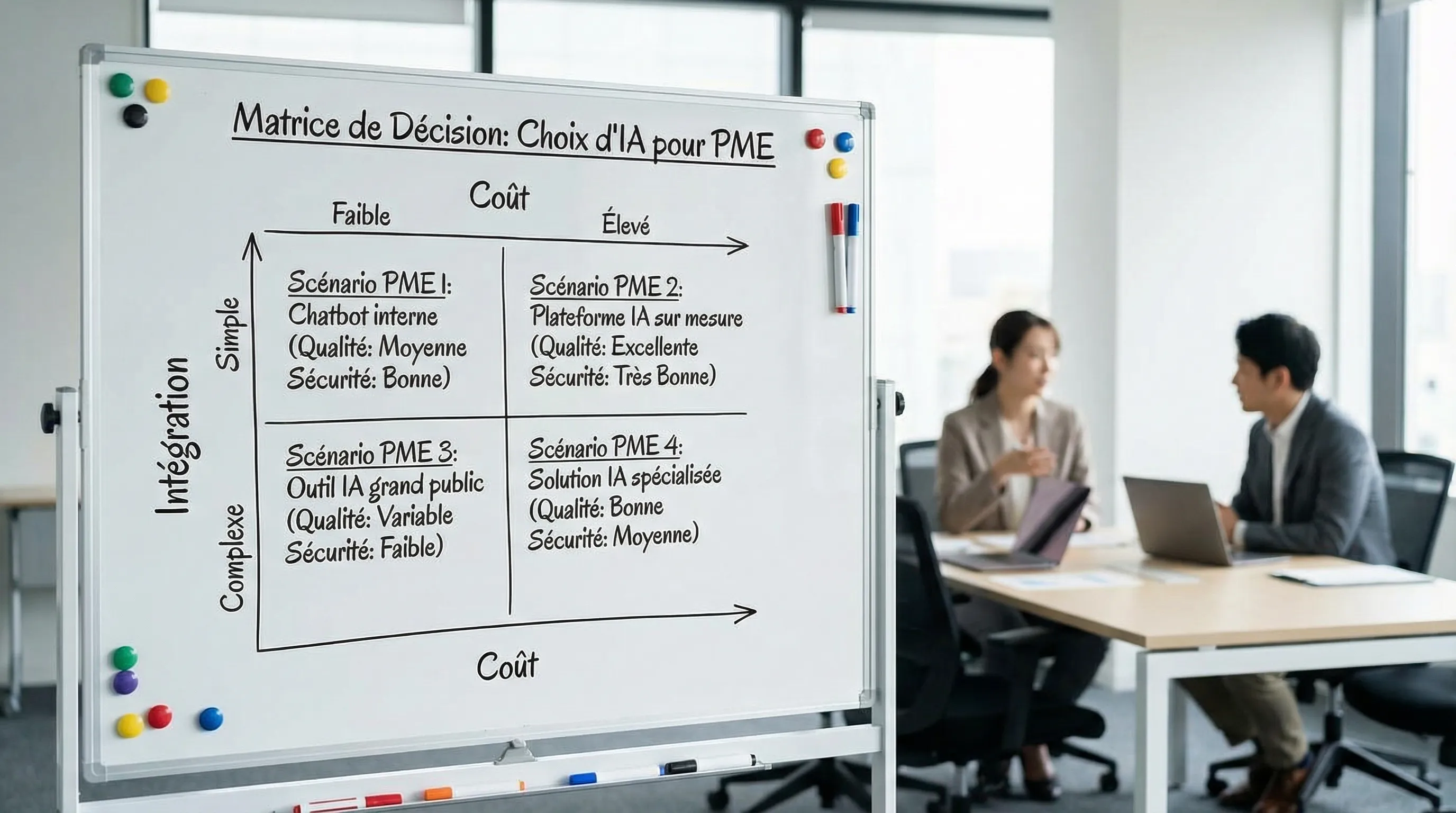
Step D: decide with a scorecard
Your decision should fit on one page:
quality score,
risk score (data, compliance),
integration score,
estimated cost,
Go / No-Go / Go but with guardrails decision.
This logic aligns with a simple philosophy: in business, the advantage comes from execution (integration, measurement, governance), not the name of the model. If you want a more comprehensive framework geared towards SMEs, see also AI report 2026: trends and actions for SMEs.
The mistakes that make you think you chose "the most developed"... when you didn't
Choosing based on a demo, without testing on your cases.
Launching a chatbot without reliable sources (no RAG, no controlled corpus).
Forgetting integration: the AI produces text, but no one uses it.
Discovering costs after the fact (no instrumentation).
Putting governance at the end of the project (GDPR, rights, AI Act).
Regarding these traps, a useful approach is to start with a short scoping or an opportunity audit, rather than industrializing a bad case too early. (Example: Strategic AI Audit: mapping risks and opportunities.)
FAQ
What is the most developed artificial intelligence in 2026? In 2026, there is no universal "most developed" AI. Leading models vary depending on the criterion (quality, multimodality, cost, security, integration). For a company, the best AI is the one that performs on your real cases, with governance, costs, and risks under control.
What is the best AI model for an SME? The one that brings a measurable net gain on a frequent use case (support, writing, sales, ops), and that integrates with your tools. In many SMEs, a well-governed cloud model wins in deployment speed, then a RAG and guardrails make the whole thing "production-grade".
How to reliably compare two AIs? Test them on 30 to 50 real cases, measure a quality score, a risk score (data, hallucinations), an integration score (can it act), and the cost per task. Public benchmarks help, but do not replace your tests.
Are open source AIs less developed than cloud AIs? Not necessarily. They can be more suitable if you need control, sovereignty, or fine optimization. However, they require more engineering (deployment, security, monitoring), which must be factored into the total cost.
Is "the most developed" necessarily the one that gives the best answers? No. In business, a useful AI is also one that is traceable (sources), operable (runbook, monitoring), and controllable (guardrails, authorized actions). A brilliant but ungoverned AI can create more risk than value.
Moving from the "best model" question to a useful (and measured) AI
If you are hesitating between several options, the fastest way is often to test properly rather than debate.
Impulse Lab supports SMEs and scale-ups on:
AI opportunity audits to prioritize 2 short-ROI use cases,
setting up measured pilots (KPIs, testing protocols, costs),
development and integration (API, RAG, agents with guardrails),
training to accelerate adoption.
You can discover the approach on impulselab.ai or start with a discussion to scope a realistic and secure pilot.