An AI agent prototype can impress in 48 hours, then prove unusable with real data. In SMEs, moving to production isn't about the "best model," it's about **framing, integration, guardrails, and operations**.
février 19, 2026·9 min de lecture
An AI agent prototype can impress in 48 hours, then prove unusable as soon as it touches real data, hurried users, or imperfect business tools. In SMEs, the transition to production is not a question of the “best model”, it is a question of framing, integration, guardrails, and operations.
The goal of this article is simple: to give you a pragmatic path to take AI agents from prototype to reliable, measurable, and governed production, without turning your IS into a permanent laboratory.
Prototype, pilot, production: why agents often fail in SMEs
AI agents have a strong promise: observe a context, reason, then act (e.g., create a ticket, prepare a quote, follow up with a client, extract data, execute a task). On paper, it’s a productivity leap.
In reality, failures rarely come from the AI “itself”. They come from very SME-compatible points:
Scope is too broad (the agent “does everything” and does nothing reliably).
Context is fragile (outdated documents, scattered knowledge, fuzzy access rights).
Actions are irreversible (sending email, CRM modification, refund) without a confirmation mechanism.
There is no evaluation (no test sets, no baseline, no observability).
The run is not planned (who fixes, who validates, who tracks incidents, who updates rules?).
Good framing consists of treating an agent not as a demo, but as a mini-product: clear intention, UX, metrics, guardrails, then rapid iteration.
To lay the foundations, you can also clarify the notion of an agent in your organization (definition, components, types) via the Impulse Lab glossary sheet: AI Agent.
Step 0: choose an “agent-ready” use case (and refuse the others)
Before architecture, the best decision is often not to agentify too early.
The 4 criteria of a use case that passes into production
A good candidate in an SME generally ticks these boxes:
High frequency: the task comes up every day (otherwise, adoption and ROI collapse).
Access to truth: the agent can rely on a reliable source (CRM, ERP, knowledge base, helpdesk).
Bounded actions: the agent acts within a clear perimeter (create a draft, propose, classify, trigger a workflow).
The bad candidates (at the start)
Avoid topics in V1 that combine: regulated decisions, high responsibility, highly sensitive data, and lack of trace. Typically, “the agent decides to refuse a refund” or “the agent validates a payment” without control.
Escalation: when the agent must stop and hand over.
This contract becomes your reference for testing, compliance, and training.
Step 2: move from a “prompt” to a minimal exploitable architecture
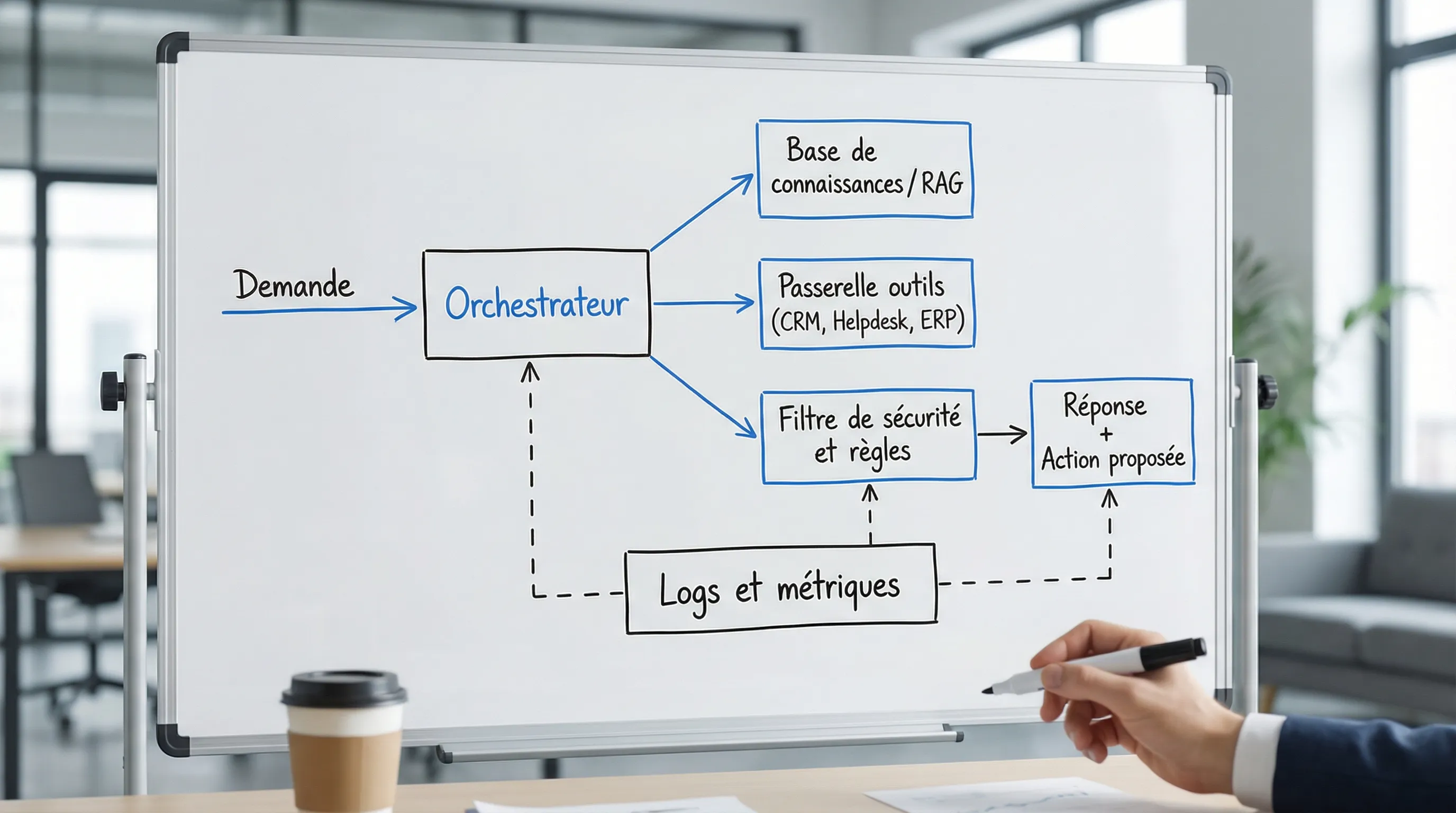
An agent prototype is often limited to “a prompt + a model”. In production, you need a lightweight architecture, but one that is separable, observable, securable.
Here is a minimalist structure that works well in SMEs:
Context layer: brings company data (documents, CRM, tickets, procedures).
Actions layer: connectors to tools (APIs, webhooks, automations).
Guardrails layer: checks before action (PII, injection, business rules, confirmation).
Observability layer: logs, metrics, traces, test sets.
Key point: integration is your advantage
In SMEs, the agent that “answers well” but integrates with nothing remains a gadget. The one that pre-fills, classifies, routes, and triggers controlled actions becomes a lever.
Step 3: build a reliable context (RAG, sources, permissions)
Production often fails on a basic question: where does the truth come from?
If the agent relies on obsolete documents, it will give “good wrong answers”.
If access rights are not respected, you create a major risk.
RAG in production: treating knowledge like a product
When the agent must cite internal procedures, contracts, or a catalog, a robust RAG (Retrieval-Augmented Generation) becomes essential.
SME-friendly best practices:
Define 1 to 3 “official” sources at the start (and keep them up to date).
Version key documents and trace provenance.
Display excerpts or references when useful (trust and audit).
To go further on robustness, evaluation, and monitoring: Robust RAG in production.
Standardized connections: MCP and tool ecosystem
When you multiply integrations, technical debt arrives quickly. Standardized approaches (e.g., MCP) are useful for structuring access to tools, tracing, and governing.
Step 4: put guardrails “action-first” (not just content)
An agent becomes dangerous when it can act without controls. The right approach is to put guardrails at the moment of action, not just at the moment of generation.
Three levels of effective guardrails in SMEs
Level
Objective
Concrete Example
Prevention
avoid forbidden actions
block email sending to an unauthorized domain, prevent writing in certain CRM fields
Validation
require confirmation
“Here is the ticket I am going to create, validate” before creation in the helpdesk
Recovery
correct and learn
log errors, add a rule, enrich a test set
“Idempotent actions” and preview
Two simple patterns make a huge difference:
Preview: the agent proposes a draft (email, ticket, quote), a human clicks “send”.
Idempotency: if the agent retries an action, you avoid duplicates (two tickets, two emails).
These are engineering details, but they are what allow going to production without stress.
Step 5: create an evaluation before opening to 50 users
An agent that “looks good” on 10 conversations can collapse on 200 real situations. You must therefore measure.
The minimal test pack
Without turning it into an overly complex system, aim for:
A set of representative scenarios (20 to 60 anonymized real cases).
Acceptance criteria per scenario (good routing, good extraction, good format, good escalation).
Production: routing to the right queue + suggestion of relevant articles + escalation if low confidence.
What makes this case solid: bounded actions, high frequency, obvious KPIs, immediate benefit for the team.
Where an agency makes the difference (without overpromising)
Moving an AI agent to production requires a combination quite rare in SMEs: product framing, IS integration, security, conversational UX, tests, and adoption management.
Impulse Lab typically intervenes at three levels (depending on your maturity):
AI Opportunity Audit to select 1 to 3 “agent-ready” use cases, with KPIs and risks.
Custom development (web + AI) to integrate the agent into your tools (CRM, helpdesk, ERP), with an iterative delivery logic.
Adoption training so that the agent is used correctly (and improvable), not just “deployed”.
If you want to frame a first agent, or challenge an existing prototype before moving to production, you can start with a conversation via impulselab.ai.