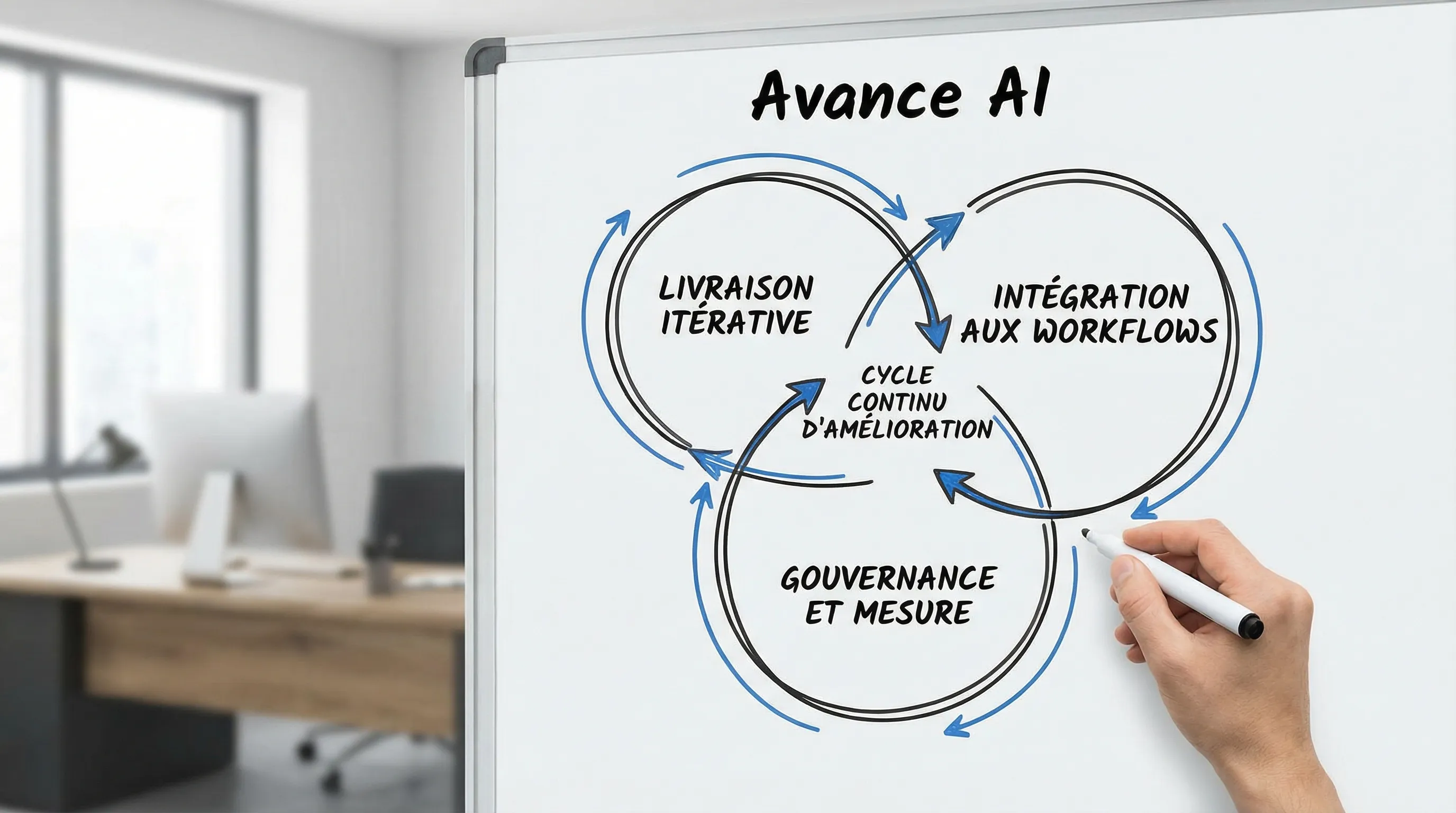
In 2026, the "AI edge" no longer comes from having access to a model; everyone has that. It comes from your ability to **transform AI into decisions and actions within your workflows**, with guardrails, metrics, and rapid execution.
janvier 31, 2026·8 min de lecture
In 2026, the "AI edge" no longer comes from having access to a model; everyone has that. It comes from your ability to transform AI into decisions and actions within your workflows, with guardrails, metrics, and rapid execution.
In other words, the differentiator is shifting: less "which AI do you use?", more "how fast do you deliver reliable, integrated, measurable, and adopted use cases?".
What "AI Edge" Really Means in 2026
We can summarize the AI edge as a cumulative advantage: you learn faster than your competitors, you industrialize what works, you cut what doesn't, and you secure risks (data, compliance, reputation) before they slow you down.
In practice, the AI edge is built on three loops:
Product loop: deliver, measure, iterate.
Operational loop: integrate AI into existing tools (CRM, support, ERP, DMS), avoid "disconnected copilots".
5 signals you are losing your edge (even if you are "doing AI")
The trap of 2026 is believing you are ahead because you "deployed a tool" or "did a POC". Here are the weak signals indicating the opposite.
1) A graveyard of POCs
You have impressive demos but few production deployments, or deployments without adoption. This is often a scoping problem (unclear objective) or an integration problem (not in the workflow).
2) Uncontrolled "shadow AI" usage
Teams use consumer tools with ambiguous (or sensitive) data, without clear rules. Result: legal risk, information leaks, and an inability to capitalize on learnings.
3) No KPI linked to a baseline
Without a baseline (before/after) and without impact metrics, you don't have operational truth. You have opinions.
To scope this properly, you can rely on a KPI approach like the one in our guide on AI KPIs.
4) A bill that climbs without control
API, context, observability, and maintenance costs end up exceeding the "token cost" seen during the POC. Anticipating the total cost prevents killing a profitable project. See also our guide on hidden costs of AI APIs.
5) Governance arrives too late
When an incident occurs (data, hallucination, unauthorized action), the typical reaction is to "freeze". The AI edge, on the contrary, consists of planning minimal guardrails from V1 to keep delivering.
The 6 levers that create a real AI edge in 2026
These levers are intentionally execution-oriented; they are valid for an SME as well as a scale-up. The idea is not to do everything, but to build a foundation that accelerates everything else.
1) Prioritize frequent use cases, close to cash
The best first cases are those that recur every day (support, qualification, content production, operations), because the cumulative effect is rapid.
A simple method is to score each idea according to Impact, Effort, Risk, then select a maximum of 2 to 3 subjects (otherwise you dilute the team and the data).
2) Treat data as a product (even at small scale)
Your advantage rarely comes from a "secret model", it comes from:
the quality of your sources (documents, tickets, CRM, procedures),
their freshness (updates, ownership),
their accessibility (rights, formats, APIs),
their traceability (where does the answer come from?).
This is particularly true for knowledge assistants (RAG). If you need to industrialize, our resource on a robust RAG approach in production details the structural choices.
3) Integrate AI into existing tools (the "workflow" moat)
In 2026, a non-integrated AI is just another tab, therefore one tool too many.
The edge comes when:
the AI reads the context (ticket, opportunity, email, order),
proposes an action (response, qualification, summary, CRM update),
4) Implement continuous evaluation (not "a test before launch")
The key question is not "does it work?" but "does it still work when data changes, when the model evolves, when users bypass the process?".
A simple and reproducible protocol (scenarios, scorecard, monitoring) helps decide quickly. You can draw inspiration from this corporate AI test protocol.
5) Deploy proportionate governance (aligned with GDPR and AI Act)
Compliance should not be a "final phase". In Europe, the AI Act imposes requirements that vary according to use cases, risk levels, and the organization's role (provider, deployer, etc.). A useful reference to situate the framework is the European Commission's official page on the EU AI Act.
The AI edge consists of having simple rules from the start: data classification, logs, access control, correction procedures.
6) Accelerate adoption (training, rituals, "definition of done")
Most organizations overestimate the tech and underestimate the change: targeted training, feedback rituals, internal support materials, and a common usage framework.
To structure roles and responsibilities without creating a bureaucracy, our guide on AI organization can serve as a base.
Pilot Dashboard: linking "lever" to "deliverable" and "measurement"
AI Edge Lever
Concrete Deliverable
Useful Measurement Example
Frequent use cases
Prioritized backlog (Impact/Effort/Risk)
% of initiatives with KPI and baseline
Data as a product
Identified sources, owners, access rules
Source coverage, freshness, rate of sourced answers
Adoption by team, satisfaction, impact on business KPI
A 30 / 60 / 90 day execution plan to keep the advantage in 2026
The goal here is to deliver a useful V1 (not a demo), then stabilize it.
Days 1 to 30: frame, choose, instrument
You are looking for a clear decision: "what are we piloting, for what impact, with what constraints?".
At this stage, keep a reduced scope: 1 process, 1 team, 1 channel, 3 to 5 representative scenarios.
If you are starting from scratch, a structured audit-type approach saves you lost weeks. Impulse Lab describes, for example, what a strategic AI audit (risks and opportunities) covers.
Days 31 to 60: deliver an integrated MVP (with guardrails)
This is the phase where many teams go wrong: they polish the prompt instead of integrating.
Instead, seek:
integration into the right tool (support, CRM, back-office),
a clear degraded mode (human handoff, escalation),
actionable logs (quality, costs, errors),
a simple UX (the user shouldn't have to "learn AI", just do their job).
Days 61 to 90: stabilize, measure, decide (stop / iterate / scale)
At 90 days, you must be able to answer without ambiguity:
Which KPI moved, and by how much (vs baseline)?
What is the total cost (tools, API, time, maintenance)?
Which risks remain open (data, compliance, actions)?
Which 2 improvements increase ROI the fastest?
If the results are good, you "productize": documentation, ownership, tests, robust integrations, then duplication on a second similar case.
How to avoid the "tools of the moment" trap
Models and tools evolve fast, but your advantage must survive version changes. Three rules help a lot:
Decouple the product app from the AI provider (via an orchestration layer, stable API contracts, and logs).
Keep your data and prompts governed (versioning, access, tests, audit).
Preserve reversibility (if you change models tomorrow, the impact must be measured and controlled).
For teams equipping themselves, a good reflex is to evaluate reliability before industrializing. You can use the grid from our article on reliable AI sites in 2026.
Frequently Asked Questions
Is the AI Edge mostly a question of tools or organization? In 2026, it is primarily a question of organization and integration. Tools are interchangeable; your ability to deliver and measure within workflows is much less so.
How many use cases should be launched to "get ahead"? Often 2 to 3 well-scoped cases are enough to create a foundation (data, integrations, governance, metrics) reusable on 10 others.
What is the difference between a POC and a useful pilot? A POC proves a technical possibility. A pilot proves measurable value in real conditions (users, data, security, costs, adoption).
How to reduce hallucinations without over-complicating? By combining sources of truth (RAG), sourced answers, guardrails (refusal if uncertain), test scenarios, and human escalation on sensitive cases.
Should we internalize or get support? If your team already has the skills (integration, security, data, product, change management), you can internalize. Otherwise, short, delivery-oriented support can accelerate without creating dependency.
What are the minimum prerequisites to start in 30 days? A business sponsor, a frequent use case, accessible data (even if imperfect), a KPI with a baseline, and a controlled perimeter (one team, one flow, one channel).
Moving from intention to AI edge, without dispersion
If you want to keep an AI edge in 2026, the priority is to select 1 to 2 use cases with short ROI, integrate them cleanly into your tools, then measure and industrialize.
Impulse Lab supports SMEs and scale-ups via AI opportunity audits, adoption training, and the development of custom web and AI solutions (automation, integrations, platforms). To move fast on a clear scope, you can contact us via the Impulse Lab website.
Entreprise et intelligence artificielle : démarrer sans risque en 30 jours
Beaucoup d’entreprises veulent “faire de l’IA” mais repoussent le démarrage par peur de trois choses très concrètes : fuite de données, projet qui n’aboutit pas, coûts qui explosent. La bonne nouvelle, c’est qu’en 2026, **démarrer avec l’intelligence artificielle en entreprise n’exige pas un program...