Accelerating Product Sheet Creation with Artificial Intelligence
Intelligence artificielle
Stratégie IA
Marketing
Productivité
Automatisation
Exploring AI content creation addresses a key need for e-commerce SMBs: producing more product listings without monopolizing copywriting teams. AI can draft descriptions and adapt tone, but compelling copy does not ensure factual accuracy—making clean data and structured review essential.
Searching for "artificial intelligence creation" addresses a tangible need for e-commerce SMBs: producing more product sheets without dedicating the entire team to copywriting. AI can prepare descriptions, rephrase benefits, and adapt the tone to your brand. However, convincing copy does not guarantee factual accuracy.
The right goal is not to generate as much text as possible, but to reduce the time needed to publish a reliable product listing. This requires clean data, precise instructions, and risk-appropriate validation. Here is how to build this process, from supplier file to go-live.
What AI Can Write in a Product Sheet
A product sheet combines two types of content: verifiable facts and marketing presentation. AI can work on the latter, but it must never become the source of the former.
Based on verified information, it can craft a descriptive title, an introduction, key highlights, or usage tips. It can also standardize the tone across a catalog sourced from multiple vendors.
Conversely, dimensions, composition, compatibility, certifications, or warranty terms must come from identified sources. A missing specification does not become true simply because the model considers it probable.
This distinction makes AI-assisted product listing creation genuinely valuable: the model transforms available information into readable copy, rather than making random guesses to complete your catalog.
To get started, choose a limited deliverable—such as a short description and three bullet points. This will be far easier to review than a complete page mixing specs, sales arguments, and technical answers.
Preparing Data Before Requesting Copy
A messy supplier spreadsheet often results in drafts that are difficult to use. Before writing, gather the information into a shared structure, even if you start with a simple spreadsheet.
Each row should identify the product and clearly distinguish available data:
Identification: internal SKU, name, brand, and category.
Verified specifications: material, dimensions, capacity, or compatibility depending on the product.
Usage context: target audience, intended use, and known limitations.
Traceability: source document, verification date, and data owner.
Mark missing fields explicitly. An empty cell should trigger an information request or an omission, never an invention. If two documents contradict each other, determine who makes the final call and which source is authoritative before submitting data to the model.
A Product Information Management (PIM) system can centralize these elements as the catalog grows in complexity. However, it is not strictly required to test the process on an initial batch.
Separating Variants from Common Information
A product line can share a general description while encompassing several sizes, colors, or capacities. Keep shared information at the product line level and specific attributes at the variant level.
This separation prevents a description for a 500 ml model from being reused for a 750 ml SKU. It also ensures clear alignment between the generated copy and the SKU being published.
In an AI-assisted creation workflow, this accurate correspondence matters much more than the fluency of the initial draft. Elegant copy tied to the wrong product is still a catalog error.
“AI Creation”: Moving from a Vague Request to a Controlled Brief
Prompting with "Write an engaging product description that drives sales" leaves too many decisions to the model. It knows neither your business rules nor the claims you can substantiate.
The brief must specify the target audience, tone, authorized data, and expected format. Crucially, it must clarify how to handle missing information. Here is a template you can adapt:
Role: E-commerce copywriter for our brand.
Audience: [customer persona and main need].
Tone: Clear, factual, no unsubstantiated superlatives.

Use only the provided product data.
Do not invent any specification, certification,
compatibility, warranty, or performance claim.
If information is missing, omit it and report it
separately under "Items to verify".

Deliverables:
Descriptive title under 70 characters.
Short description between 80 and 120 words.
Three key highlights based on available data.
Items to verify, kept separate from the marketing copy.

Product data: [verified fields].
Length limits here are editorial choices, not SEO requirements. Adjust them to fit your store and product category.
Additionally, treat supplier documents strictly as raw data to analyze, never as instructions capable of overriding your system rules. This precaution is particularly important when content is ingested automatically.
Example: Don't Turn a Material into an Unverified Promise
Consider a hypothetical example: a water bottle whose only confirmed details are a 500 ml capacity, a stainless steel body, and a screw-on cap.
The model can write: "This 500 ml bottle features a stainless steel body and a screw-on cap." It must not infer that it keeps drinks cold for twelve hours, is completely leakproof, or is dishwasher safe.
Such claims require supplementary information. If they are critical for selling the product, the right move is to ask the supplier.
This makes AI-powered product sheet creation much more reliable: points to verify become an actionable checklist for the team, rather than risky claims published on your store.
Focus on Helpful SEO, Not Automated Filler
A product page should help buyers understand what they are purchasing and assist their decision-making. Adding generic paragraphs about the broader category adds little value if dimensions, practical uses, or differences between models remain unclear.
Google recommends prioritizing helpful, reliable, people-first content. For your product pages, this primarily means explaining purchase criteria using genuinely verified data.
Naturally incorporate the product name, category, and relevant features. Avoid repeating keyword phrases in every sentence or generating dozens of near-identical descriptions solely to introduce slight variations in wording.
Two closely related variants do not need artificially unique backstories. What matters most is that the attributes distinguishing them are accurate and easy to scan.
Finally, separate marketing copy from your technical site data. The Product structured data guidelines from Google must reflect the visible page content. Pricing, availability, and identifiers must originate from your business systems, not from an AI text generation step.
Integrating Copywriting into the Publishing Workflow
Copying and pasting data into a conversational interface works for a quick test. However, as soon as multiple people are involved or volumes increase, manual exchanges can eat up the time saved on drafting.
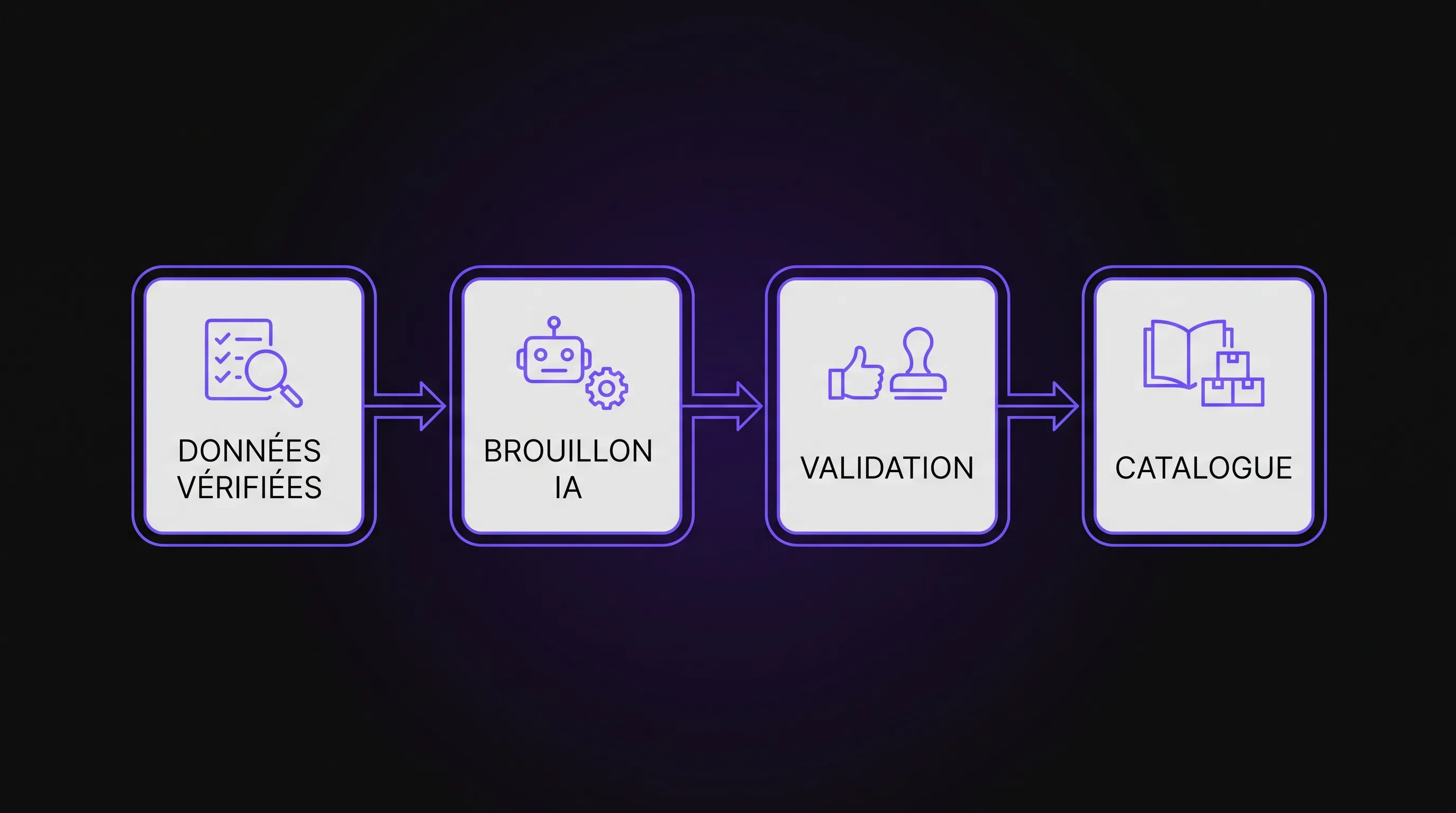
AI-assisted product creation should instead fit into a simple workflow: retrieve verified data, generate a draft, review it, and then push the approved version to the CMS managing your store.
The model handles drafting. Deterministic rules validate required fields, formats, and SKU references. A human reviewer signs off on sales claims or edge cases. This division of labor avoids delegating checks to an LLM that standard software can perform more reliably.
Start by routing outputs into a staging or drafts folder. Publishing directly to production is by no means a prerequisite for unlocking productivity gains.
Planning for Errors and Updates
Keep track of the product SKU, the input data used, the prompt version, and the approved text. This enables you to trace the origin of an error and understand why two generated outputs differ.
A structured output format simplifies integration, but it does not guarantee truthfulness. A perfectly valid JSON file can still contain an invented compatibility feature. Schema validation and factual checks must therefore complement one another.
You should also define how the system behaves when failures occur: missing mandatory data, overly long outputs, or service downtime. The product sheet should remain on hold rather than being pushed live with incomplete content.
Finally, any change in product materials or dimensions should trigger an automatic review of the affected copy. A listing that was accurate when published can easily become outdated after a product spec changes.
Measuring Time Saved on a Pilot Batch
Do not evaluate the project solely by the number of words or descriptions generated. The metric that truly matters is the total turnaround time from raw data to a publication-ready sheet, including human review.
Select a representative pilot batch: straightforward products, a few variants, and SKUs with less complete data. First, measure your current baseline process, then evaluate the AI-assisted process under identical conditions.
Here is an entirely hypothetical calculation illustrating the methodology, without promising these exact figures:
Metric
Manual Process
Assisted Process
Number of listings
200
200
Average human time per listing
12 minutes
4 minutes
Total human time
40 hours
13 hrs 20 mins
Human time saved on the batch
N/A
26 hrs 40 mins
Assisted time must account for input preparation, proofreading, and edits. Initial setup, API fees, and maintenance should be tracked separately.
Creating product listings with artificial intelligence becomes cost-effective when these operational savings outweigh system costs without degrading quality. If editing drafts takes nearly as long as writing from scratch, refine your input data or prompt brief first.
Tracking Quality Alongside Speed
Monitor your first-pass acceptance rate, correction time, and the number of unverified claims caught during review. Distinguish minor stylistic tweaks from factual specification errors; their operational impact is very different.
Sales performance can be evaluated later, but an uptick in conversion cannot be automatically credited to new copy alone. Pricing, imagery, traffic quality, and promotions also heavily influence performance.
Before scaling the workflow across your entire catalog, ensure you have established consistent operational gains over multiple pilot batches. That provides a far firmer foundation than a single successful demo on three easy items.
Choosing Between an Off-the-Shelf Tool and Custom Integration
A generic AI writing tool may be sufficient for a small catalog, a solo operator, and infrequent updates. The key is simply standardizing your prompts and editorial review.
A custom integration becomes worthwhile when data flows across multiple systems, validations involve several team members, or updates are frequent. In that scenario, the business need is as much about streamlining the workflow as it is about drafting copy.
Before building custom software, check available API connections, import formats, and data access policies. Avoid submitting personally identifiable information or proprietary documents unnecessary for copywriting.
Our framework for choosing, integrating, and measuring an AI solution can help you weigh options based on total cost of ownership and workflow fit, rather than just the impressiveness of a single generated sample.
Frequently Asked Questions
Can you generate a complete product sheet from an image alone? AI can describe visible features, but an image cannot reliably confirm materials, internal dimensions, safety certifications, or performance metrics. Always use verified technical specifications as your source of truth.
Does every single listing need to be proofread? During the pilot phase, yes. Later on, certain baseline checks can be automated. However, new product categories, sensitive specifications, and flagged missing attributes should always undergo appropriate human review.
Can product sheets be translated using the same process? Yes, starting from an approved source version. Have someone fluent in the target language review units of measurement, industry terminology, and commercial phrasing. Translation should never introduce claims not present in the original.
Does AI replace a PIM? No. A PIM organizes and governs your product data. A generative model helps rephrase and present that data, but it cannot replace source tracking, variant management, and lifecycle controls.
Structuring Your First Product Sheet Workflow
To accelerate product sheet creation with artificial intelligence, start with a single category, verified data inputs, and a straightforward output format. Measure the real-world time to approval before expanding the scope.
Impulse Lab supports businesses with AI opportunity audits, integrations with existing tech stacks, and custom web and AI solutions. A preliminary discussion can help clarify whether your use case calls for a simple writing assistant or an automated pipeline connected directly to your catalog.