Sound is often neglected in digital projects despite being a key quality factor. With **AI Audio**, you can generate voiceovers and audio assets quickly, but achieving a “pro” result requires a method. This guide offers a pragmatic approach to industrializing quality audio generation.
January 04, 2026·8 min read
Sound is often the poor relation of digital projects, even though it is one of the first factors in perceived quality (ads, product videos, onboarding, support). With AI Audio, you can now generate voiceovers, voice messages, or audio packaging quickly, but obtaining a “pro” result requires a method. Between incorrect pronunciations, artificial intonations, artifacts, and legal issues (rights, consent), many teams find themselves improvising.
This guide gives you a pragmatic approach to generating quality voice and audio with AI, in the context of SMEs and scale-ups, and above all, to industrialize the result.
AI Audio: What exactly are we talking about?
Under the term “AI Audio,” we find several families of technologies. Confusing them is a frequent source of disappointment because the constraints, the quality, and the risks are not the same.
Need
AI Audio Family
Input
Output
Typical Cases
Make text speak
Speech Synthesis (Text-to-Speech, TTS)
Text
Voice
Video voiceover, e-learning, IVR
Transform one voice into another
Voice Conversion (Speech-to-Speech)
Voice Audio
Voice Audio
Localization, “brand” voice
Reproduce a target voice
Voice Cloning
Voice Examples
Similar Voice
Persona, content continuity
Create “non-verbal” sound
Audio Generation (music, ambiance, SFX)
Prompt, reference
Audio
Jingles, sound design, background sound
Improve a recording
Enhancement (denoising, separation, mastering)
Raw Audio
Cleaned Audio
Podcasts, video calls, interviews
In business, most quick-ROI projects start with TTS + post-production (and sometimes enhancement). Cloning comes later, when the need for brand consistency is real and the legal framework is clear.
Business Use Cases that “Make AI Audio Profitable”
For an SME or a growing team, AI Audio becomes interesting when it reduces production time or increases content volume without lowering quality.
Marketing and Content: voiceovers for ads, product videos, demos, social content, multi-language versions.
Good habit: start with a use case where you can measure an impact (production cost, time-to-publish, conversion, CSAT, reduction in tickets). If you already have a KPI approach, you can align it with your global tracking (see also the Impulse Lab article on AI KPIs).
What Does “Quality Audio” Look Like (and How to Evaluate It)
Audio quality isn't limited to the fact that “it sounds natural.” It also requires consistency, intelligibility, and usage robustness.
Criteria
What it means
How to test it quickly
Intelligibility
Understood without effort, even on mobile
Headphone + phone speaker test, long sentences
Prosody
Credible rhythm, pauses, emphasis
Scripts with questions, numbers, proper names
Pronunciation
Brand names, anglicisms, acronyms
List of “sensitive” words and business validation
Consistency
Same timbre and style from one episode to another
Generate 10 excerpts, compare cold
Artifacts
No glitches, strange breathing, “stuck” syllables
Attentive listening to silences and ends of sentences
Mix and loudness
Regular volume, not aggressive, adapted to platform
Normalize, verify before export
Latency and throughput
Generation time compatible with usage
Measure on 50 requests, peaks included
To go further, many teams use listening tests inspired by industry practices (for example, the Mean Opinion Score, MOS logic, common in speech evaluation). The important thing is less the “perfect score” than the comparison between versions and stability.
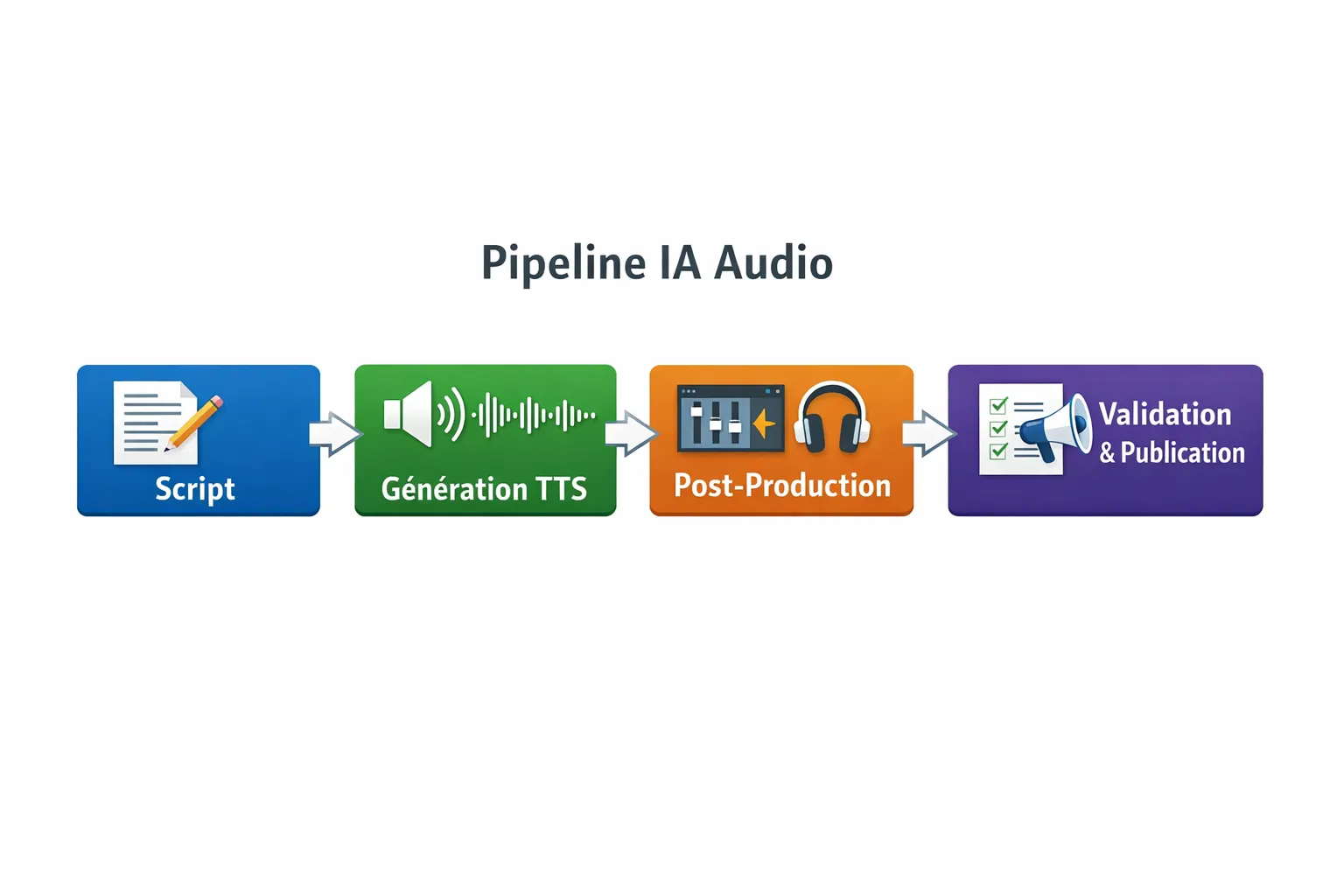
Simple Method to Generate Truly Clean AI Voice (Without Spending Weeks)
Most failures come from a briefing and validation problem, not the model.
1) Set the editorial framework (before generating)
Define a light “audio charter,” just as you would for a graphic charter.
Target audience (prospects, clients, internal)
Tone (neutral, energetic, premium, educational)
Speed (slow for training, more dynamic for ads)
Pronunciation rules (brand, products, acronyms)
Constraints (languages, duration, distribution platform)
A point often underestimated: the script is an audio quality tool. A sentence that is too long or too “written” quickly results in an artificial rendering.
2) Prepare representative test scripts
Before producing 200 minutes of audio, prepare 1 to 2 pages containing:
Numbers (prices, dates, percentages)
Proper names and business terms
Short and long sentences
Questions, exclamations, transitions
These scripts serve as a test bench to compare voices, settings, and post-processing.
3) Choose the approach: off-the-shelf or custom
In practice:
Standard TTS: fast, low risk, ideal for starting.
Custom/Cloned Voice: useful if the voice is a brand asset (podcast, sonic identity), but requires a legal framework and a stricter validation process.
The right choice depends on your publication frequency, the number of formats, and your risk exposure (brand, legal, reputation).
4) Switch to “production quality” with minimal post-prod
Even an excellent AI voice benefits from light treatment:
Cleaning breaths or clicks if necessary
Light equalization (EQ) to clarify
Gentle compression to stabilize
Level normalization (loudness) according to the platform
This is often where the difference between “decent AI” and “studio rendering” is made.
5) Validate with a simple (and repeatable) protocol
Before publication, have it validated by 2 profiles:
A “business” profile (accuracy of terms, pronunciation)
A “communication” profile (tone, brand consistency)
Keep an identical checklist from one piece of content to another. You drastically reduce variability.
Data, Rights, and Compliance: The Point Not to Miss
As soon as you manipulate voices, you touch upon identity and consent. Two simple rules:
Do not clone a voice without explicit and traceable authorization (contract, consent, scope of usage).
Do not reuse recordings containing personal data without a clear legal basis and without governance (storage, access, deletion).
In France, for personal data aspects, refer to the recommendations of the CNIL and your DPO if you have one.
Regarding regulations, the European AI Act introduces transparency obligations for certain synthetic content (depending on use cases and qualification). For a reference reading, consult the official European Commission page on the AI Act.
In practice, put in place:
An internal “synthetic audio content” policy (when, how, disclaimer, validations)
A registry of voices used (source, rights, duration, limitations)
An approval process for sensitive content (support, HR, crisis communication)
Industrializing AI Audio: Integration and Automation
Audio generation becomes truly profitable when it integrates into your workflows. Examples:
From a CMS: generate an audio version of an article (and update it when the text changes)
For Product: produce voice messages from validated templates
For Support: standardize IVR announcements, hold messages, logistical information
As soon as tools are connected, quality is no longer enough. You need clean integration (auth, logs, monitoring, quota management, security). If you have a tech team, you can draw inspiration from integration best practices described in the Impulse Lab article on AI APIs (clean and secure models).
Buy vs Build: When to Go Custom?
Many companies start with a SaaS tool, then stumble on consistency, governance, or integration. Here is a simple benchmark.
Not measuring: without a protocol, you don't know if you are improving.
FAQ
What does “AI Audio” mean in a business context? AI Audio groups together technologies capable of generating, transforming, or improving audio, notably speech synthesis (TTS), voice conversion, voice cloning, music/ambiance generation, and audio enhancement tools.
How to get an AI voice that sounds natural? Naturalness comes from a combination: a script written for speaking, a good choice of voice and settings (rhythm, pauses), then light post-production (EQ, compression, normalization). Without these steps, even a good model can sound artificial.
Can we clone the voice of a leader or employee? Yes technically, but it requires a strict framework: explicit consent, scope of usage, duration, secure storage, and legal validation. Without this, the risk (legal and reputational) is high.
How to evaluate the quality of AI-generated audio without being an expert? Use a simple protocol: test scripts containing numbers and sensitive terms, listening on phone + headphones, checklist of artifacts and pronunciation, then cross-validation (business + communication).
When to switch from a tool to a custom solution? When you publish often, when brand consistency becomes critical, when you need to integrate generation into your workflows (CMS, CRM, support), or when you have compliance and data constraints.
Turning AI Audio into a Brand Asset (Rather Than a Gadget)
If you are considering AI Audio to produce voiceovers, structure an audio pipeline, integrate voice generation into your product, or frame voice cloning, Impulse Lab can help you frame it quickly.
Audit of opportunities and risks (quality, compliance, ROI)
Development of custom web and AI solutions
Integrations with your existing tools and workflow automation
Training teams for responsible adoption
You can present your context and constraints via the Impulse Lab site, then start with an exchange: impulselab.ai.