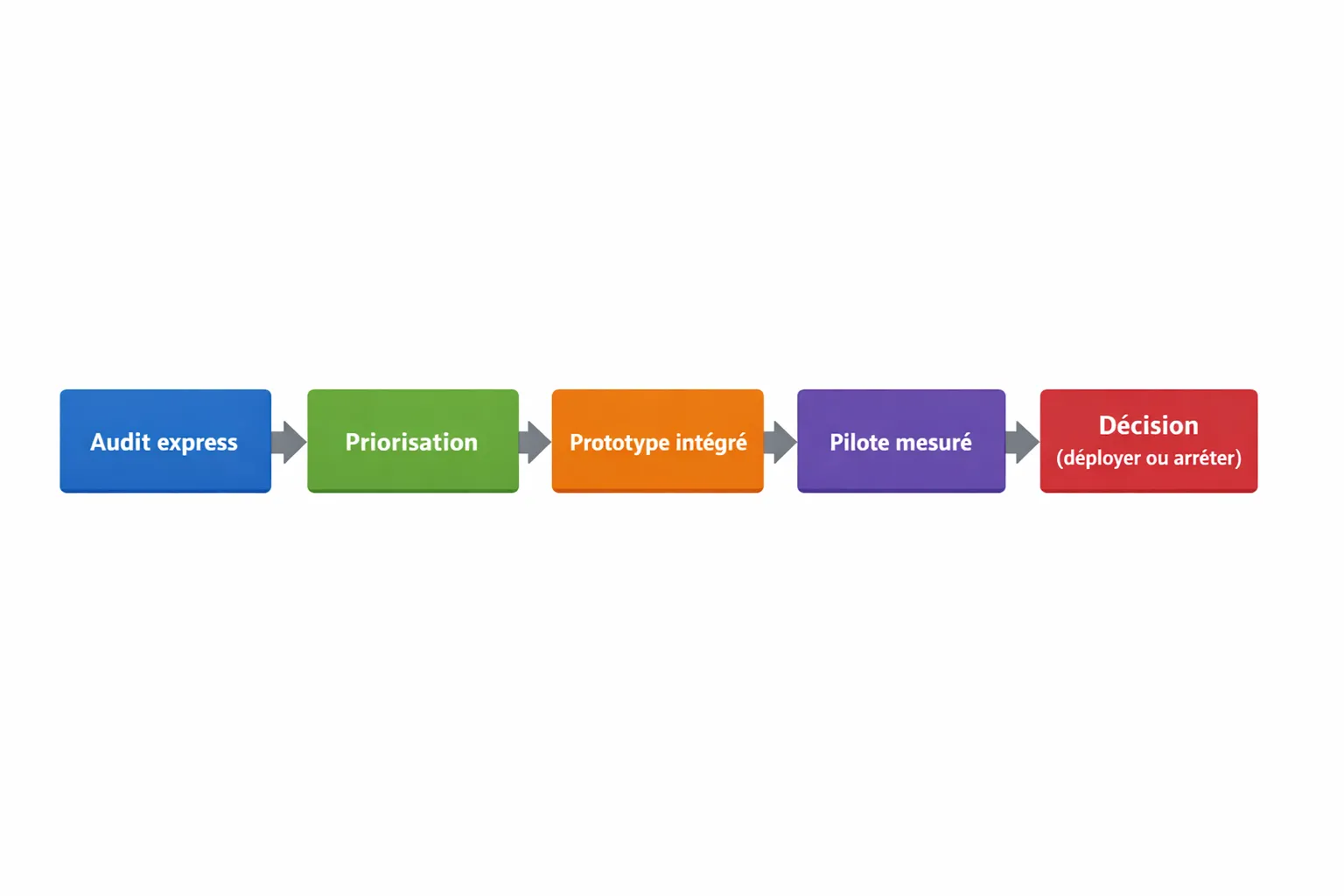
You don’t need a 6-month project to start capturing value with AI. Most SMEs and scale-ups already have "pockets" of efficiency within their tools and processes, accessible in a few days or weeks… provided you know where to look.
This express AI audit checklist is designed to identify realistic quick wins (automation, assistance, information extraction, light integration) and avoid false good ideas (gimmicky POCs, overly risky topics, impossible-to-use data).
What is an AI audit "quick win" (and what it isn’t) A quick win isn’t necessarily "technically simple." It is primarily a use case that ticks 4 boxes:
Measurable impact (time saved, tickets avoided, accelerated revenue, reduced errors)
Short integration into the existing workflow (CRM, helpdesk, Google Workspace/M365, Slack/Teams, ERP…)
Controlled risk (data, compliance, security, quality)
Rapid deployment (prototype in a few days, pilot in 2 to 4 weeks in many contexts)
Conversely, the following are rarely quick wins:
Replacing a core tool (ERP/CRM) "with an AI"
Automating a process that isn’t standardized
Deploying AI on sensitive data without a framework (contracts, health, HR) or guardrails
Criterion
Typical quick win
Long / risky bet
Data
Already available, low sensitivity, fairly clean
Scattered, sensitive, ungoverned
Usage
Repetitive and frequent
Rare, highly variable
Integration
In existing tools
New product, major change
Measurement
Easy KPI to instrument
Diffuse impact, complex attribution
The express checklist (45 to 90 minutes) to find your quick wins Objective: leave this mini-audit with 3 to 7 use cases ranked, each with an ROI hypothesis, a risk level, and a clear next step.
1) Frame the scope in one sentence Without framing, you collect ideas, not a plan.
Good format: "Reduce time spent on Y (function) by X%, without increasing risk Z, within 30 days."
Realistic examples:
Reduce support response time on simple requests, without exposing personal data
Accelerate sales qualification, without degrading info quality in the CRM
Decrease document processing time (quotes, invoices, orders), with human oversight
2) List 10 "low value" tasks that recur every week Here, no need to be exhaustive. You are looking for tasks that combine volume + repetition + friction .
Good signal: "We do it because we have to, not because it creates value."
Frequent examples in SMEs/scale-ups:
Summarizing meetings and producing actionable minutes
Searching for info in internal docs (Notion, Drive, Confluence)
Categorizing, routing, replying to recurring emails
Updating the CRM after calls / meetings
Extracting fields from PDFs (orders, invoices)
You want to know where AI can fit in fast. Take a sheet of paper and note:
"System" tools: CRM, helpdesk, ERP, billing, knowledge base
"Flow" tools: email, internal chat, forms, calendar
Where data is: Drive, Notion/Confluence, SQL bases, data warehouse
Who owns what: business owner + IT/data owner
Tip: a quick win is often a short integration rather than "yet another AI tool."
4) Identify manipulated data and classify risk Before even talking models, ask the question: what data passes through the AI?
Simple categories:
Public / non-sensitive : marketing content, public FAQs
Internal non-critical : internal procedures without personal data
Personal data (GDPR) : emails, tickets, CRM, HR
Confidential / strategic : pricing, contracts, finances, code
If you touch personal data, look at a minimum at:
Legal basis and minimization (GDPR)
Contract/DPA with the provider and retention rules
Logging and access control
To situate obligations, the European AI Act also formalizes a risk-based approach (it is not just a "tech" topic).
5) Write an ROI hypothesis (even a rough one) The ROI of a quick win must be proven. Do a simple calculation:
Minutes saved per occurrence
Occurrences per week
Loaded cost (or capacity freed)
Quality impact (errors avoided, reduced delay)
Example (simple): 8 minutes saved on 150 tickets/month = 1,200 minutes, i.e., 20 hours/month. Then, you apply a cost and compare it to the effort.
If you want to go further on measurement, you can rely on dedicated KPI logic (Impulse Lab has a complete guide on the subject: AI KPIs: measuring the impact on your company ).
6) Prioritize with an "Impact / Effort / Risk" scorecard Don’t discuss for 2 weeks. Score quickly, then test.
Dimension
Question
Score 1
Score 3
Score 5
Impact
Is the gain visible on an operational KPI?
Vague
Measurable
Critical
Frequency
How many times/week?
Rare
Regular
Daily
Effort
Integration and process changes
Heavy
Medium
Light
Data
Accessible and usable?
No
Partial
Yes
Risk
GDPR/security/business error
High
Medium
Low
Then choose 2 use cases :
1 "very safe" (low effort, low risk)
1 "more ambitious" (higher impact, reasonable effort)
7) Define the expected "next proof" A quick win advances through proofs, not opinions.
For each selected use case, note:
A pilot scope (team, volume, duration)
A main KPI (north star)
2 guardrails (quality, compliance, cost)
A clear stop condition (if it doesn’t work)
For a structured testing approach, you can also draw inspiration from a rapid validation protocol (see: Enterprise AI Test: simple protocol to validate your ideas ).
The most frequent quick wins (and what to check beforehand) The idea isn’t to copy a "trendy" use case, but to spot those that fit into your operational reality.
Function
Frequent AI quick win
Necessary data
Vigilance point
Support
Assisted responses + ticket routing
Ticket history, knowledge base
Confidentiality, hallucinations, tone
Sales
Call minutes + CRM update
Recordings/calls, CRM fields
Consent, summary quality
Ops
Field extraction from PDF/email
Recurring docs, stable formats
Error rate, human oversight
Finance
Pre-categorization and document checking
Invoices, accounting rules
Sensitive data, traceability
HR
Internal FAQ + drafting assistance
Internal policies, docs
Personal data, access
Marketing
Content reuse + briefs
Existing content, ICP
Brand consistency, validation
On "support" cases, Impulse Lab has already detailed the impacts and deployment patterns (if this is your priority: Chatbot for SMEs: use cases that pay off ).
"Ready-to-print" mini-checklist (to tick during the audit) To check
Simple question
If "no"
Clear problem
Can the task be described in 1 sentence?
Reformulate, otherwise stop
Baseline
Do we currently measure time/cost/quality?
Measure for 1 week
Data
Do we know where the data is and who owns it?
Appoint an owner
Integration
Can it be inserted into the current tool?
Review the approach
Validation
Who validates quality (business side)?
Appoint a reviewer
Compliance
Is the data sensitive?
Define guardrails
Adoption
Who will use it, when, and why?
Add a change management step
Cost
Do we have a monthly cost ceiling?
Set a budget guardrail
The 5 signals indicating it’s not a quick win When these signals appear, you aren’t "blocked," you are just on a topic that deserves a more complete audit.
Unfindable or inconsistent data If you spend more time looking for data than testing the use case, the order of priorities is clear: governance, access, quality.
Non-standardized process AI amplifies a process, it doesn’t replace it. If everyone does it "their own way," start by standardizing the minimum.
High legal or reputational risk As soon as you touch sensitive decisions (HR, credit, compliance, health), you need a more robust framework, not a quick fix.
No integration, only a demo An AI "on the side" creates friction. Without integration, adoption drops and so does ROI.
No one is owner A quick win without an owner becomes a ghost POC.
After the checklist: a simple 10-day plan to take action D1 to D2: choose 2 use cases and freeze KPIs Even if your KPIs are imperfect at the start, they prevent you from making up stories.
D3 to D6: integrated prototype (not a mockup) Priority on: authentication, access rights, logs, controlled cost, and insertion into the daily tool.
D7 to D10: short pilot, measurement, decision Decide based on a scorecard:
Operational gain
Quality (error rate, user feedback)
Risk (incidents, data)
Cost (predictable, capped)
Then: either you industrialize, or you cut it cleanly.
When to switch from an express checklist to a full AI audit If you have identified quick wins but also see cross-functional topics (data, security, stack, governance), a checklist is no longer enough.
In this case, a more structured AI audit allows mapping opportunities and risks and producing a roadmap. For understanding this format, you can read: Strategic AI Audit: mapping risks and opportunities .
Need an external look to secure your quick wins (without slowing down delivery) If you want to:
Identify 5 to 10 truly profitable AI opportunities quickly
Prioritize with ROI and risk logic (GDPR, security, AI Act)
Build a pilot integrated into your tools, delivered in short iterations
Impulse Lab accompanies SMEs and scale-ups via AI audits , custom development , automation , integration , and adoption training .
You can start with a scoping discussion via the site: impulselab.ai .