AI Consultant: missions, deliverables, and rates in 2026
Intelligence artificielle
Stratégie IA
Audit IA
Gestion des risques IA
ROI
Hiring an **AI consultant** in 2026 is no longer about "testing ChatGPT" or launching an isolated POC. Successful companies know: value comes from **processes**, AI must be **integrated** into the existing stack, and risks must be addressed early.
April 01, 2026·9 min read
Hiring an AI consultant in 2026 is no longer about "testing ChatGPT" or launching an isolated POC. Most successful companies have understood three things: value comes from processes, AI must be integrated into the existing stack, and risks (data, security, compliance, costs) must be addressed right from the scoping phase.
This guide helps you purchase an AI consulting mission as a professional deliverable: which missions to assign, which deliverables to demand, and how to read the rates without falling into the demo effect trap.
AI Consultant in 2026: one profession, multiple profiles
The term "AI consultant" covers very different realities. In 2026, we generally encounter 3 profiles, often combined within the same mission.
Profile
Main objective
When it's the right choice
Risk if poorly chosen
Strategy / opportunities
Prioritize use cases and scope the value
You have many ideas, little prioritization
A "PowerPoint" with no execution or metrics
Delivery / AI product
Build a useful, integrated, measured V1
You need to deliver fast and cleanly
A demo that cannot be used in production
Adoption / change management
Drive AI usage, standardize practices
Teams are not adopting or are doing shadow AI
A tool in place, but zero impact
In SMEs and scale-ups, the best configuration is often a consultant who knows how to scope and deliver, or a hybrid team (product + data/AI + software) depending on the complexity.
Typical missions of an AI consultant (and the intention behind them)
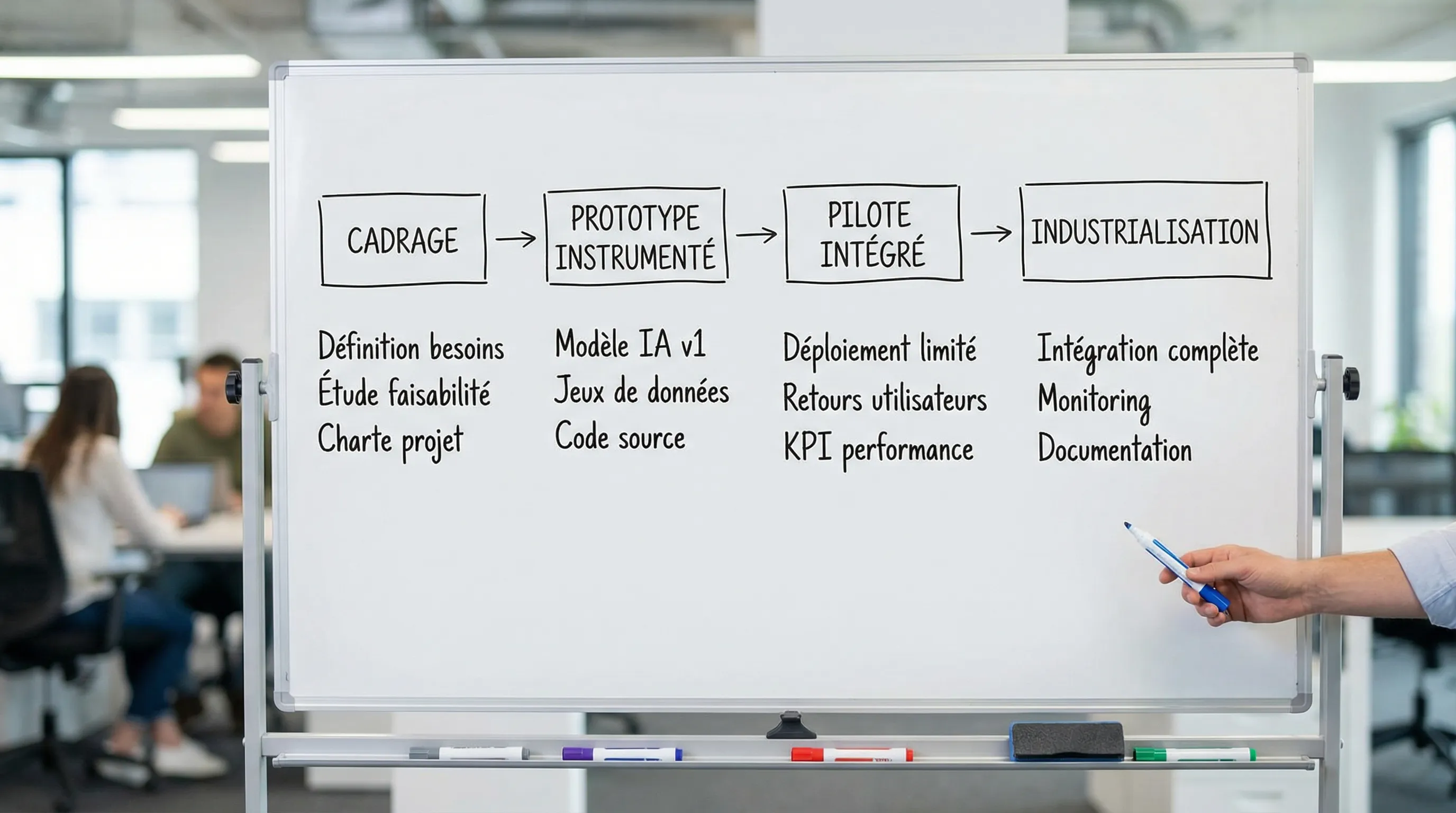
When purchasing services, the "missions" matter less than the expected result. Here are the most frequent missions in 2026, along with their associated intention.
1) AI opportunities audit (aiming for quick wins, without losing focus)
Objective: identify 2 to 5 use cases with a fast ROI, feasible within your constraints (data, tools, teams).
This type of mission is particularly useful when:
you have AI requests popping up everywhere (marketing, support, ops) but no common framework,
you fear buying a tool too early,
you want a short, actionable roadmap.
At Impulse Lab, this angle corresponds to the AI audit logic (opportunities + risks + 90-day plan), detailed in the guide on the strategic AI audit.
2) AI project scoping (moving from an idea to a usage contract)
Objective: transform "we want an assistant" into a testable, measurable scope with rules.
A good AI consultant helps you to:
define the users, the workflow, and the entry point (CRM, helpdesk, intranet, website),
specify what the AI must do, and especially what it must not do,
choose the right pattern (API, RAG, agent) according to risk and maturity.
3) Instrumented prototype (proving value, not technology)
Objective: obtain a prototype that already looks like a product, with metrics, rather than a demo.
In 2026, serious prototypes often include:
a selection of real cases (tickets, emails, documents),
a reproducible test protocol,
minimum guardrails (data, refusals, escalation).
4) Integrated pilot (putting a V1 into the workflow)
Objective: deploy on a restricted scope, with users, metrics, and an improvement loop.
This is where the majority of POCs fail, because the effort shifts towards: integrations, access rights, traceability, support, training, and cost control.
5) Industrialization and run (securing the long term)
Objective: move from "it works for 5 people" to "it's a reliable enterprise component".
This almost always involves:
a minimum of observability (quality, latency, costs, incidents),
a run plan (who fixes, who arbitrates, who validates evolutions),
On the KPI side, a serious consultant must talk about instrumentation and impact, not just "adoption". The topic is detailed in the guide Transforming AI into ROI: proven methods.
Expected deliverables of a "production-minded" pilot
A useful pilot must leave reusable artifacts. Otherwise, you pay twice.
Integrated MVP (even minimal): real entry point (CRM/helpdesk/intranet), authentication, rights.
Evaluation: results on real cases, quality measurements, and clear decisions.
Logging and traceability: at a minimum, being able to explain "why" an answer was given, and from which sources if RAG.
Pre-runbook: typical incidents, degraded mode, who does what.
AI consultant rates in 2026: how to reason (without getting trapped)
The price depends less on the word "AI" than on three parameters: seniority, scope (scoping vs. delivery), and risk level (sensitive data, actions on systems, compliance requirements).
Common billing models
Model
When it's relevant
Advantage
Vigilance
Daily Rate (TJM)
Exploratory mission or iterative delivery
Flexible, easy to start
Demand weekly deliverables and exit criteria
Fixed price per phase
Audit, scoping, timeboxed pilot
Better budget visibility
A vague fixed price often hides exclusions
Time & Materials + cap
Long projects with uncertainties
Financial risk control
Without governance, scope creep happens fast
Monthly retainer
Run, optimization, adoption
Continuity, continuous improvement
Requires a backlog and clear prioritization
Daily rate (TJM) ranges in France: 2026 orders of magnitude
Rates vary greatly depending on specialty (LLMs, data, product, security), scarcity, and ability to deliver. The ranges below are observed orders of magnitude in the market (freelancers and agencies) and not "official" prices.
To be read with a simple rule: if your use case touches sensitive data, executes actions (agent), or impacts the end customer, paying a little more for seniority often costs less than fixing a fragile V1.
Budgets by mission type: useful benchmarks
Without inventing a "single price", we can provide benchmarks by intensity and duration.
For obligations and best practices, the CNIL publishes useful resources on the compliance side.
2) Integrations: where ROI is won
Integrating cleanly into your CRM, helpdesk, ERP, or intranet can represent a significant part of the effort, but it is also what transforms AI into real productivity.
3) Controlling variable costs (especially with LLMs)
Without guardrails, the inference bill can drift: prompts that are too long, lack of caching, out-of-scope usage, or poorly controlled agent loops.
Beyond the daily rate, compare based on evidence. A good AI consultant quote should clearly answer these points.
1) Value and measurement
Which North Star KPI will be improved?
What is the baseline (before) and what is the measurement method (during/after)?
What are the guardrails (quality, risk, compliance)?
2) Deliverables and exit criteria
What is delivered at D+7, D+14, D+30?
What is the go/no-go to move to the next phase?
Who validates, and on what criteria?
3) Reversibility and maintenance
Documentation, runbook, ownership,
ability to change models or providers if needed,
skills transfer.
4) Security, GDPR, AI Act
In 2026, it is difficult to justify a client-facing project without a minimum of governance.
For the legal framework, the reference text is the EU AI Act. (Obligations are progressive, and your level of requirement will depend on the risk.)
For risk management, many organizations use the NIST AI RMF as a practical grid.
Red flags (you will pay dearly later)
"We'll see about the KPIs later, first we prove it works."
No written deliverables, only meetings.
A POC that doesn't touch your actual tools.
No discussion about data (sources, access, PII) or operations.
For an agent, no mention of permissions, confirmations, logs.
These signals do not mean "bad consultant", but they often mean "poorly purchased mission".
Freelance consultant vs. AI agency: the right decision in 2026
Many companies hesitate between a freelance AI consultant and an agency.
Freelance: excellent for precise scoping, fast execution on a limited scope, or reinforcing a team.
Agency: useful as soon as you need multidisciplinary delivery (product, design, software, data, security), short cycles, and continuity.
If you are an SME or a scale-up "in structuring phase", the most robust trajectory often looks like: short audit (prioritization) then integrated pilot (measured) then industrialization.
Working with Impulse Lab: a deliverables and value-oriented approach
Impulse Lab supports SMEs and scale-ups with a simple logic: opportunities audit, adoption training, then custom development when necessary (platforms, automations, integrations). If you want to start without getting the scope wrong, you can begin with:
an opportunities audit (to prioritize and estimate costs),
or project scoping (to lock in KPIs, data, architecture, test plan).
You can present your context and constraints on the Impulse Lab website to quickly determine the right mission format and the deliverables to target from the very first weeks.
AI Copilot or AI Agent: Which Format for Which Process?
Should you equip teams with an AI copilot or deploy an autonomous AI agent? Discover the operational differences, decision criteria, and real-world use cases to choose the right AI format for your business processes.