AI Culture: The Competitive Asset for SMEs in 2026
Stratégie d'entreprise
Stratégie IA
Culture IA
In 2026, SME competitive advantage won't come from a magic tool, but from a solid AI culture shared by leadership and teams. Companies placing AI at the center of operations, decisions, and revenue are already accelerating execution speed, reducing costs, and improving customer experience.
December 29, 2025·8 min read
In 2026, the competitive advantage of SMEs will not come from a new magic tool, but from a solid AI culture, shared by leadership and teams. Companies that place AI at the center of their operations, their decisions, and their revenue are already accelerating execution speed, reducing costs, and improving customer experience. The difference lies in discipline, measurement, and alignment, not just technology.
What is meant by "AI culture" in an SME
AI culture describes a set of norms, skills, and rituals that make the use of AI natural, measurable, and safe on a daily basis. It is not limited to experimenting with a chatbot. It implies structuring decisions, processes, and data so that AI becomes a lever for revenue and efficiency.
Concretely, a healthy AI culture brings together five elements:
A clear business vision with measurable objectives.
Accessible and governed data, connected to AI-ready platforms.
Diffused skills, thanks to training and mentorship.
Automated processes via rapid iterations.
Continuous measurement of value created and risks controlled.
This culture articulates very well with a RevOps approach, which aligns Marketing, Sales, and Customer Success around the same pipeline, the same data, and the same indicators.
Why 2026 is the year of cultural advantage
Models are becoming a commodity. The differentiator shifts from "which model" to "what data, what processes, what execution".
Agent architectures and orchestration standards like MCP are accelerating end-to-end automation. See our analysis on Agentic AI and MCP.
The regulatory framework is settling in. The European AI Act is adopted and enters into progressive application until 2026, favoring structured and compliant players. Read the European Parliament's summary on the AI Act.
The economic potential is massive. McKinsey estimates the annual value of generative AI between 2.6 and 4.4 trillion dollars globally, driven by cognitive automation and large-scale personalization, according to its 2023 report on the potential of generative AI (source).
Organizations capable of learning faster than their competitors, replicating what works, and stopping what doesn't, consolidate a cumulative advantage that is hard to catch up with.
Tangible business effects, measured on the right KPIs
An AI culture is only valuable if it translates into indicators. Here is a simple mapping between cultural practices and expected effects on KPIs. Results vary by context, but the direction of impact is robust.
The executive committee must sponsor AI objectives linked to clear business priorities, for example reducing sales cycle time or improving first-contact resolution. Governance includes a use case registry, risk classification, and ethical guardrails. Refer to the OECD principles and the NIST AI RMF risk management framework to structure your policies.
2) AI-ready Data and Platforms
A solid foundation of CRM, customer and product repositories, and indexed unstructured data is indispensable. SMEs are increasingly combining semantic search and RAG. See our entry on RAG and the role of CRM in activation.
3) Skills and Continuous Training
AI literacy must go beyond the IT perimeter. Organize initiation sessions, shadowing, and an "AI champions" program. Managers become adoption coaches and quality guarantors. Practical and sector-specific training accelerates responsible daily usage.
4) Processes and Automation
Map high-frequency, low-complexity tasks, then automate end-to-end, favoring weekly deliveries. The role of GTM Engineer is key to industrializing commercial workflows, API integrations, and data pipelines.
5) Measurement and Continuous Improvement
Instrument every interaction with usage, quality, and business result metrics. Avoid intuition-based steering and favor short iterations, with ex-ante success criteria. Our guide dedicated to AI KPIs details the indicators to select according to your objectives.
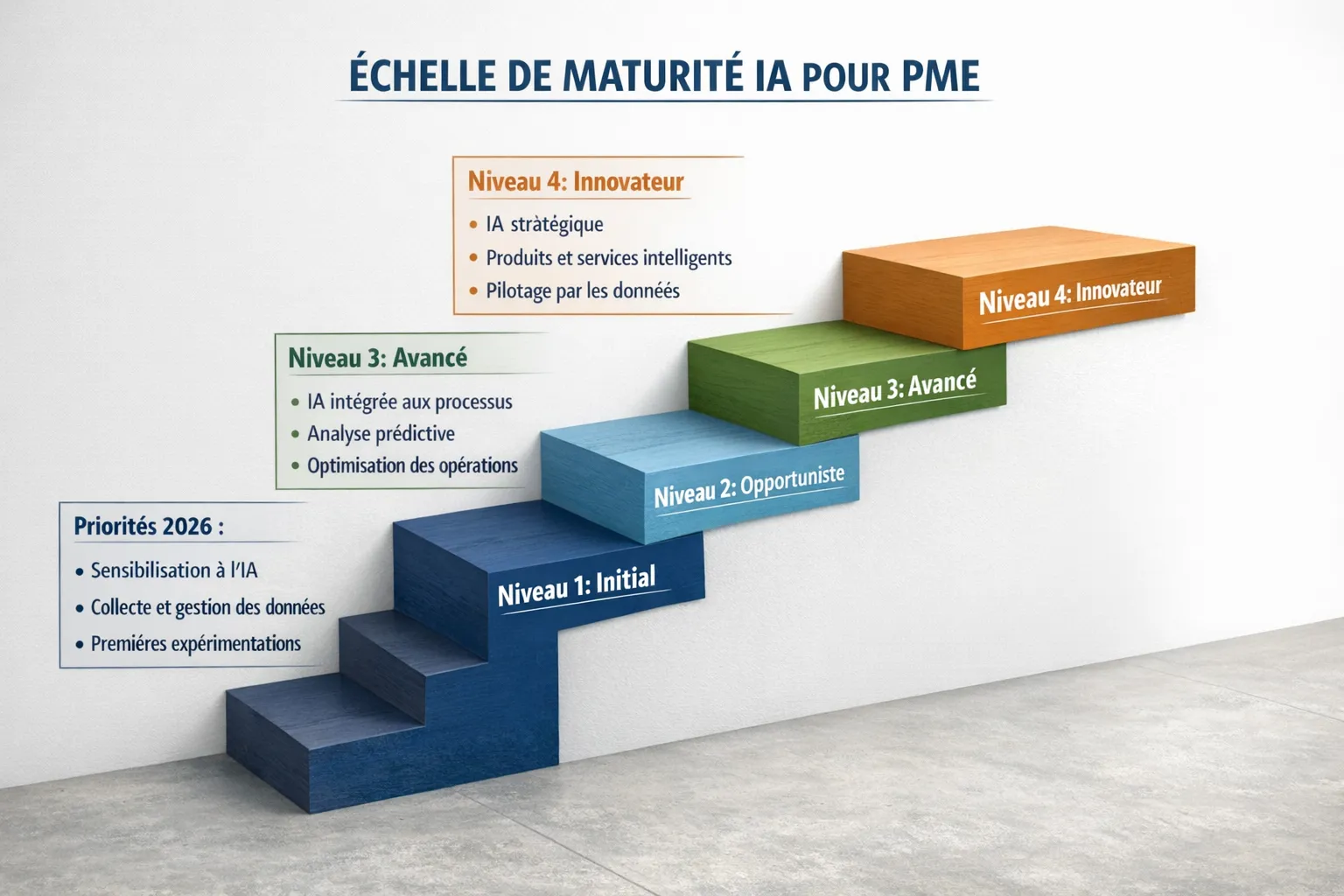
AI Maturity Scale for SMEs
Level
Description
2026 Priorities
M0 – Opportunistic
AI tools used on the fly, without policy or measurement
Awareness, usage inventory, minimal policy
M1 – Structured
A few framed and measured use cases, basic data
90-day roadmap, measured POCs, prompt governance
M2 – Industrialized
Data pipelines, integrations, cross-functional automations
Continuous QA, A/B testing, quality SLO, security and compliance
M3 – Diffused and Strategic
AI integrated into business rituals, clear budget allocation and ownership
Use case portfolio optimization, center of excellence, continuous improvement
The 90-day roadmap to install AI culture
Weeks 1 to 2 – Diagnosis and prioritization
Audit of AI opportunities, mapping of data and regulatory constraints.
Selection of 2 high-impact, low-risk use cases, with clear objectives and metrics.
End-to-end automation of ancillary tasks, workflow documentation.
Weeks 9 to 12 – Scaling and Governance
Deployment to production, impact measurement, continuous improvement loop.
Implementation of AI Act guardrails, reporting to sponsors, extension plan.
Use cases that anchor AI culture, by function
Marketing and Sales
Segmentation, enrichment, and targeting with reliable data, orchestrated by RevOps and a GTM Engineer.
Prospect prioritization via Lead Scoring enriched by behaviors and intent data.
Personalization of messages and sequences, with human validation before broadcasting.
Customer Service
Conversational assistants that resolve frequent questions, escalate cleanly, and feed the knowledge base. For proof of value, follow these Chatbot KPIs.
Operations and Back-office
Document extraction, reconciliations, quality controls, drafting of standardized analyses.
Search augmented by RAG on internal procedures and technical documentation. See our entry RAG.
Finance and HR
Synthesis of internal policies, secure Q&A for employees, contract pre-analysis with legal validation.
Security, compliance, and risk management in 2026
Compliance becomes a competitive advantage. To prepare for the AI Act and client expectations:
Classify your use cases according to risk level and document purpose, data, and controls.
Protect sensitive data, isolate contexts, encrypt and mask PII.
Deploy robust hygiene against prompt injection, context leakage, and API abuse. Our best practices on AI API integrations detail these defenses.
Log interactions for audit, explainability, and continuous improvement.
The OECD guidelines and the NIST AI RMF offer a useful backbone, complementary to AI Act obligations.
Typical value trajectory example
A B2B SME of 70 people, with busy customer support and 60-day sales cycles, can aim for in 6 to 9 months:
Deployment of a RAG-based support assistant for documentation, coupled with the CRM.
Automation of ticket sorting and level 1 responses, with escalation to a human when necessary.
In parallel on the Sales side, a mixed fit and engagement lead scoring to prioritize prospecting.
Typical effects observed in this type of trajectory, depending on context and execution quality: reduced response time, lower cost per contact, better qualified pipeline, and increased customer satisfaction. Gains are confirmed by rigorously following AI KPIs.
What a true AI culture changes
You end the innovation theater and enter a logic of proven impact.
You make your teams more autonomous, thanks to shared tools and skills.
You build a cumulative advantage, because every iteration feeds your data, your processes, and your execution.
In 2026, the question will no longer be "have you tested AI", but "do you have the capacity to deploy, secure, and measure it at scale".
How Impulse Lab can help you install this culture
Impulse Lab accompanies SMEs and scale-ups to transform AI into measurable value:
AI opportunity audits to prioritize use cases with rapid ROI.
Development of custom web and AI platforms, integrated with your existing tools.
Process automation and clean, secure API integrations.
Training and adoption to diffuse skills within teams.
Weekly delivery cadence and dedicated client portal, for transparent execution involving your teams.
From exploration to deployment, end-to-end support, with your involvement at every step.
If you want to structure an AI culture that produces results within the first 90 days and then strengthens over time, let's talk. Discover our approaches and use cases, or contact us via impulselab.ai.
The Mistakes That Cause an AI Pilot to Fail in Under a Month
AI pilots rarely fail because the tech doesn't work, but because gray areas emerge: vague KPIs, missing users, bad data, or poor integrations. For an SME or scale-up, the real danger is testing without a framework solid enough to drive a clear decision.