AI Ecommerce: Simple Strategies to Boost Your Sales
optimisation
automatisations
Intelligence artificielle
Stratégie d'entreprise
Marketing
You don’t need a 6-month “AI project” to increase sales. In e-commerce, AI has a simple advantage: it **reduces friction** (finding the right product, reassurance, fast checkout) and **increases relevance** (right message, right time, right channel).
You don’t need a 6-month “AI project” to increase your sales. In e-commerce, AI primarily offers a simple advantage: it reduces friction (finding the right product, getting reassured, paying quickly) and it increases relevance (the right message, at the right time, on the right channel).
In this article, we focus on simple and actionable strategies for ai ecommerce for SMEs and scale-ups, with clear KPIs and a pragmatic order of priority.
What “ai ecommerce” means (without jargon)
In an e-commerce context, AI is useful when it does at least one of these 3 things:
Understand a visitor better (intentions, constraints, context).
Most measurable gains come from use cases “close to the cart”, not futuristic features. Before going far, verify that you know how to measure: qualified traffic, conversion, AOV, margin, returns, processing times.
The 7 simple strategies that actually work in e-commerce
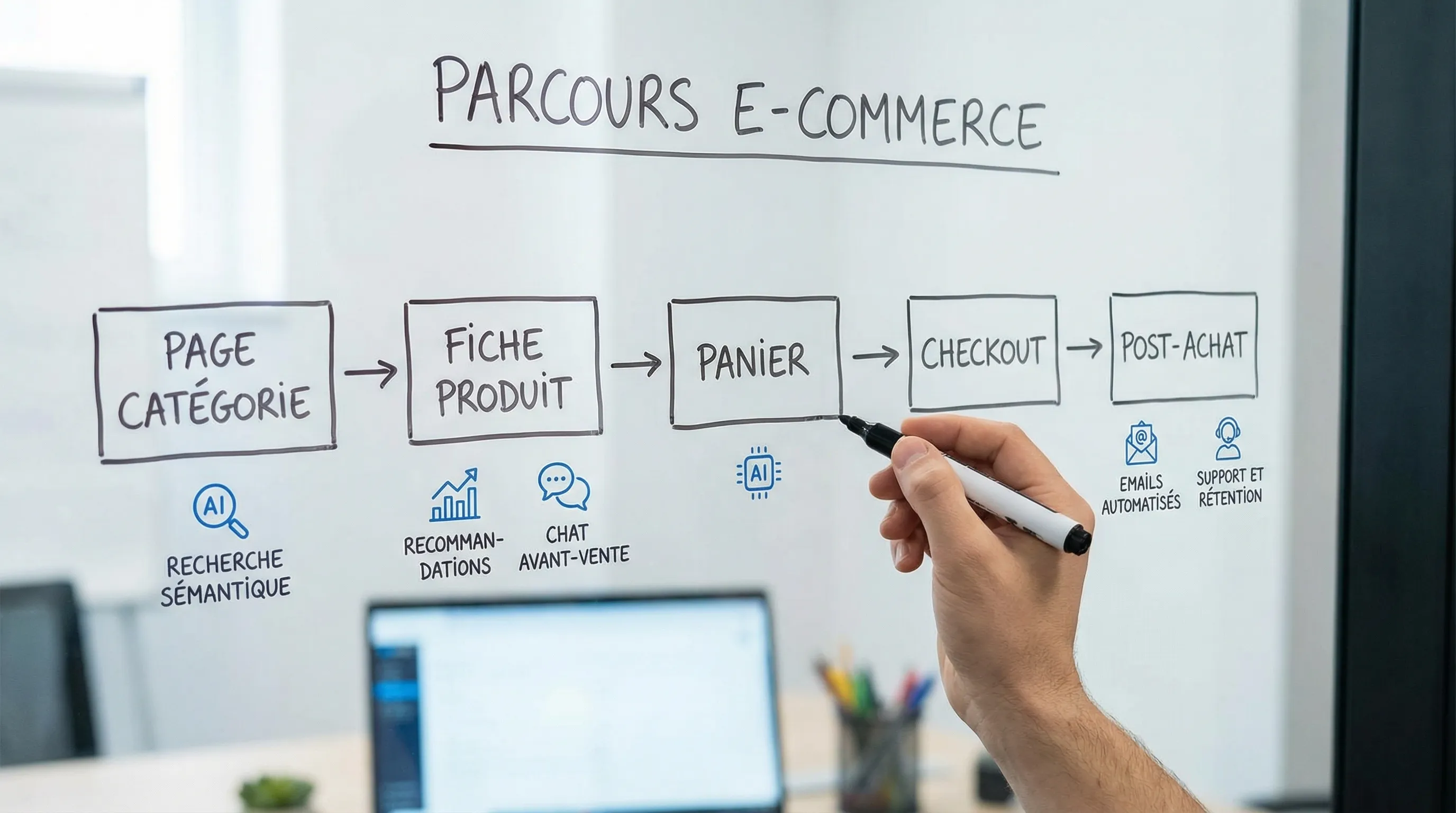
1) Improve internal search (often the fastest ROI)
On many sites, internal search is an under-exploited conversion point: poorly managed synonyms, typos, irrelevant results, incomplete filters. Yet, search captures strong intent (the user wants to buy or compare).
Simple AI approach: semantic search (understanding meaning, not just keywords) + re-ranking results based on performance (clicks, add-to-cart, conversion) + synonym management.
KPIs to track:
Search usage rate
CTR on results
Conversion of sessions with search vs without search
2) Product recommendations (but with a controlled scope)
“You might also like” recommendations exist everywhere, but AI becomes truly interesting when you constrain the engine with business rules: stock, margin, returns, sizes, compatibility, seasonality.
Simple AI approach: start with a maximum of 2 placements (e.g., product page and cart) and one objective (AOV or conversion) rather than “personalizing the whole site”.
KPIs to track:
Add-to-cart rate from reco modules
AOV uplift (average basket)
Conversion uplift (ideally via A/B test)
Margin impact (do not steer solely by revenue)
3) “Pre-sales” chat to overcome objections (not a catch-all chatbot)
A profitable e-commerce chat shouldn't “know everything”. It must primarily:
Simple AI approach: a chatbot with a controlled knowledge base (FAQ, policies, product sheets, guides), plus conversion-oriented conversational scenarios.
6) Detection of “churn risk” signals and intelligent follow-ups
In e-commerce, retention is often more profitable than “buying traffic”. AI can help identify: drop in purchase frequency, lower average basket, abnormal returns, support dissatisfaction.
Simple AI approach: customer scoring (RFM + support signals) and proportionate follow-up scenarios (offer, content, service, not necessarily promo).
KPIs to track:
Repeat purchase rate
LTV (or contribution margin LTV)
Share of reactivated customers
7) Merchandising forecasting and steering (simpler than it seems)
Without going as far as “supply chain AI”, you can already do better than steering by intuition:
Demand forecasting by category
Alerts on probable stockouts
Bundle recommendations based on co-purchases and season
Simple AI approach: lightweight models + business rules (stock constraints, supplier lead times, margin).
KPIs to track:
Stockout rate
Stock rotation
Margin and markdown
Prioritizing: what to do first (SMEs and scale-ups)
The right order depends on your volume, your catalog, and your organization. But for the majority of teams, this grid avoids scattering efforts.
AI ecommerce use case
Typical effort
Data prerequisites
Expected impact
Good starting point if…
Semantic internal search
Medium
Clean catalog, search logs
High
You have many SKUs and complex filters
Conversion-oriented pre-sales chat
Medium
FAQ/policies, top questions, handoff
High
You have many repetitive objections
Recommendations (PDP + cart)
Medium
Catalog + events (view/add/cart/buy)
Medium to High
You already have volume and a clean product base
Assisted product content
Low to Medium
Structured attributes
Medium
Your catalog is incomplete or heterogeneous
Automated emails + segmentation
Low
CRM events, consent
Medium
You have traffic but little repurchase
Simple stock forecasting
Medium
Measuring without mistakes: the minimal KPIs
An ai ecommerce strategy that “works” must be visible in business metrics, not just in demos.
E-commerce quickly touches personal data (orders, addresses, history). Best practice is to reduce the data sent to the AI, log properly, and frame the purposes.
Hallucinations: do not let AI invent policies or specs
An assistant that “invents” a return condition can cost more than it brings in. Reliable strategies:
Controlled knowledge base (source documents)
Sourced answers when necessary
Refusal and escalation if info is missing
Integration: AI is worth what it triggers
An isolated AI module, unconnected to the CRM, CMS, or support, quickly hits a ceiling. Key integrations are often: catalog, stock, CRM/emailing, helpdesk, analytics.
A simple 30-day plan (without a redesign)
Here is a realistic format if you are aiming for a measurable quick win.
Week 1: choose 1 use case and define measurement
A single business objective (e.g., +0.3 pt conversion on PDP)
A baseline (before)
A reduced scope (1 country, 1 category, 20% of traffic)
Weeks 2 to 3: build an integrated MVP
Connection to the right sources (catalog, FAQ, analytics)
Market tools may suffice to start. Custom-made becomes relevant when:
You need specific integrations (ERP, PIM, pricing rules, marketplaces)
Performance depends on fine business rules (margin, stock, product constraints)
You need to master security, traceability, and costs (TCO)
You want a differentiating experience, not a generic widget
How Impulse Lab can help you with ai ecommerce
If you want to move fast without multiplying POCs, Impulse Lab accompanies SMEs and scale-ups via:
AI opportunity audits to prioritize e-commerce use cases, frame risks, and define KPIs
Development of custom web and AI solutions (platforms, search modules, chat, integrations)
Automation and integration with your existing tools (CRM, CMS, support, analytics)
Adoption training so that marketing, support, and ops teams actually use the solution
The goal is to deliver a measurable V1, then iterate with a clear delivery cadence, rather than staying at the “demo” stage. To start, you can explore the audit approach: Strategic AI Audit: mapping risks and opportunities or contact the team via the Impulse Lab site.
AI at Work: 10 Tasks to Delegate Without Losing Control
AI at work is useful when it removes friction, not when it replaces business judgment. For SMEs and scale-ups, the right question isn't "what can AI do for me?", but rather: "what tasks can I delegate to it to save time while keeping control?"