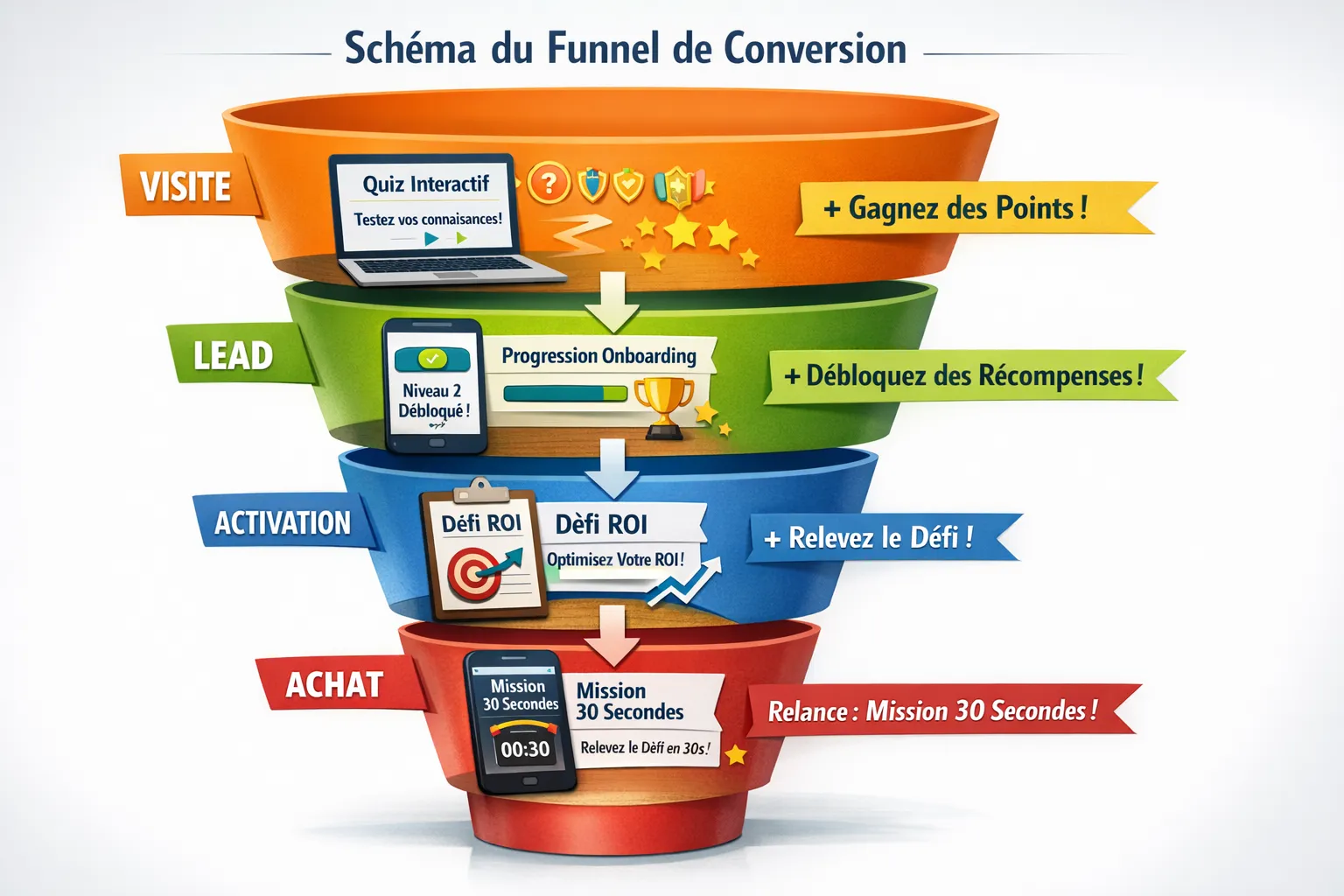
Most sites don’t have a “traffic problem,” they have an attention and action problem. This is exactly where **AI Game** (AI + game mechanics) can become a competitive advantage: transforming a cold experience (forms, quotes, onboarding, checkout) into a motivating journey.
Most sites and products don’t have a “traffic problem,” they have an attention and action problem. That’s exactly where AI Game (AI + game mechanics) can become a competitive advantage: transforming a cold experience (forms, quotes, onboarding, checkout) into a progressive, motivating, and measurable journey, without becoming a gimmick.
What changes in 2026 is the combination of two forces:
gamification has become a mature discipline on the UX side (progression, feedback, engagement)
AI models make gamification customizable and automatable (at the right time, with the right message, for the right user)
The goal of this article: to give you concrete ideas for AI-assisted gamification, directly oriented towards conversion (leads, activation, cart, upsell) and actionable for an SME or scale-up.
Gamification “conversion”: what it means (and what it isn’t)
Gamification isn’t about “putting badges everywhere.” To convert more, it must follow a simple logic:
reduce perceived effort (one step at a time)
increase feedback (I know where I stand)
create a dynamic of progression (I want to finish)
provide a clear benefit (I save time, I reduce my risk, I make a better choice)
AI doesn’t replace these mechanics. It serves to:
adapt the journey to the context (traffic source, sector, maturity)
To frame effectiveness, it is useful to keep a research reference: a highly cited academic review concludes that gamification often has positive effects, but they vary according to design and context (hence the importance of testing and measuring) (Hamari, Koivisto & Sarsa, 2014).
The 5 Golden Rules of an “AI Game” Strategy That Truly Converts
1) Start with a KPI, not a mechanic
Before talking points, levels, or challenges, choose a single main objective:
increase activation (account created → first value)
reduce checkout abandonment
increase qualified appointment rate
Only then do you choose a mechanic.
2) Design progression as UX (not as a promo)
A progression must be readable, reassuring, and “finishable.” The more it looks like an anxiety-inducing checklist, the less it converts.
3) Use AI to personalize, not to manipulate
AI can help simplify, explain, guide, and qualify. It must not push dark patterns (artificial urgency, guilt-tripping, misleading incentives). It’s bad for your brand, and risky regarding compliance.
4) Instrument from the start
Without tracking, gamification becomes decoration.
You don’t need a complete “game,” you need a journey that finishes.
12 AI Gamification Ideas to Convert More (SMEs and Scale-ups)
The ideas below are designed for real-world contexts: lead generation, appointment booking, SaaS onboarding, quotes, e-commerce, support, and expansion.
1) The interactive diagnostic that “finishes” (and turns into a lead)
Instead of a long form, offer a diagnostic in 6 to 10 questions with visible progression. AI serves to:
rephrase questions based on the sector
adapt examples and choices offered
generate a personalized mini-report at the end (summary + recommendations)
3) The “coach” chatbot that earns clarity points (not gimmick points)
Instead of abstract points, you attribute progression to a useful goal:
“Brief 70% complete”
“Quote ready for pricing”
“Migration plan ready”
AI serves to pre-fill, detect fuzzy areas, and propose options. You gamify clarification, which is the biggest blocking step in B2B.
4) The ROI simulator in “challenge” mode
Offer a simulator where the user “unlocks” the final result by providing 3 to 5 pieces of information.
AI plays two roles:
verify the consistency of inputs (avoid garbage in, garbage out)
explain the result in business language, with transparent assumptions
Conversion driver: reduction of uncertainty, perception of seriousness.
5) The offer configurator in “build your stack” mode
Ideal for services, agencies, B2B SaaS: the user chooses modules (integration, automation, training, etc.) and sees a recommendation.
AI can:
recommend a “starter” vs “scale” path
identify risks (data, security, adoption)
generate an exportable scoping note
6) Product onboarding in personalized “missions”
For a SaaS, transform onboarding into 3 to 7 short missions (the first value must arrive quickly).
AI personalizes missions based on:
role (sales, ops, support)
declared use case
actual activity in the product
Example: if the user doesn’t connect a key tool, AI proposes a specific walkthrough instead of a generic tutorial.
7) The useful (and non-guilt-tripping) “streak”
The streak works if it aligns with a real benefit:
“2 days in a row, your deals are updated”
“3 sessions, your knowledge base is clean”
AI helps propose a “minimum viable” action to maintain momentum, without pressure.
8) Dynamic social proof, contextualized by AI
Instead of displaying the same logos to everyone, AI selects social proof based on context:
same sector
same company size
same issue
Warning: stay transparent and do not fabricate fake testimonials.
9) The “qualification quiz” that directs to the right CTA
Many sites lose conversions because they have a single CTA (request a demo) while intentions differ.
A short, gamified quiz can direct to:
appointment booking
express audit
premium resource
template
AI can detect intention and generate a clear recommendation.
10) Objection hunting (objection bingo)
You list 6 frequent objections (price, integration, security, ROI, delay, adoption). The user checks what worries them and “unlocks” a structured answer.
AI generates:
a short answer (pitch)
a detailed answer (for decision-makers)
points to validate on a call
Conversion driver: lower friction, feeling of control.
11) AI post-abandonment follow-up as a “30-second mission”
Instead of a “You forgot your cart” email, offer a mini-mission:
“Answer 1 question and I’ll send you the most suitable option.”
AI adapts the question based on the page left (pricing, form, checkout) and can propose a shortcut (pre-filling, comparison, alternative).
12) Gamified support that reduces churn (and increases upsell)
Gamifying support doesn’t mean “congratulations, you created a ticket.” It means:
How to Deploy an “AI Game” Strategy Without Starting a Huge Project
For an SME or scale-up, the safest path looks like a short cycle (2 to 6 weeks) rather than a 6-month “platform” project.
Scoping: 1 journey, 1 objective, 1 experiment
Choose a point in the funnel and formulate a clear hypothesis:
Example: “If we replace the form with a progressive diagnostic + AI summary, then the completion rate increases, and the qualified appointment rate increases.”
Conversion rarely depends on “one more tool.” It depends on integration:
CRM (qualification, attribution)
marketing tools (UTM, sequences)
analytics (events, cohorts)
support (if post-purchase)
Measurement: A weekly improvement loop
AI Game becomes powerful when you iterate fast:
week 1: baseline
week 2: A/B variant
week 3: segmentation
week 4: friction optimization
When to Get Support
If you already have traffic and a clear offer, AI-assisted gamification is often a quick lever, provided it is treated as a product project (UX + data + integration + measurement).
Impulse Lab supports these types of initiatives via AI opportunity audits, custom development, integrations, and adoption training, with a weekly delivery logic. If you want to frame a first experiment, the simplest entry point is often a short conversion-oriented audit (journeys, data, stack, risks, metrics). You can also browse the detailed approach here: Strategic AI Audit: Mapping Risks and Opportunities.
The idea is not to “put a game” on your site. The idea is to design a journey that makes people want to go to the end, then let AI personalize and automate what was previously manual, generic, or slow.
Should You Wait for Artificial General Intelligence Before Investing?
Should you put projects on hold while waiting for AGI? For an SME or scale-up, no—provided you invest in measurable outcomes rather than tech promises. A system doesn't need to do everything to reduce processing times or simplify access to internal documentation.