AI Intelligence: Meaning, Use Cases, and ROI for SMEs
automatisations
Intelligence artificielle
Stratégie IA
ROI
Productivité
In 2026, many SME leaders discuss "AI Intelligence" without clarity. Is it marketing hype or a productivity promise? The useful reality for SMEs is simpler: the ability to transform data and workflows into measurable decisions and actions. It's not just a tool, but a business competency.
In 2026, many SME leaders talk about "AI Intelligence" without being sure what it covers. For some, it is a marketing synonym for "artificial intelligence." For others, it is a promise of immediate productivity via assistants. The useful reality for an SME is simpler (and more actionable): AI Intelligence is the ability to transform data, models, and workflows into measurable decisions and actions.
In other words, it is not an isolated tool; it is a corporate competency that materializes through concrete uses and managed ROI.
AI Intelligence: A Pragmatic Definition (SME Side)
To simplify, AI Intelligence in a business context groups 3 blocks:
Decide: assist humans with recommendations, scores, simulations, priorities.
Act: automate (or semi-automate) tasks within existing tools.
This definition is intentionally operational. It distinguishes itself from two notions often confused with it:
Business Intelligence (BI): BI describes and visualizes (dashboards, reporting). AI Intelligence, on the other hand, interacts (natural language), anticipates (prediction), and triggers (automation) at the heart of processes.
"Standalone" Generative AI: a generic chat can help occasionally, but ROI arrives when AI is integrated with your data, your rules, your validations, and your applications.
For an SME, the question is therefore not "which AI to choose?", but "which business process needs to become faster, cheaper, more reliable, and how to measure it?"
The 4 Value Levers of AI Intelligence
In an SME, AI Intelligence almost always pays off via a combination of 4 levers. The classic trap is to pursue only one (often productivity) without instrumenting the others.
Lever
What it changes
Examples of metrics (simple)
Productivity
Less time spent per task
Average time per case, volume processed per person, automation rate
Revenue
More opportunities, better conversion
Conversion rate, appointment rate, average order value, lead response time
Lead time, cycle time, processing delays, time-to-quote
This grid is useful because it prevents you from judging an AI project on the "perceived quality" of a model. An impressive output is not business impact.
Concrete AI Intelligence Use Cases That "Match" an SME
The best use cases have two characteristics: they are frequent (volume) and they touch a bottleneck (time, friction, errors).
1) Augmented Customer Support (and truly measurable)
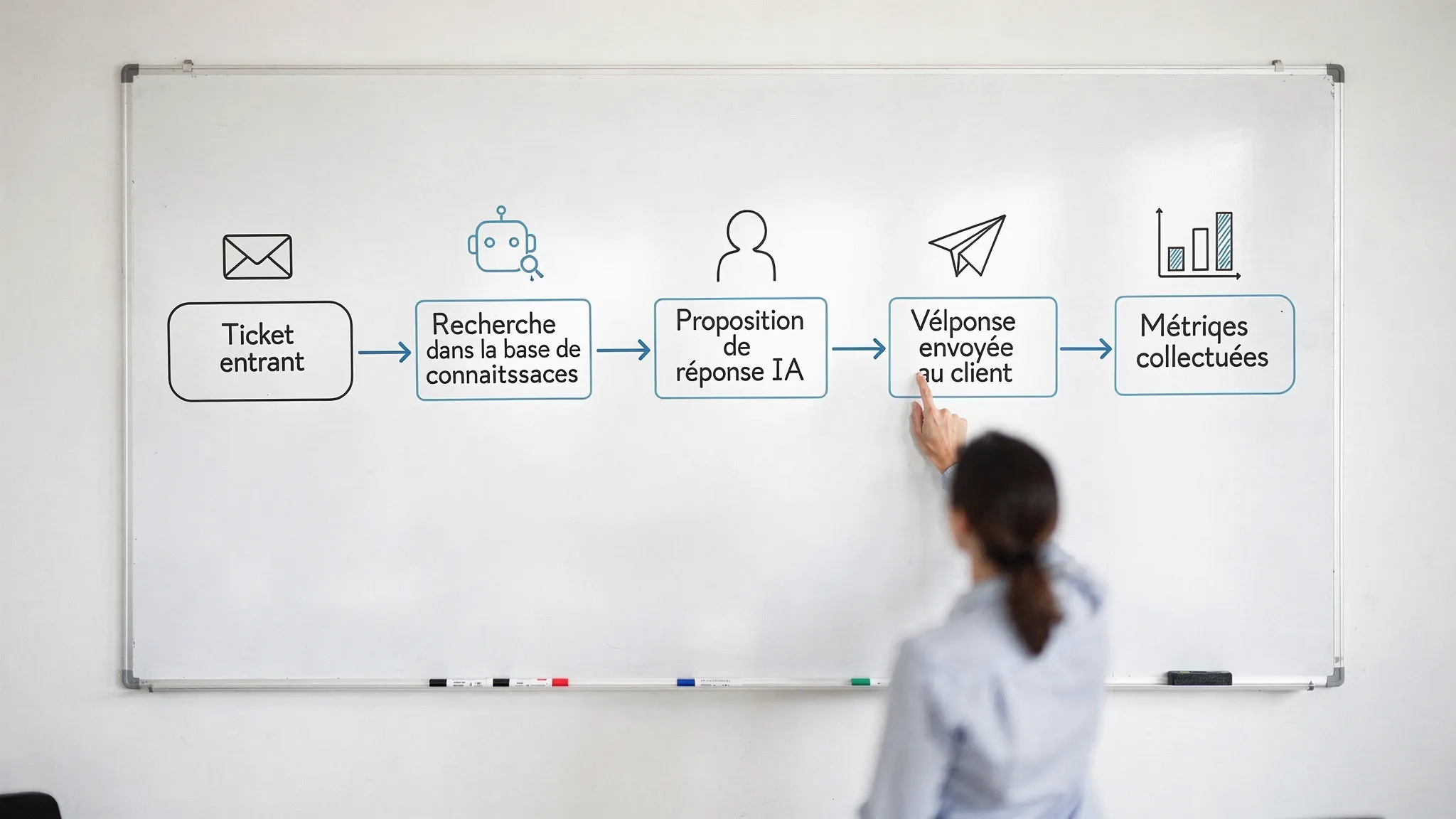
We often think "chatbot." But AI Intelligence also covers qualification, routing, drafting, searching for info in the knowledge base, and summarization.
Examples of impact: lower first response time, higher first contact resolution, reduction in cost per ticket.
If this topic is strategic for you, you can go further with the Impulse Lab article on Essential AI Chatbot KPIs.
2) Internal Knowledge Assistant (RAG type) to reduce "context tax"
In many SMEs, the hidden cost is information retrieval: procedures, client history, specifications, contracts, product documentation.
An assistant connected to your internal sources (and governed) allows you to:
answer with sources,
accelerate onboarding,
reduce interruptions between teams.
It is a very profitable "foundation" entry point when knowledge is dispersed. To deepen the concept, see the definition of RAG (Retrieval-Augmented Generation).
The value is not to produce more text, but to produce less useless work: qualification, call preparation, exchange summaries, CRM updates, faster responses.
In many teams, AI Intelligence justifies itself via: lead response time, no-show rate, administrative time per salesperson.
5) Product and IT (acceleration, but with guardrails)
On the tech side, AI accelerates development, testing, review, and documentation. On the product side, it helps analyze feedback (tickets, reviews), detect recurring themes, and prioritize.
Note: this is only profitable if you track simple metrics (lead time, bugs, rework). Otherwise, you are mostly buying a "sensation of speed."
How to Calculate a Credible (and Defendable) ROI for the Executive Committee
A serious ROI starts with a baseline. Without a baseline, you will have impressions at best.
The Minimal Formula
Net Monthly Gain = (time saved x fully loaded cost) + (incremental revenue x margin) + (estimated avoided risk)
ROI = (total gains – total costs) / total costs
Payback (return period) = initial costs / net monthly gain
What matters is less the formula than the discipline: baseline, instrumentation, before/after comparison.
Costs Not to Forget (Otherwise Your ROI is Wrong)
In SMEs, the most common mistake is forgetting integration and adoption, then concluding that "AI doesn't work."
Cost Category
What it really is
To watch
Tools and Models
licenses, APIs, consumption
variability, token costs, limits, SLAs
Integration
CRM/ERP/support connections, SSO, rights
dev time, security, maintenance
Data
cleaning, access, structuring
quality, rights, updates
Product
UX, user journey, human handoff
adoption, usage rate
Governance
logs, audits, compliance
GDPR, AI Act, internal policies
To structure an end-to-end KPI approach, you can rely on the Impulse Lab guide dedicated to AI KPIs.
Prioritizing Your Use Cases: The "Impact, Effort, Risk" Method
An SME does not have the luxury of launching 10 AI projects in parallel. The right reflex is to choose 2 to 3 use cases, instrumented, delivered quickly, and then capitalize.
A simple scorecard works very well:
Impact: expected effect on a business KPI (€/month, time, conversion, incidents)
Effort: integration, complexity, dependencies, team load
Risk: sensitive data, costly errors, compliance
Data Prerequisites: available sources, quality, access rights
If you want an "express" version (45 to 90 minutes) to identify quick wins without getting scattered, the AI audit checklist for quick wins is a good starting point.
Realistic Roadmap for an SME (30 Days to Lay Foundations, 90 Days to Prove)
Phase 1: Frame "ROI-first" (1 to 2 weeks)
You are looking for a use case where measurement is possible and integration is feasible.
Concretely: define the process, the objective, the baseline, the guardrails (quality, security), and the human validation loop if necessary.
Phase 2: Build a Measurable Pilot (3 to 6 weeks)
The pilot doesn't need to be perfect, it must be:
integrated into the workflow (otherwise no one uses it),
instrumented (otherwise you don't know if it works),
secured (otherwise you won't dare to deploy it).
Phase 3: Industrialize (6 to 12 weeks)
This is where AI Intelligence becomes an asset: access rights, monitoring, logs, improvement processes, team training.
For a complete and structured approach, the strategic AI audit is often the most effective format to align opportunities, risks, and execution plans.
Vigilance Points (GDPR, Security, Compliance) Without Blocking Delivery
Two realities coexist: AI accelerates, but it introduces new risks (data leakage, hallucinations, unwanted actions, bias, prompt injection attacks). The right compromise for an SME is light, but non-negotiable governance.
Useful reflexes:
Classify data (what can, or cannot, leave your IS).
Trace (logs, decisions, sources used, versions).
Keep a human in the loop as soon as an error is costly.
Regarding the framework, the European Union has adopted the AI Act and obligations are being deployed gradually according to usage. On the risk management side, the NIST AI RMF framework is an excellent pragmatic base.
Build, Buy, or Hybrid: How to Decide Quickly
For an SME, the best decision is often hybrid: buy what is standard, develop what is differentiating (and integrate properly).
Some simple signals:
Buy (market tool) if your need is common, not very specific, and integration is standard.
Build (custom) if your value depends on your data, business rules, specific UX, or complex integrations.
Hybrid if you want to start fast while keeping control of the architecture and ROI.
Conclusion: Useful AI Intelligence is AI Connected to Your Numbers
For an SME, AI Intelligence is not an abstract concept. It is an approach: choose a high-volume process, augment it with AI, integrate it into the workflow, and prove the ROI with simple KPIs.
If you were to retain only one rule: do not finance a demo, finance a baseline + an instrumented pilot.
Frequently Asked Questions
Is AI Intelligence just another word for "artificial intelligence"? Not exactly. In business practice, "AI Intelligence" often refers to AI applied to decisions and execution within workflows (understanding, recommendation, action), rather than isolated technology.
What is the best first AI Intelligence use case for an SME? One that combines volume + pain + measurement. Often: customer support (triage, assisted responses), internal knowledge assistant (RAG), or back-office automation (documents, repetitive requests).
How to avoid an AI project that serves no purpose? By setting a baseline, defining a maximum of 3 to 5 KPIs, integrating AI into the tool where teams already work, and planning a human validation loop when errors are costly.
How long does it take to see an ROI? On a well-chosen case, a measurable pilot can show a signal in 4 to 8 weeks. Consolidated ROI depends mainly on integration, adoption, and operational stability (monitoring, governance).
Should we worry about GDPR and the AI Act from the start? Yes, but without paralyzing delivery. The right approach is "compliance by design": data classification, access control, logging, and internal usage rules.
Moving from "AI Intelligence" to ROI, with a Method
Impulse Lab accompanies SMEs and scale-ups with a value-oriented approach: AI opportunity audit, adoption training, and custom development (automation, integration, web platforms, and AI).
If you want to frame 2 to 3 prioritized, quantified, and deliverable use cases, you can start with an AI audit or share your context with the team via the Impulse Lab site.
Can You Trust Artificial Intelligence with Your Math Calculations?
Can you trust AI with math calculations? Yes, provided you distinguish suggested reasoning from actual computation. Discover how to inspect, verify, and ground AI-driven calculations into reliable business decisions.