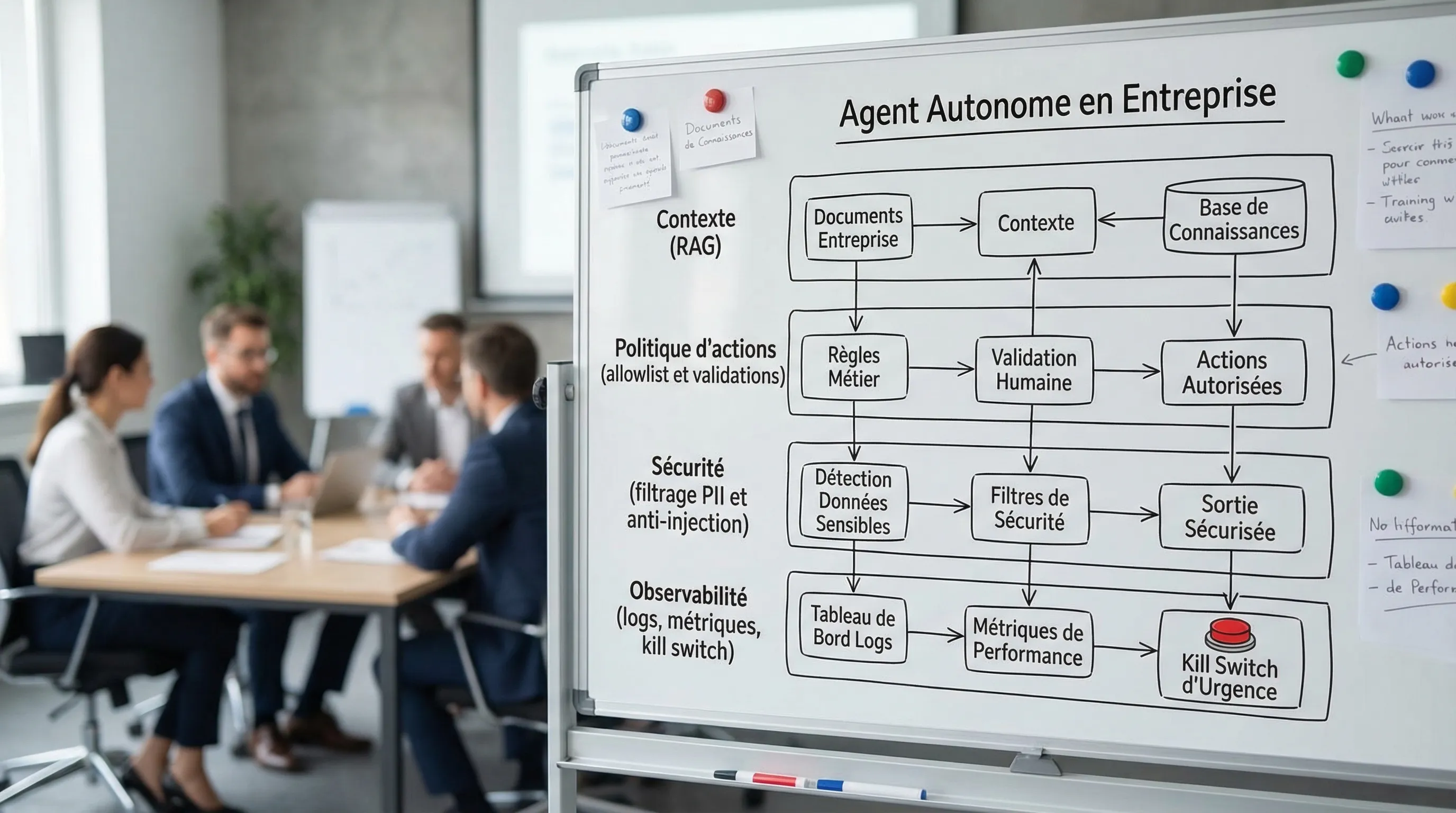
Autonomous Agents in the Enterprise: Guardrails and Validation
Intelligence artificielle
Stratégie IA
Validation IA
Gestion des risques IA
Automatisation
Enterprise autonomous agents promise a productivity leap by **planning and executing** actions in your tools (CRM, ERP, helpdesk). The problem is simple: the more the agent acts, the costlier the error becomes. Without guardrails and validation, you risk incidents rather than time savings.
Enterprise autonomous agents promise a productivity leap because they don't just "answer" but plan and execute actions in your tools (CRM, ERP, helpdesk, messaging, document bases). The problem is simple: the more the agent acts, the costlier the error. Without guardrails and structured validation, you quickly go from saving time to an incident (exposed data, irreversible actions, cost overruns, non-compliant decisions).
The goal of this article is pragmatic: to give you a framework of guardrails (security, compliance, reliability, cost) and a validation process to put agents into production without "slowing down" the organization.
What changes with an autonomous agent (and why guardrails are non-negotiable)
An autonomous agent is not just a chatbot. It generally combines:
a model (often an LLM) to reason and generate,
a context (RAG, memory, internal tools),
"tools" or actions (API, automations, database writing, sending emails),
a decision loop (plan, execute, verify).
This loop introduces three recurring risks:
Action risk: the agent does "something", sometimes irreversible (deletion, sending, ticket creation, status change, price modification).
Information risk: the agent states false information, retrieves irrelevant data, or leaks data (prompt injection, bad ACL, sensitive documents).
Operational risk: inference costs that explode, latency, silent errors, lack of traceability, difficulty in reproducing and fixing.
A good agent design, in the enterprise, looks less like "a prompt" and more like a system with gates, limits, and proofs.
1) Guardrails on context (RAG, tools, memory)
When an agent makes a mistake, it is often because the context is bad (documents not up to date, inconsistent chunking, poorly managed permissions, or contradictory sources). Useful guardrails:
Verifiable sources: prioritize answers "with proofs" (citations, internal links, excerpts) rather than answers that are "fluent but unverifiable".
Document-level access control: the agent must never be able to retrieve a document that the user does not have the right to see.
Knowledge base versioning: you must know which corpus was consulted, especially if your documentation changes.
Malicious instruction detection: prompt injection often aims to hijack the agent via retrieved content. The OWASP framework cited above is a good starting point.
2) Guardrails on action (this is where it all plays out)
In the enterprise, actions must be designed as "safe APIs", not like magic powers.
The most robust patterns:
Action allowlist: the agent only has access to a closed list of functions. No "generic" access to an API.
Preview: before execution, the agent displays a draft (email, ticket, CRM update) with a "validate" button.
Idempotency: if the agent repeats an action (latency, retry), the effect must remain unique (for example via an idempotency key).
Double validation on sensitive actions: certain gestures require a second "OK" or a specific role.
Business guardrails: deterministic rules on top of the LLM (e.g., "never send to an external domain", "never modify the price", "never act without a mandatory field").
This is often the most cost-effective layer: even if the model hallucinates, you prevent the error from landing in your systems.
3) Security, data, and compliance guardrails (GDPR, AI Act)
Without getting into legal wording word-for-word, a healthy posture consists of treating the agent as a system handling potentially sensitive data.
Typical controls:
Data classification (public, internal, sensitive) and prohibition of sending certain classes to unauthorized services.
Minimization: send the minimum necessary to the model (pseudonymization when possible).
Logging and audit: who asked for what, which sources were consulted, what action was executed.
Vendor contract and retention rules: DPA, "no training" options, localization, durations.
For compliance, keep an eye on the European framework, notably the EU AI Act (European Commission) which structures obligations according to the risk level, and on the operational recommendations of the CNIL on AI.
Golden set: a stable test set to compare versions (prompts, models, RAG, tools).
Simulated action tests: the agent "proposes" the action, but never executes it.
If you are looking for a reproducible method, the "test protocol + go/no-go scorecard" logic is detailed in the spirit of enterprise validation approaches (see also the Impulse Lab article on AI testing: Enterprise AI testing).
Level 2: Controlled pilot (with real users, but barriers)
Objective: measure value and risks in real conditions, without damage.
HITL (human-in-the-loop): the agent proposes, the human validates, then execution.
Reduced scope: one team, one type of request, one channel.
Instrumentation: you measure the baseline before/after (time, quality, cost, escalations).
Level 3: Controlled production (and continuous revalidation)
Objective: switch to partial or total autonomy only if indicators are stable.
Progressive autonomy: certain actions on automatic (low risk), others remain in validation.
If you are considering autonomous agents in the enterprise, the most robust sequence is often:
Opportunity audit (use case, risks, data, integrations, KPI) before buying or developing.
Instrumented pilot with action guardrails (preview, allowlist, validation) rather than an overly autonomous agent.
Industrialization only after a clear scorecard (value + risks + operations).
Impulse Lab supports this type of approach via strategic AI audits, training for adoption, and the development of custom solutions integrated into your tools. If you wish, we can frame a use case together and define a "go/no-go" validation in a few days, before investing more heavily.
Personalizing Customer Education with Artificial Intelligence
AI in customer education goes beyond school settings to help users master products. Discover how to personalize onboarding, boost user autonomy, and build reliable learning paths.