Enterprise AI Integration: API, RAG, and Agent Patterns
Intelligence artificielle
Stratégie d'entreprise
Stratégie IA
In 2026, companies no longer have a "model problem," but an **integration problem**. The key differentiator is the ability to connect AI to your data, tools, and rules (security, compliance) without creating unmanageable technical debt.
March 05, 2026·9 min read
In 2026, most companies no longer have a "model problem," they have an integration problem. LLMs are accessible, high-performing, and often interchangeable. What makes the difference is your ability to connect AI to your data, tools, and rules (security, compliance, quality), without creating unmanageable technical debt.
This article offers an operational look at enterprise AI integration through three families of patterns that constantly reappear in production: API, RAG (Retrieval-Augmented Generation), and agents. The goal: to help you choose a realistic architecture for an SME or scale-up, and know how to combine these building blocks without trapping yourself.
Enterprise AI Integration: What Are We Really Talking About?
In many organizations, "integrating AI" is confused with "plugging in ChatGPT". In production, AI integration actually covers 5 very concrete subjects:
Controlled model access (cloud, on-prem, hybrid), with key management, quotas, costs, and versioning.
Context access (internal data, documents, CRM, tickets, ERP), with traceability and governance.
Action execution (creating a ticket, sending an email, generating a quote), with guardrails.
Evaluation and observability (quality, drift, security, costs), because "it works in the demo" is not enough.
Adoption (UX, usage rules, training), because unused AI creates no ROI.
The API, RAG, and agent patterns are three complementary answers to these needs.
The 3 Building Blocks Recurring in Production: API, RAG, Agents
1) API Pattern: AI as an Application Service
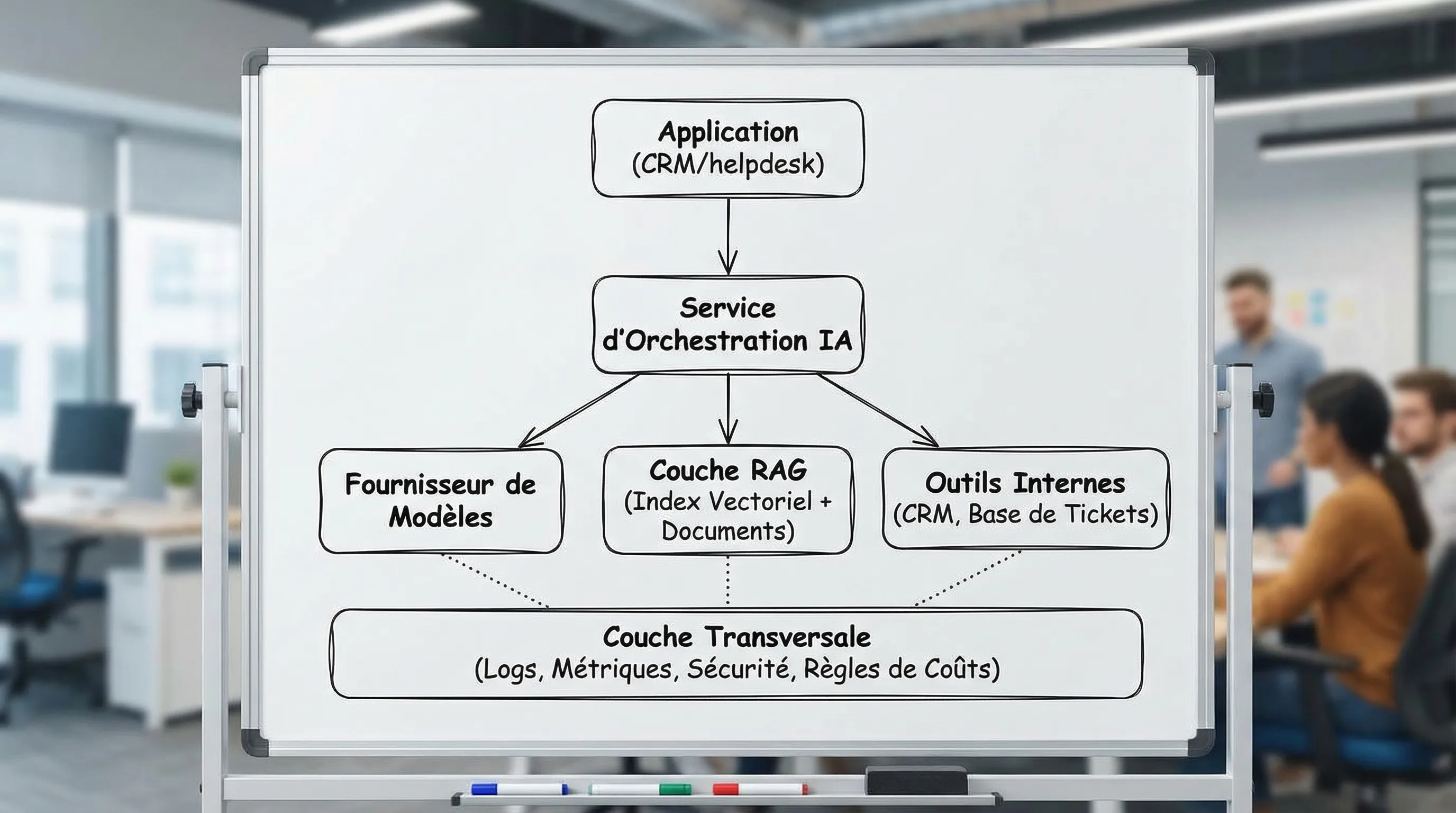
The "API" pattern corresponds to an approach where you encapsulate AI as a software capability consumed by your products and tools (web app, CRM, helpdesk, back-office). We aren't just talking about calling an external API, but designing a stable contract: inputs, outputs, errors, metrics, security.
This pattern is often the best starting point when you want to:
industrialize a specific use case (e.g., ticket summary, classification, field extraction),
control costs and latency,
maintain control over confidentiality,
avoid the proliferation of tools used via personal accounts.
RAG aims to reduce hallucinations and increase relevance by injecting excerpts from internal documents (procedures, contracts, wiki, product sheets, resolved tickets) into the prompt.
The key point: in an enterprise setting, RAG is not a "nice-to-have" feature, it is often a condition for reliability.
If you are looking for a more advanced approach (evaluation, chunking, reranking), see: Robust RAG in Production
3) Agent Pattern: AI That Executes (With Control)
An AI agent, in the operational sense, is an AI that can chain steps (reasoning, tool calls, verifications) to achieve a goal. Example: "qualify a request, propose a response, then create a ticket if necessary".
Agents are powerful, but they also increase risk (erroneous actions, security, costs). They become relevant when:
tasks closed, cycle time, cancellation rate, incidents
This table is not theory: in most solid deployments, agents rely on a clean API layer and reliable RAG, even if minimal.
Pattern 1 (API): Building a Stable "AI Capability"
A good enterprise API pattern rarely looks like "the app calls the provider directly". Instead, we look for an orchestration layer (sometimes called AI gateway or AI service), which allows you to:
centralize secrets and security,
version prompts and models,
implement caching and cost rules,
log requests (with a data policy),
handle errors and resilience.
A useful principle: separate AI orchestration from business logic. Your business application calls a stable function (e.g., summarize_ticket(ticket_id)), and the orchestrator manages the LLM, prompt, formats, and retries.
Two Best Practices That Avoid 80% of Regrets
Structured Input Contracts: Even if the LLM manipulates text, your system must exchange objects (JSON), with validations. This reduces drift and simplifies testing.
Idempotency and Preview: As soon as an output can trigger an action (email, ticket, modification), plan for a validation step (human or automatic) and an execution identifier to avoid duplicates.
Pattern 2 (RAG): Stabilize "Context" Before Stabilizing the Model
Useful enterprise RAG is not just a vector index. It is a mini-value chain.
1) A Source of Truth
RAG often fails because internal documents are:
obsolete,
contradictory,
poorly structured,
or without an owner.
Before talking embeddings, set a simple rule: every corpus has an owner (product, support, legal), and an update frequency.
2) Access Control
The classic trap: an assistant that answers correctly, but using a document the user didn't have the right to read. In enterprise AI integration, permissions must be designed at the retrieval level (filtering by rights, spaces, teams).
3) "Citing Sources" as a UX Contract
Reliable RAG is not just better, it is auditable: the interface must be able to display the excerpts or references used. This facilitates adoption and accelerates correction when a source is bad.
Pattern 3 (Agents): Moving from "Answering" to "Doing", Without Losing Control
An agent becomes interesting when you can make an agent contract explicit:
objective,
authorized tools,
forbidden data,
validation rules,
stop conditions,
logs and audit.
Without this contract, agents quickly become uncontrollable automatons.
A Very Robust Pattern: "Guarded Agent"
Instead of letting the agent act freely, we make it work within a secured corridor:
actions limited to a list of tools,
bounded parameters (e.g., no external email, no attachments),
mandatory validations on sensitive actions,
automatic fallback to a human if uncertain.
This is also the approach most compatible with proportionate governance (and compliance expectations).
This approach reduces risk, improves measurability, and accelerates adoption.
Decision Checklist: Which Pattern to Choose for Your Next Project?
Ask these 5 questions before choosing an architecture.
1) Is your value in the text, or in the action?
If value is in a text deliverable (summary, extraction, email), an API pattern is often enough.
If value is in execution (creation, update, scheduling), you will move towards an agent, but a guarded one.
2) Do you have a usable source of truth?
If the answer depends on procedures, contracts, knowledge base, then RAG is generally required.
3) Is the risk of error acceptable?
The higher the risk (finance, legal, critical operations), the more you must:
limit autonomy,
require sources,
impose validations,
trace decisions.
4) Are you capable of operating (run) the solution?
AI in production requires "run": incidents, source updates, cost tracking, user feedback. Without an owner and monitoring ritual, integration degrades.
5) Can you measure impact, not just usage?
The "number of users" KPI is rarely sufficient. Aim for process-related metrics: processing time, resolution rate, error rate, cost per operation.
Frequent Errors in Enterprise AI Integration (and How to Avoid Them)
Building an agent before stabilizing RAG
If your agent acts based on unstable context, it acts poorly, but faster. Stabilize retrieval and sources first.
Letting integration happen in the shadows (Shadow AI)
This is the typical scenario: unversioned prompts, sensitive data copied, untraceable results. An API layer and simple usage rules strongly reduce this risk.
Forgetting "LLM-native" security
AI introduces specific risks (e.g., prompt injection, exfiltration via context). Guardrails are not optional as soon as there are RAG and tools.
Not instrumenting from V1
Without logs, metrics, and minimal test sets, you won't know if quality is improving or degrading. And you won't be able to justify scaling up.
FAQ
What is the difference between a chatbot, a RAG, and an agent? A chatbot is a conversational interface. A RAG is a technique to answer with your sources. An agent is a system that can chain steps and execute actions via tools.
Is RAG always needed to integrate AI in the enterprise? No. For transformation tasks (summary, extraction, classification) on data already provided as input, an API integration may suffice. RAG becomes key when AI needs to "know" based on your documents.
Are AI agents suitable for SMEs? Yes, if you limit autonomy (guarded agent), restrict tools, and impose validations on sensitive actions. Otherwise, risk and cost explode.
How to avoid AI divulging internal information? By classifying data, controlling access to RAG (filtering by rights), minimizing what is sent to the model, and implementing logs and security rules.
Where to start concretely? With a frequent use case, close to a KPI (processing time, resolution rate, cost), with a V1 integration (API), then RAG if necessary, then guarded agent if the action creates net gain.
Moving from Demo to Production (With an Architecture That Holds Up)
If you wish to move fast without sacrificing quality, Impulse Lab accompanies SMEs and scale-ups across the entire chain: AI opportunity audit, adoption training, and custom development (web + AI) with integration into your stack.
You have a use case and are hesitating between API, RAG, or agents? Let's talk: Impulse Lab.
You want to structure your approach before building? Start with an audit: Strategic AI Audit.
Can You Trust Artificial Intelligence with Your Math Calculations?
Can you trust AI with math calculations? Yes, provided you distinguish suggested reasoning from actual computation. Discover how to inspect, verify, and ground AI-driven calculations into reliable business decisions.