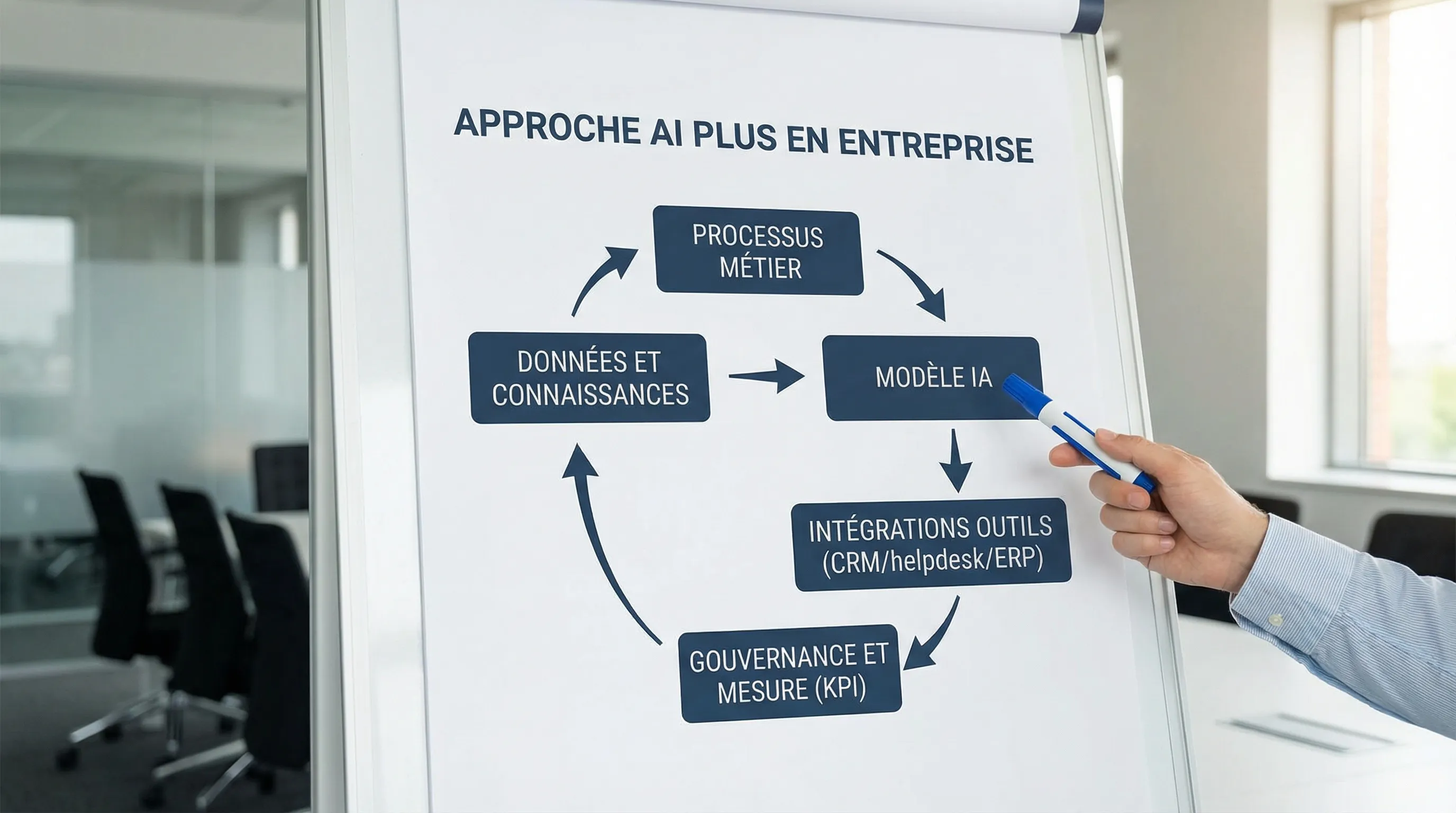
In 2026, companies no longer ask *if* they will use AI, but **how to gain a measurable advantage** without chaos. This is exactly where the concept of **AI Plus** (often written *AI+*) becomes useful.
January 29, 2026·7 min read
In 2026, most companies are no longer asking if they will use AI, but how to derive a measurable advantage from it without creating chaos (scattered tools, GDPR risks, unstable results). This is exactly where the concept of AI Plus (often written AI+) becomes useful.
AI Plus is not a “new miracle tool.” It is a way to industrialize AI by adding it to what already runs your business: your processes, your data, your tools, your teams, your rules.
AI Plus: A Simple (and Useful) Definition
AI Plus means: AI + business context + data + integrations + governance + adoption.
In other words, we don’t just “put a chatbot” on the company. We augment existing workflows to obtain a concrete gain: faster, fewer errors, better quality, better conversion, better service.
What AI Plus Is Not
It is not “ChatGPT for everyone” without usage rules.
It is not a demo that impresses but integrates nowhere.
It is not blind automation that makes sensitive decisions without control.
Why This Concept Is Exploding Now
Three reasons keep coming up in the field:
Models have become good enough to automate part of cognitive work (summarizing, classifying, writing, extracting, proposing).
Value is unlocked at integration, not at the prompt: CRM, helpdesk, ERP, document drive, messaging, BI.
Compliance and security are becoming non-negotiable, especially in Europe with the AI Act and GDPR.
What AI Plus Is Used For in Business: 6 Uses That Pay Off Most Often
AI Plus is judged by ROI and reliability. Here are the most frequent and profitable uses when integrated correctly.
1) Augmented Customer Support (reduced delays, better quality)
AI is used to answer faster, but above all to answer correctly, with the right sources (help articles, internal procedures, after-sales policies).
When done seriously, we often combine:
a structured knowledge base,
a search mechanism (RAG type),
a clear human handover,
KPI tracking (deflection, CSAT, handling time).
If this topic interests you, Impulse Lab has already published a guide on AI Chatbot KPIs.
2) Internal Copilot (answers and documents based on your “real” knowledge)
This is the “foundation” use case par excellence: an assistant that retrieves and synthesizes information from your documents, tickets, meeting minutes, procedures, contracts, etc.
The difference between a gadget and a strategic asset lies in:
5) IT and Product (internal support, QA, delivery acceleration)
AI Plus is often used to:
help IT support (diagnosis, procedures),
accelerate code writing and review,
summarize incidents and tickets,
produce documentation.
But the challenge is robustness and security (secret exposure, vendor dependence, logs). Basic best practices like NIST AI RMF are useful for framing risks.
6) “Agents” and Orchestrations (when the workflow needs actions)
AI Plus becomes truly powerful when AI doesn't just answer, but acts via tools: creating a ticket, filling a CRM, triggering a workflow, generating a document.
At this stage, one must be even more rigorous: permissions, audit logs, guardrails, test scenarios, observability. Frameworks like the OWASP Top 10 for LLM Applications provide a good threat framework (prompt injection, data leakage, etc.).
The Real “Plus”: Creating Measurable Value
AI Plus is a useful approach because it forces a question: which business lever are we improving?
In practice, we almost always come back to 4 levers:
Productivity: time saved on repetitive tasks, better preparation, less re-entry.
Frequent Errors with AI Plus (and How to Avoid Them)
Confusing “AI tool” and “AI Plus system”
A tool can help individually. An AI Plus system must be operational: integrated, measured, secured, maintainable.
Underestimating data and access rights
The best model does not compensate for:
obsolete documents,
a contradictory knowledge base,
inconsistent access rights.
Wanting to agentify everything too soon
Agents (that act) are powerful, but risky. Very often, you must first succeed at:
reliable search and synthesis,
integration,
measurement.
Only then do you automate actions.
FAQ
What does AI Plus mean exactly? AI Plus (AI+) refers to an approach where AI is added to your processes, data, tools, and rules to produce a measurable impact in business.
What is the difference between AI Plus and “using ChatGPT at the office”? Using an AI tool is individual usage. AI Plus aims for an integrated system (CRM, helpdesk, ERP), with governance, KPIs, security, and adoption, to industrialize value.
Is AI Plus suitable for SMEs and scale-ups? Yes, often more so than for large groups, because an SME can deploy faster if it chooses 1 to 3 frequent use cases, with a baseline and a short pilot.
What are the minimum prerequisites to succeed? A recurrent use case, accessible data of sufficient quality, integration into the workflow, and clear measurement (3 to 5 KPIs) with guardrails.
What risks should be anticipated? Hallucinations, data leaks, silent errors, drifting costs, and low adoption. These risks are reduced with RAG, access controls, tests, observability, and training.
Moving from Idea to Real AI Plus (with Impulse Lab)
If you want to make AI Plus a concrete lever (and not a pile of tools), Impulse Lab can accompany you with: AI opportunity audit, adoption training, and development of custom web and AI solutions (automation, integrations, platforms).
To start properly, you can begin with a short diagnostic, then follow up with a measured pilot and industrialization in weekly delivery cycles. Discover the approach at impulselab.ai.