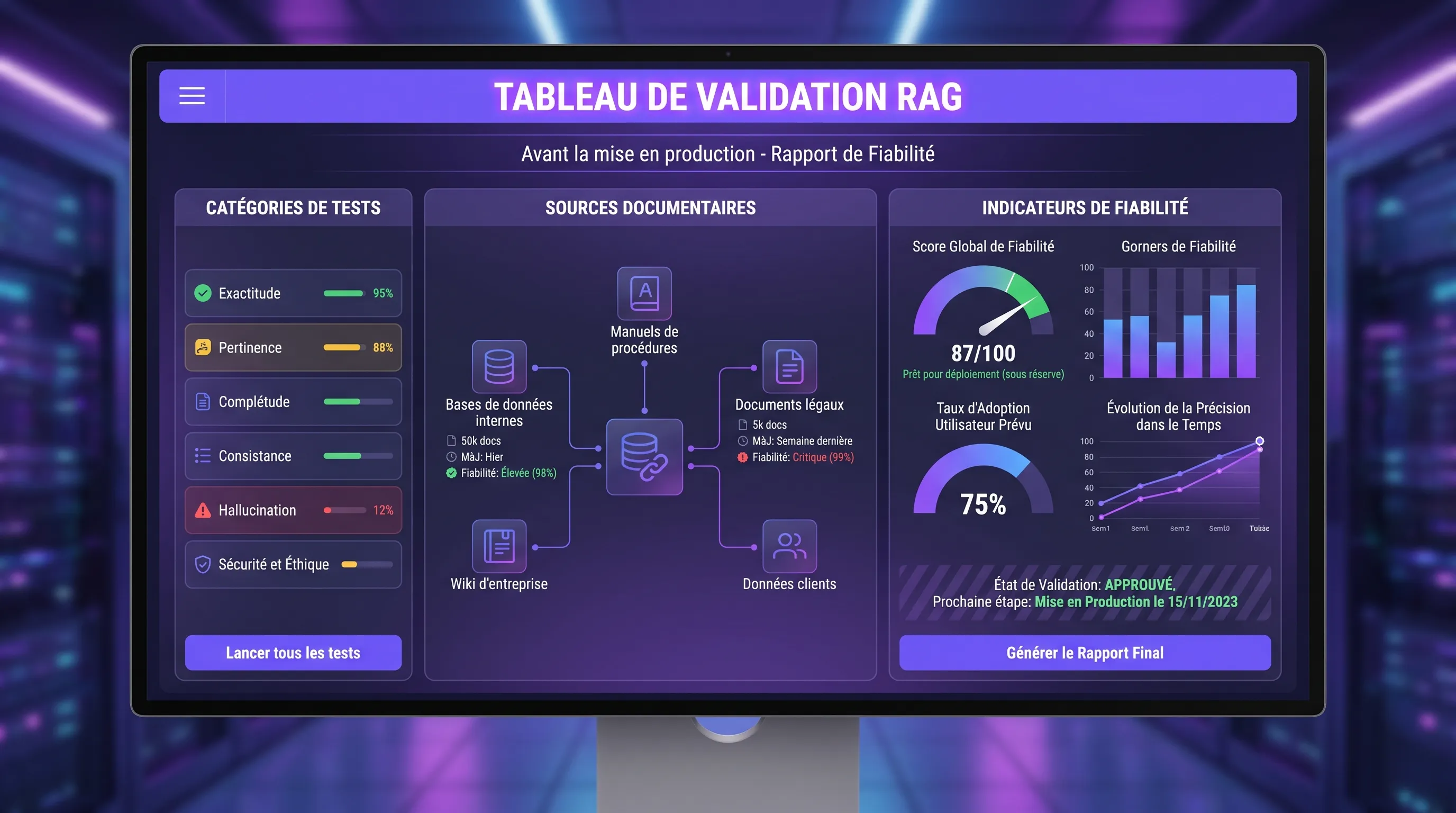
AI RAG: How to ensure answer reliability before going to production
Intelligence artificielle
Stratégie IA
Validation IA
Gestion des risques IA
A RAG assistant can seem reliable early on. The demo answers quickly, cites internal docs, and seems to understand the business. Then come real team questions, outdated docs, commercial exceptions, and access rights...
June 24, 2026·14 min read
A RAG assistant can give an impression of reliability very early on. The demo answers quickly, cites a few internal documents, reformulates neatly, and seems to understand the business. Then come the real questions from the teams, outdated documents, commercial exceptions, access rights, internal acronyms, and ambiguous requests. This is where quality is truly tested.
Ensuring the reliability of an AI RAG project before going to production is not just about choosing a better model. Reliability comes from a set of measurable decisions: source quality, search accuracy, the ability to refuse an answer, verifiable citations, security, metrics, and launch thresholds. For an SMB, a scale-up, or a growing company, the goal is simple: prevent a seemingly useful assistant from becoming an operational risk.
If you first want to clarify the concept, the definition of RAG explains the principle of retrieval-augmented generation using documents. Here, we will focus on the most important question before production: how do you know if the answers are reliable enough to be used by real teams?
What a "reliable answer" means in a RAG system
A reliable answer is not simply a well-written one. In a business context, it must be accurate, traceable, and usable without creating confusion. A RAG can produce a perfectly fluent sentence while relying on the wrong document, an outdated source, or an overly broad interpretation.
Before testing anything, reliability must therefore be defined in observable terms. A good answer should generally meet six criteria.
Criterion
What it verifies
Example of risk if the criterion fails
Accuracy
The answer matches the sources of truth
The assistant invents an HR or commercial rule
Traceability
The cited sources allow the information to be verified
The user cannot verify the answer
Coverage
The system can handle frequent and important cases
Teams abandon the tool after a few tries
Abstention
The system knows how to say it doesn't know
It confidently answers an out-of-scope question
Security
Access rights and sensitive data are respected
A user sees confidential information
Usability
The answer is clear, actionable, and tailored to the business
The answer is correct but practically unusable
This definition avoids a common trap: judging the RAG based on a few successful conversations. In pre-production, you must move from an impression of quality to proof of quality.
Start by defining the scope of use
The RAG should not answer everything. It must respond within a specific scope, with identified sources, known users, and prioritized use cases. The blurrier the scope, the more impossible tests become to interpret.
A good framework answers concrete questions: who will use the assistant, for what decisions, from which sources, and with what acceptable level of risk? An internal assistant that helps customer support find procedures does not have the same requirements as an assistant advising a sales rep on contractual terms.
The scope must also specify what the system does not do. For example: it does not replace legal advice, it does not directly modify a CRM, it does not answer confidential financial questions, and it does not provide an answer if no approved source is found. This boundary is a condition of reliability, not a project limitation.
For a broader project, this step must be part of a production roadmap. The key steps for production-ready AI development help place the RAG within the entire cycle: scoping, integration, security, validation, and operations.
Audit your sources before evaluating the model
Many teams try to improve prompts when the problem actually lies in the corpus. A RAG cannot be more reliable than the documents it retrieves. If the sources are contradictory, outdated, or poorly structured, the model will produce unstable answers.
A source audit must verify at least freshness, authority, format, duplicates, and access rights. You need to know which document is authoritative when an internal policy exists in multiple versions. You must also identify useful but dangerous content, such as old contract templates, uncleaned client exports, or unvalidated drafts.
An often underestimated point concerns metadata. The date, document type, business owner, confidentiality level, and version are essential for filtering, prioritizing, and explaining answers. Without metadata, the RAG retrieves pieces of text, but it does not understand their status within the organization.
Here is a simple grid to decide if a source can enter the pre-production corpus.
Question
Recommended decision
Is the document validated by a business owner?
Include it only if the owner is identified
Are there multiple contradictory versions?
Keep the reference version and archive the others
Does the document contain sensitive data?
Apply access rules or exclude it from the initial corpus
Is the validity date known?
Add a freshness metadata tag or request validation
Is the content usable in short fragments?
Rework it before indexing if the structure is confusing
This step may seem less spectacular than choosing the model, but it often determines 60 to 80% of the quality perceived by users. A clean corpus reduces hallucinations, improves citations, and makes corrections easier.
Build a representative test set
A reliable RAG is not validated with ten questions asked by the project team. You must create a test set that reflects real situations: simple questions, ambiguous questions, edge cases, out-of-scope requests, contradictory documents, and varied phrasings.
This test set must be built with the business teams. Support, operations, HR, finance, or sales teams know which questions come up often and where mistakes are costly. The ideal approach is to combine real historical data, when available, with written scenarios to cover risks.
A good test set contains several families of questions:
Frequent questions with a direct answer in a validated source
Questions that require combining two or three documents
Questions where the answer depends on a date, country, customer segment, or user role
Questions with no answer in the corpus, to test abstention
Intentionally ambiguous questions, to check if the assistant asks for clarification
Adversarial questions, to test for data leaks and prompt injection
The quality of the test set matters as much as its size. For an initial pre-production run, 80 to 150 well-chosen cases can already reveal major issues. For a high-impact business assistant, it will often be necessary to go further, enrich the cases based on feedback, and automate part of the evaluation.
Measure retrieval and generation separately
When an answer is wrong, you need to know why. Did the RAG retrieve the wrong documents? Did it find the right documents but poorly synthesize the information? Did it ignore an important citation? Did it answer when it should have refused?
This is why you must evaluate the retrieval part (information fetching) and the generation part (the final answer) separately. Otherwise, you risk fixing the wrong component.
Evaluated level
Useful metric
Question it answers
Retrieval
Presence of the right source in top results
Does the system find the right document?
Retrieval
Precision of retrieved context
Is the context provided to the model relevant or noisy?
Generation
Faithfulness to the source
Does the answer remain grounded in the documents?
Generation
Citation quality
Do the citations truly justify the answer?
Generation
Abstention
Does the system correctly refuse questions without a source?
Experience
Clarity and response time
Is the answer usable by the team?
In more advanced environments, metrics like recall on expected documents, context precision, or factuality scores can be used. But for many companies, a well-structured human evaluation grid is already highly effective. Each answer can be rated on a simple scale: correct, partially correct, incorrect, unverifiable, or expected refusal.
Automated evaluations can speed up sorting, but they do not replace business validation. An answer can be factually close to the source yet unsuited to internal policy. Humans remain indispensable for judging meaning, risk, and utility.
Set thresholds for going to production
The worst time to decide on launch criteria is the day before going to production. Thresholds must be defined before testing to avoid subjective decisions.
These thresholds depend on the use case. An internal document search assistant can tolerate a few partial answers if the sources are visible. An assistant used in a critical customer process must be much stricter.
Here is an example of pre-production decision criteria.
Indicator
Indicative threshold before launch
Correct answers on priority cases
Very high, especially on frequent questions
Dangerous answers or contrary to sources
Zero tolerance on critical cases
Out-of-scope questions correctly refused
Clear majority, with mandatory improvement if failed
Verifiable citations
Mandatory for sensitive answers
Response time
Compatible with actual team usage
Respect for access rights
Zero exceptions accepted
The idea is not to aim for abstract perfection. The goal is to know exactly what risks remain, who accepts them, and what measures reduce them. A successful production launch is rarely a giant leap. It is rather a controlled transition, with an initial scope, guardrails, and an improvement plan.
Test failure cases, not just success cases
Demonstrations often show what the system can do. Pre-production must show what happens when it cannot. User trust is won or lost in failure cases.
A reliable RAG must handle missing documents, contradictory sources, vague questions, out-of-scope requests, and bypass attempts. It must also avoid turning uncertainty into assertion.
Failure tests must include realistic phrasing. For example, a user won't always ask: "What is the official expense reimbursement policy?" They will instead ask: "Can I get reimbursed for my taxi last night?" Reliability therefore also depends on the system's ability to link an informal question to a documented rule, or to ask for clarification.
Security must be part of these tests. The OWASP Top 10 for Large Language Model Applications project notably lists the risks of prompt injection, sensitive information leakage, and excessive use of permissions. These risks are particularly high in a RAG connected to internal documents.
Implement visible guardrails
An effective guardrail is not just a hidden instruction in a system prompt. It must translate into the assistant's behavior and the user experience.
The most useful guardrails before going to production are often simple: cite sources, display the date or document type, refuse unproven answers, ask for clarification in case of ambiguity, and clearly distinguish synthesis from recommendation. In some cases, it is also necessary to limit the assistant to read-only access, without direct action in business tools.
For companies wanting to go further, it is useful to document behavioral rules in a usage charter: what the assistant can do, what it cannot do, when the user must verify a source, and how to report an error. This documentation reduces unrealistic expectations and facilitates adoption.
The NIST AI Risk Management Framework recommends approaching AI systems with a logic of governance, measurement, and risk management. Applied to RAG, this means that reliability is not a magical property of the model. It is a continuous control process.
Prepare observability before launch
A common mistake is putting the assistant into production, then wondering how to track its quality. Observability must be planned before launch. Otherwise, every incident becomes difficult to diagnose.
You must be able to retrieve a conversation, the retrieved documents, the displayed citations, the prompt version, the corpus version, and potentially the model used. Without this information, you won't know if an error comes from a bad document, improper indexing, a model change, or an unforeseen use case.
Observability should not become an uncontrolled data collection. You must log what is necessary for diagnosis while respecting confidentiality, retention periods, and access rights. In some contexts, sensitive fields will need to be anonymized or excluded.
A pre-production dashboard can track a few simple indicators: question volume, refusal rate, reported answer rate, error categories, most used sources, response time, and average cost per query. These indicators help decide if the system can be rolled out to more users.
Organize business acceptance testing, not just technical
RAG acceptance testing must involve the people who will live with the tool. Technical tests validate the pipeline, embeddings, filters, prompts, and permissions. Business tests validate actual utility.
Good acceptance testing takes place in a small group with representative users. They are asked to pose their real questions, then rate the answers based on simple criteria: accuracy, clarity, confidence, useful source, and next action. Qualitative feedback is invaluable, as it often reveals problems that metrics miss.
For example, an answer might be correct but too long for a support agent. A citation might be accurate but point to a document no one understands. An answer might be useful for a manager but too risky for a new hire. Reliability always depends on the context of use.
For more complex architectures combining RAG, actions in tools, and conversational agents, the criteria must be even stricter. The best practices for robust RAG in production allow you to dive deeper into technical choices like chunking, reranking, hybrid search, and evaluation.
Decide on the production launch mode
Once tests are completed, the question is not just "can we launch?" but "how do we launch without taking unnecessary risks?" For many organizations, the right answer is a phased production rollout.
The launch can start with a pilot group, a limited documentary scope, or an assistance mode where the user must validate the information before acting. This approach allows you to observe real usage, quickly correct sources, and adjust thresholds.
The production launch must also include a feedback process. A reporting button, a weekly review of errors, and a corpus correction loop are sometimes enough to create a solid improvement cycle. Without this loop, quality degrades over time, especially as internal documents evolve.
Finally, owners must be appointed. Who validates new sources? Who arbitrates contradictions? Who handles reported errors? Who decides to expand the scope? A reliable RAG is as much an organizational topic as it is an AI topic.
Reliability checklist before going to production
Before granting access to your RAG assistant to a broader team, verify that the following points are covered:
The scope of use is defined, with excluded cases clearly documented
Sources of truth are identified, cleaned, dated, and linked to business owners
Access rights are tested with multiple user profiles
A representative test set covers frequent, ambiguous, critical, and out-of-scope questions
Errors are analyzed by distinguishing retrieval, generation, security, and user experience
Sensitive answers cite verifiable sources
Launch thresholds are decided before final acceptance testing
Logs necessary for diagnosis are available while respecting confidentiality
A pilot group and a feedback loop are planned post-launch
If several points remain uncertain, it is better to delay or reduce the scope than to launch an unstable assistant. User trust is difficult to rebuild after blatantly false answers.
FAQ
Does an AI RAG completely eliminate hallucinations? No. RAG reduces the risk of hallucination by grounding answers in sources, but it does not eliminate it. Quality depends on the corpus, retrieval, prompt, guardrails, and tests.
How many questions should be tested before going to production? There is no universal number. For an initial internal scope, 80 to 150 well-chosen cases can already reveal the main flaws. Critical cases must be tested more extensively.
Should you prioritize a better model or a better corpus? In many projects, improving the corpus, metadata, and retrieval produces more gains than simply changing the model. The model remains important, but it does not compensate for confusing sources.
Who should validate the answers of a RAG assistant? Business teams must validate the accuracy and utility of the answers. Technical teams validate the architecture, security, performance, and observability. Both validations are necessary.
Can a RAG be put into production without citations? It is possible for certain low-sensitivity uses, but not recommended as soon as answers influence a business decision. Citations allow the user to verify information and make error diagnosis easier.
Securing your RAG before going to production
Ensuring the reliability of a RAG before production requires a method: scoping uses, auditing sources, measuring answers, testing failures, and organizing continuous improvement. It is this work that transforms a promising demo into a truly useful tool.
Impulse Lab supports companies in auditing AI opportunities, designing custom solutions, integrating with existing tools, and training teams. If you want to evaluate the reliability of your RAG assistant before launch, you can connect with Impulse Lab to structure an approach tailored to your business challenges.