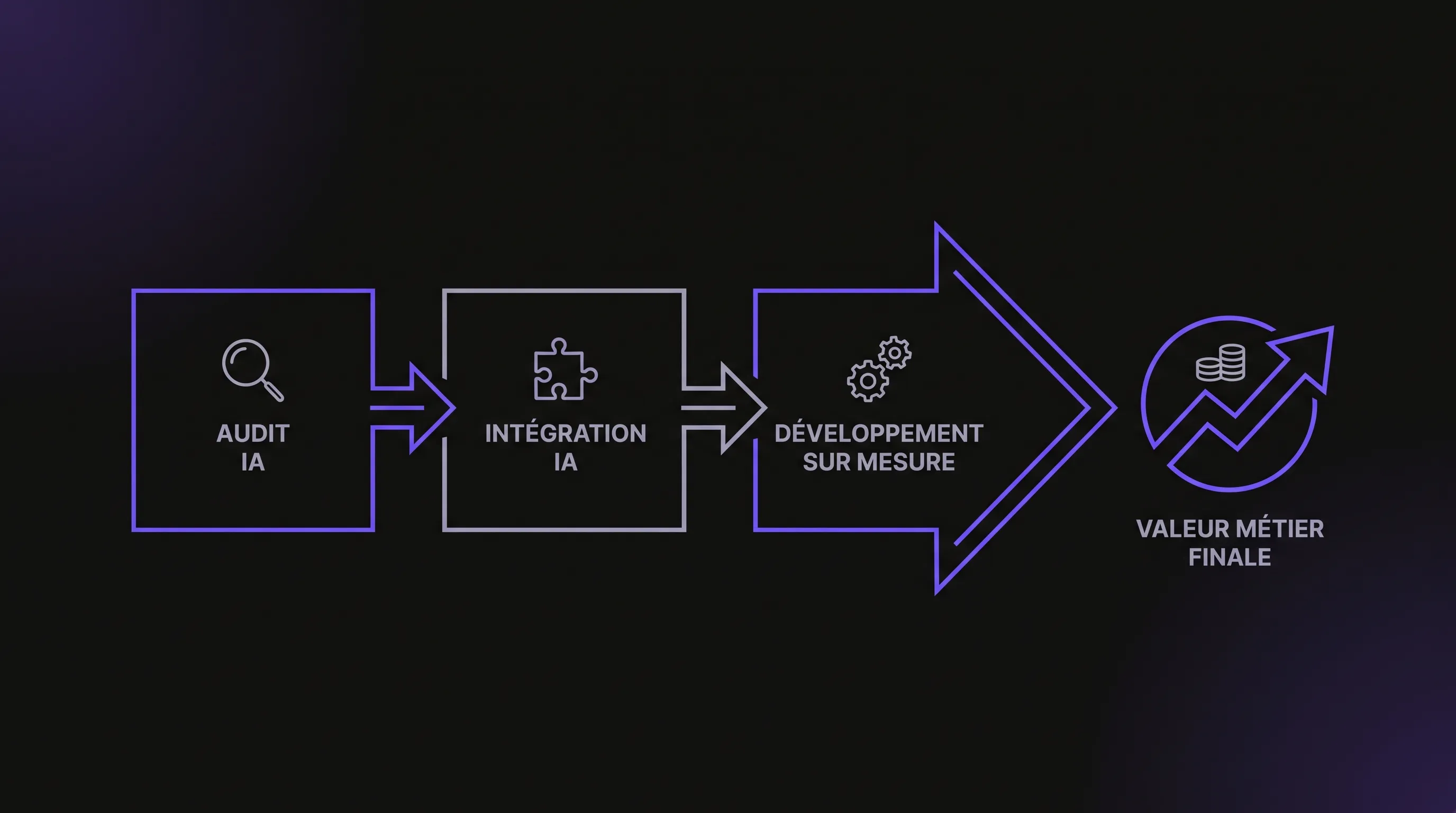
AI Services: Audit, Integration, or Custom Development?
Intelligence artificielle
Stratégie IA
Audit IA
Automatisation
Optimisation
Choosing an **AI service** isn't about buying the latest tech. For an SME, scale-up, or growing business, the right choice hinges on three questions: is your problem well-defined, can your current tools connect, and does the expected ROI justify custom work?
Choosing an AI service isn't about buying the latest technology. For an SME, scale-up, or growing company, making the right decision hinges primarily on three questions: is your problem clearly defined, can your current tools be connected, and does the expected return justify custom development?
Many business leaders start by experimenting with ChatGPT, a SaaS tool, or a few isolated automations. While useful for learning, this rarely suffices to transform a core business process. Conversely, launching custom development too early can tie up budget without proven ROI. Between these two extremes, several levels of engagement exist: audit, integration, or custom development.
Which AI service should you choose based on your maturity level?
The right choice rarely depends on a single variable. You need to assess your team's maturity, data quality, the strategic importance of the process to improve, and an acceptable level of risk. A company taking its first steps with AI doesn't have the same requirements as a scale-up looking to automate a well-documented operational pipeline.
Situation
Most Logical Option
Why
You have ideas but no clear priorities
AI Audit
Identify profitable use cases before investing
You already use multiple business tools
AI Integration
Connect AI into your existing workflows
Your process is strategic and specific
Custom Development
Build a solution tailored to your rules, data, and constraints
Your teams are testing AI without guidelines
Audit followed by targeted training
Reduce fragmented usage and secure adoption
A SaaS tool covers 80% of your needs
Integration or configuration
Avoid unnecessarily expensive development
A simple rule helps frame the decision: the more frequent, differentiating, and dependent on internal data a process is, the more relevant an integrated or custom approach becomes. Conversely, if your needs are still fuzzy, an audit is often the best starting point.
AI Audit: Clarifying opportunities before investing
An audit is the most appropriate AI service when a company knows it needs to move forward, but doesn't yet know where to focus its efforts. Its goal isn't to produce a lengthy, theoretical report. A good audit must turn a general intuition—such as "we want to save time with AI"—into a prioritized list of actionable use cases.
When an audit is the right choice
An audit is relevant when multiple teams are already experimenting with AI tools without coordination, when leadership receives conflicting requests, or when available data is poorly understood. It is also ideal when a company wants to avoid picking a tool before understanding its operational constraints.
In an SME, an audit might reveal that the best initial project isn't the most flashy one. Automating inbound lead qualification, streamlining quote generation, or improving sales reporting reliability can deliver far more value than a poorly fed public chatbot.
Deliverables to expect
A rigorous audit must lead to decisions. The most valuable deliverables include process mapping, a prioritized list of use cases, estimated potential impact, risk analysis, and an implementation roadmap. To explore this further, you can rely on a report template and ROI scorecard for an AI audit.
The key takeaway is prioritization. Not all use cases deserve a dedicated project. Some require a simple tool adjustment, others lightweight automation, and others custom development.
AI Integration: Putting AI to work in your existing tools
Integration is often the most cost-effective AI service when a company already possesses a relatively stable IT system. It involves connecting AI components to your current stack: CRM, ERP, knowledge base, support ticketing, messaging, vertical software, or internal platform.
Unlike a simple SaaS subscription, integration embeds AI directly into the actual workflow. For example, a sales rep shouldn't have to manually copy and paste call notes into an external tool if AI can summarize the exchange, update the CRM, and draft a follow-up email—all within the same environment.
Examples of integration use cases
AI integration can take very practical forms: automatic support ticket classification, data extraction from PDFs, meeting summary generation, semantic search across a document base, or auto-filling fields in internal software.
This approach is particularly valuable when teams waste time toggling between tools. It doesn't necessarily replace existing software; rather, it makes them more productive by automating repetitive tasks, improving data quality, or speeding up decision-making.
Key considerations and pitfalls
Integration demands rigorous attention to security, access permissions, and data quality. AI connected to bad data will simply produce bad results faster. Validation rules, activity logs, and human-in-the-loop safeguards are essential.
The NIST AI Risk Management Framework highlights the importance of governing, measuring, and managing AI systems, especially when they influence operational decisions. For European companies, guidelines from data protection authorities like the CNIL on artificial intelligence also serve as a vital benchmark for personal data and compliance.
Custom Development: Building a lasting competitive edge
Custom development becomes the right AI service when your requirements cannot be effectively addressed by an off-the-shelf tool or simple workflow connector. It involves building a solution tailored specifically to your processes, data, business logic, and performance goals.
This choice is rarely justified for generic needs. It becomes rational when the process is core to your business, repeated frequently, difficult to outsource to a generic SaaS, and delivers measurable gains. A scale-up handling thousands of similar requests, documents, or decisions can achieve significant leverage with a dedicated platform.
What sets custom development apart from off-the-shelf AI tools
A market tool imposes its own framework. Custom development starts from yours. This can include tailor-made user interfaces, specific workflows, direct connections to internal databases, custom validation logic, and business rules unique to your organization.
Custom doesn't mean reinventing the wheel from scratch. In many projects, it combines existing foundation models, APIs, a business logic layer, a database, a web UI, and automations. The true value comes from end-to-end orchestration, not just the underlying AI model.
To make an objective decision, reviewing the rational criteria for custom AI development is helpful—particularly regarding usage frequency, process value, and proprietary data availability.
Comparison: Audit, Integration, and Custom Development
To decide without falling for the hype, compare your options based on uncertainty and commitment levels. The higher the uncertainty, the more scoping is required. The higher the expected impact, the more deep integration or custom development makes sense.
Criteria
AI Audit
AI Integration
Custom Development
Primary objective
Prioritize use cases
Automate within existing tools
Build a proprietary company solution
Typical duration
Short to medium
Medium
Medium to long
Main risk
Getting stuck at the report stage
Underestimating data complexity
Over-engineering before validating the need
Required data
Inventory and sample data
Accessible data via tools or APIs
Structured data, business rules, historical records
Best success metric
Clear, prioritized roadmap
Time saved in an active workflow
User adoption, reliability, and ROI on a strategic process
An AI service shouldn't be evaluated solely on its initial cost. Adoption costs, ongoing maintenance, vendor lock-in, scalability, and internal team support load must also be factored in.
How to decide in an executive committee?
The decision must be framed as an investment trade-off, not a tech purchase. Before speaking with vendors or agencies, bring business, operational, and technical leaders together around a few straightforward questions:
Which process do we want to improve first?
How often does this process occur weekly or monthly?
What is its current cost in time, errors, delays, or missed opportunities?
What data is required, and who owns it?
What level of human oversight must remain mandatory?
How will we measure success after 30, 60, or 90 days?
If you cannot answer these questions, start with an audit. If the answers are clear but your tools don't communicate with each other, integration is likely your top priority. If the process is critical, unique, and well-understood, custom development may be the most rational path.
This discussion also mirrors the choice between off-the-shelf software, assembling building blocks, and bespoke software. To compare these approaches, the guide on choosing between SaaS, assembled components, and custom AI solutions provides a valuable decision framework.
Common pitfalls when choosing an AI service
The first mistake is starting with the tool rather than the problem. Subscribing to a popular platform might give the illusion of progress, but it creates little value if no one embeds it into the daily routines of your teams.
The second mistake is confusing a prototype with a production-ready system. An AI demo can look impressive on a handful of clean examples, only to fail when confronted with messy real-world data, edge cases, or daily operational demands.
The third mistake is neglecting user adoption. Even high-performing automation can be rejected if teams don't understand its role, if outputs lack explainability, or if review procedures are murky. Training and change management aren't decorative add-ons; they determine ROI.
Finally, many organizations underestimate maintenance. Models evolve, APIs change, internal workflows adapt, and data quality degrades without active oversight. An AI initiative must plan for ongoing operations from day one.
The right roadmap: Scope, Test, Scale
In most growing organizations, the healthiest path follows three phases: first, scope opportunities through a focused audit or diagnostic; second, test the most promising use case in a controlled sandbox; third, scale only once results are quantifiable and users genuinely adopt the tool.
This phased approach avoids two pitfalls: spending months overanalyzing without shipping, or rushing to build an unmaintainable solution. It also preserves team trust, as each step delivers tangible proof.
The best AI service is the one aligned with your next immediate decision, not one promising overnight disruption. If you need to pick a starting point, focus where manual effort is high, business rules are well understood, and financial impact can be tracked.
FAQ
Which AI service should we choose if our company is just starting out? If your use cases aren't yet prioritized, start with an audit. It maps opportunities, evaluates available data, and prevents you from buying or developing a solution before validating the real need.
What is the difference between AI integration and custom development? Integration connects AI capabilities directly into your existing software stack. Custom development builds a dedicated application or platform tailored to your specific workflows, interfaces, and proprietary business logic.
Do you always need an audit before an AI project? No, not always. If the need is clear, data is accessible, and the process is well-documented, you can jump straight to an integration or prototype. An audit is essential when priorities, risks, or projected gains remain undefined.
How do you measure the ROI of an AI project? Track time saved, error reduction, increased operational capacity, faster turnaround times, and team adoption. Credible ROI relies on a baseline metric, a measurable target, and post-deployment monitoring.
Moving from decision to execution with Impulse Lab
Impulse Lab helps businesses turn AI into concrete business value without getting lost in the hype. Depending on your situation, our team can assist with opportunity audits, integration with existing tooling, workflow automation, or end-to-end custom web and AI platform development.
The most effective approach involves business teams right from scoping, delivers in iterative stages, and measures actual impact. If you're torn between an audit, integration, or custom development, start by clarifying the target process, available data, and the level of organizational bandwidth you can commit today.