Should you rely on AI translation tools or hire a human translator? For an expanding business, the choice depends on risk rather than volume. Discover when to automate, when to use human expertise, and how post-editing balances speed, cost, and accuracy.
October 09, 2026·10 min read
Your search for “AI translation” raises a very practical question: should you entrust your content to an automated tool or hire a professional human translator? For an SME expanding into a new market, the answer depends less on volume and more on the consequences of an error. An internal memo, a sales page, and a legal contract do not justify the same level of scrutiny.
AI is best suited for simple, low-risk content. A human translator remains preferable when meaning, liability, or persuasion are critical. Between the two, machine translation followed by professional post-editing can offer a balanced compromise, provided you account for the correction workload.
AI Translation: Three Options to Compare
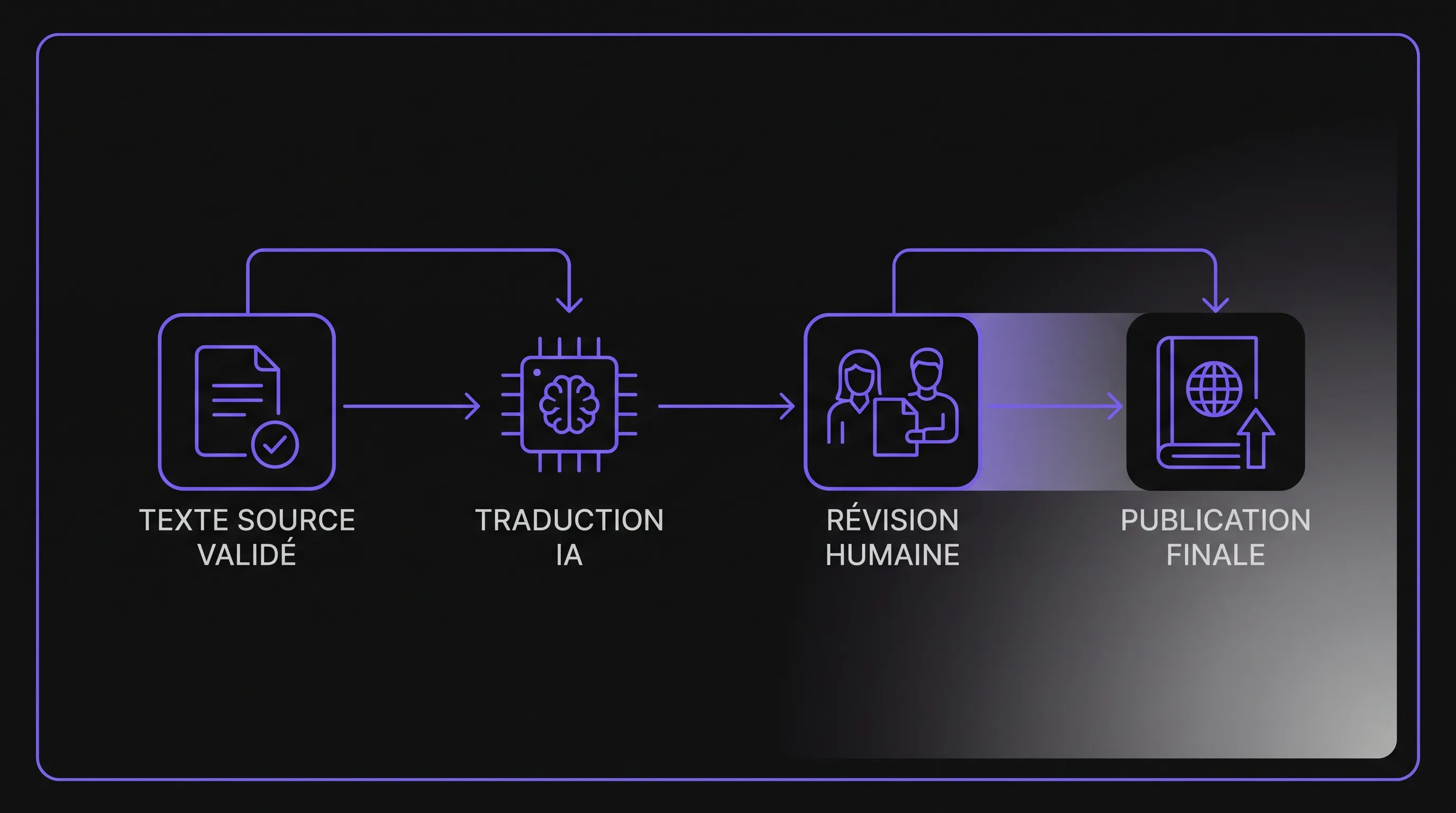
The choice is not binary. You can translate automatically, delegate entirely to a professional, or combine both approaches. This third option is called post-editing: a human edits and refines a translation produced by a machine using the source text.
Criteria
Unedited AI
Human Translator
AI with Professional Post-Editing
Initial Speed
Rapid initial output
Turnaround depends on volume and availability
Fast initial draft, followed by review time
Context Understanding
Depends on provided prompts and model
Can ask for clarification and resolve ambiguities
Reviewer verifies machine choices
Commercial Tone
Can produce fluent yet generic copy
Can adapt the message to the target audience
May require substantial rewriting
Industry Terminology
Must be monitored and controlled
Depends on the translator's specialization
Shared glossary and human verification
Confidentiality
Depends on the service and terms of use
Depends on the provider's contractual commitments
Both levels must be audited
True Cost
Includes tool fees, quality control, and edits
Depends on the project scope
Largely depends on the quality of the initial output
No single column inherently guarantees an accurate translation. A generalist human translator might misunderstand technical terminology, while an AI can produce a flawlessly fluent sentence that completely alters a legal obligation.
What AI Translates Well—and What It Cannot Guarantee
AI-driven translation performs remarkably well on clear, repetitive, and well-contextualized copy. Standardized product descriptions or structured help center articles are often far better candidates than a marketing slogan or an ambiguous contractual clause.
Dedicated machine translation engines and general-purpose large language models (LLMs) serve slightly different needs. Dedicated engines are built specifically to translate. LLMs also let you specify tone guidelines, explain phrasing choices, or generate multiple variants. However, they may over-rewrite or stray beyond what was requested.
The main pitfall is deceptive fluency. A translation that reads smoothly can still conceal an inverted negation, an omitted caveat, or hallucinated details. Reviewing only the target version is never enough: it must be cross-referenced against the source text.
To better understand this limitation, our guide on how language models work helps clarify the difference between plausible text generation and verified accuracy.
Performance also varies depending on language pairs, subject matter, and original document quality. Strong results on a French page translated into English do not automatically validate every content type or every target language.
Choose Based on Risk, Not Length
Internal Comprehension: AI May Be Sufficient
To grasp the general gist of a vendor email or public technical documentation, automated translation is often plenty. The goal is information access, not publishing flawless prose.
However, unreviewed AI translation becomes risky if that understanding drives a major decision: accepting a binding commitment, updating a safety procedure, or interpreting a critical technical instruction. A document being “internal” does not automatically make it low-risk.
Website and Sales Copy: Prioritize Human Validation
A sales landing page must convey value, build trust, and use natural idioms that resonate with the target audience. Translating words accurately does not guarantee commercial effectiveness.
For repetitive e-commerce product listings, AI followed by human proofreading can be very cost-effective. For a homepage, ad campaign, or brand tagline, a professional specialized in marketing adaptation brings far more value. This is often referred to as transcreation, where the core message and emotional impact are recreated rather than translated literally.
Localization also encompasses currency symbols, date conventions, measurement units, and cultural references. For international SEO, keywords must be researched directly in the target market, not simply translated word-for-word.
Contracts and Sensitive Content: Involve a Specialist
For legal contracts, medical notices, or safety protocols, absolute precision and risk mitigation are paramount. Work with a specialized legal or technical translator and arrange separate legal, medical, or regulatory review when required.
AI can potentially assist with drafting or preparation in a compliant, secure environment, but it should never serve as the sole gatekeeper before publication.
For official documents, verify destination requirements: a certified or sworn translator may be legally mandated depending on the jurisdiction and administrative procedure.
Setting Up a Controlled Translation Workflow
Prepare the Source Text and Terminology
Ambiguous source text creates problems for machines and humans alike. Prior to translation, eliminate convoluted phrasing, spell out acronyms, and clarify the intended audience.
AI translation becomes substantially more consistent when backed by a validated glossary: approved product names, industry terms, preferred expressions, and “do-not-translate” lists. A handful of well-defined essential terms is often more effective than a vague, lengthy prompt.
Translation memories (TMs) can also store previously approved segments for reuse. Unlike glossaries, which track individual terms, TMs manage full sentences and segments. Both resources must be actively maintained to prevent legacy errors from propagating.
Define the Deliverables for the Review Step
A quick sanity check for general meaning is not the same as a publish-ready editorial revision. Define the expected quality tier before requesting a quote or assigning tasks internally.
The ISO 18587 standard covers full human post-editing of machine translation output and post-editor qualifications. It offers a structured framework for professional engagements, without assuming all raw machine output can be salvaged.
If an initial machine draft is poor, fixing it can take longer than translating from scratch. Give the linguist permission to discard the machine draft and translate directly from the source if needed.
Check Elements That Can Break in Production
Linguistic checks must be complemented by functional testing, particularly for web pages and software applications:
Accuracy: Cross-check obligations, conditions, negations, and exceptions against the source text.
Data integrity: Verify pricing, dates, product SKUs, and measurement units.
Technical components: Protect code variables, URLs, HTML tags, and identifiers that must not be translated.
UI layout: Check buttons, navigation menus, and localized text expansion within the layout.
Automated QA tools can flag syntax anomalies, but they cannot replace a fluent native speaker when assessing flow and nuance.
Confidentiality: Audit the Tool Before Uploading Data
AI translation typically involves sending data to an external provider. Before uploading files, inspect the terms of service that govern your specific plan, not just the vendor's general brand reputation.
Specifically check data retention policies, whether inputs are used for model training, employee access privileges, and data deletion mechanisms. Free and enterprise tiers often come with vastly different data policies, but paying for a tier does not automatically guarantee complete privacy.
If the text contains personal data, the GDPR applies. You must assess the provider's legal role (data processor), mandatory contractual clauses (DPA), and cross-border data transfer mechanisms outside the EEA. Server location claims alone do not solve all compliance duties.
For an SME, a clear internal guideline helps prevent leaks: classify which documents can use approved AI tools, which require anonymization, and which must remain strictly offline or within restricted workflows. Human translators must also sign non-disclosure agreements (NDAs) that reflect your confidentiality requirements.
Compare Total Cost of Ownership Rather Than Per-Word Rates
A fast draft is not automatically cheaper to deliver. Your comparison must always evaluate the final deliverable: validated, formatted, and ready-to-publish content.
Total Cost = translation tool/subscription + preparation + review/editing + CMS integration + rework. Factor in the time spent maintaining glossaries and workflows. When comparing agencies or freelancers, confirm what is included: raw translation, independent proofreading, desktop publishing (DTP), or correction rounds.
AI translation becomes financially viable when the time saved outweighs the additional review and quality assurance effort, while delivering equivalent end-quality.
Sample Calculation Using Hypothetical Figures
Consider a team localizing 40 product sheets per month. Their traditional process takes 30 minutes per sheet, totaling 20 hours. At a hypothetical internal burdened cost of €60/hour, this costs €1,200.
An AI-assisted workflow reduces overall time to 15 minutes per sheet, including review and integration. This cuts labor to 10 hours, or €600. Factoring in €150/month in software and workflow overhead, total costs come to €750.
The net savings would be €450 per month, before initial setup fees. These numbers are purely illustrative and do not reflect specific market pricing. They highlight why measuring end-to-end time and verifying output quality is essential.
Run a Pilot on a Small Batch Before Rolling Out
Select a representative sample of your actual content: simple descriptions, technical jargon, ambiguous phrases, and interface strings. Testing only easy sentences will provide an overly optimistic picture of the process.
Benchmark human translation side-by-side with an AI-assisted workflow using identical evaluation criteria. Track time to delivery, mistranslations, terminology deviations, and post-integration bugs. Have both versions evaluated by a native speaker in the target language.
AI translation should be evaluated against your specific business reality, not standard vendor benchmarks. If editing costs more time and money than expected, restrict AI to low-complexity content or pivot your strategy.
Before scaling, establish governance: define who can trigger translations, who reviews them, and who signs off on publication. Archive both source and final approved versions to maintain traceability. A modest, well-documented workflow is far safer than an uncontrolled automated pipeline.
Frequently Asked Questions
Can AI replace a human translator? It can reliably handle basic comprehension and draft generation. For sensitive, commercial, or specialized copy, human expertise remains indispensable. The decision hinges on error tolerance and required quality.
Is post-editing always cheaper? Not necessarily. While solid machine output reduces labor, fixing low-quality machine translation can require a full rewrite. Benchmark turnaround times and quotes on a representative sample first.
Can you translate confidential documents with AI? Only within an enterprise setup compliant with your privacy commitments. Check contractual terms, data retention, access controls, and data transfers. Never paste sensitive business data into unauthorized public tools.
How do you verify a translation if no one speaks the target language? Work with a qualified native linguist or reviewer. Back-translating into the source language can catch obvious discrepancies, but it is not a foolproof verification method, as tools can duplicate or obscure translation errors.
Building a Translation Workflow Tailored to Your Business
Looking to integrate AI translation into your tech stack without compromising content quality or security? Impulse Lab provides AI opportunity audits, custom integrations, and team training.
A sensible starting point is defining a clear scope: which content to translate, what level of human review to enforce, and which KPIs to track. This audit helps determine whether your needs are best served by off-the-shelf software, an automated pipeline, or specialized language service providers.