Artificial Intelligence Development: Steps, Costs, and Pitfalls
automatisations
Intelligence artificielle
Stratégie IA
ROI
Gestion de projet IA
In 2026, the issue isn't really "doing AI" anymore, but **delivering an AI capability** that integrates with your tools, respects your constraints (GDPR, security, AI Act), and above all **produces a measurable gain** (time, revenue, quality, risk). This is exactly where most projects...
In 2026, the issue is no longer really about "doing AI", but about delivering an AI capability that integrates with your tools, respects your constraints (GDPR, security, AI Act), and above all produces a measurable gain (time, revenue, quality, risk). This is exactly where most artificial intelligence development projects are decided, and where they fail.
This guide gives you an operational overview of the steps, real costs (TCO), and classic pitfalls for an SME or scale-up.
Artificial Intelligence Development: What exactly are we talking about?
In a company, "AI development" covers several very different realities. Clarifying the type of solution avoids overestimating (or underestimating) effort, costs, and risks.
AI Solution Type
What it is
Frequent Examples
When it is relevant
Generative AI (LLM)
A language model that produces text, code, summaries
When reliability depends on your up-to-date documents
Agent (actions)
LLM that plans and executes tooled actions
Support triage, CRM updates, multi-tool workflows
When you have repeatable and reversible actions
"Classic" ML
Predictive/statistical models on structured data
Scoring, churn, simple forecasts
When you have historical data and need a score
Augmented Automation
Workflows + rules + AI (hybrid)
Email routing, pre-filling, QA
When you want control and a quick ROI
In the majority of SME/scale-up contexts, the best results come from a hybrid approach: a bit of determinism (rules, controls), an AI layer (LLM), sources (RAG), and actionable integrations.
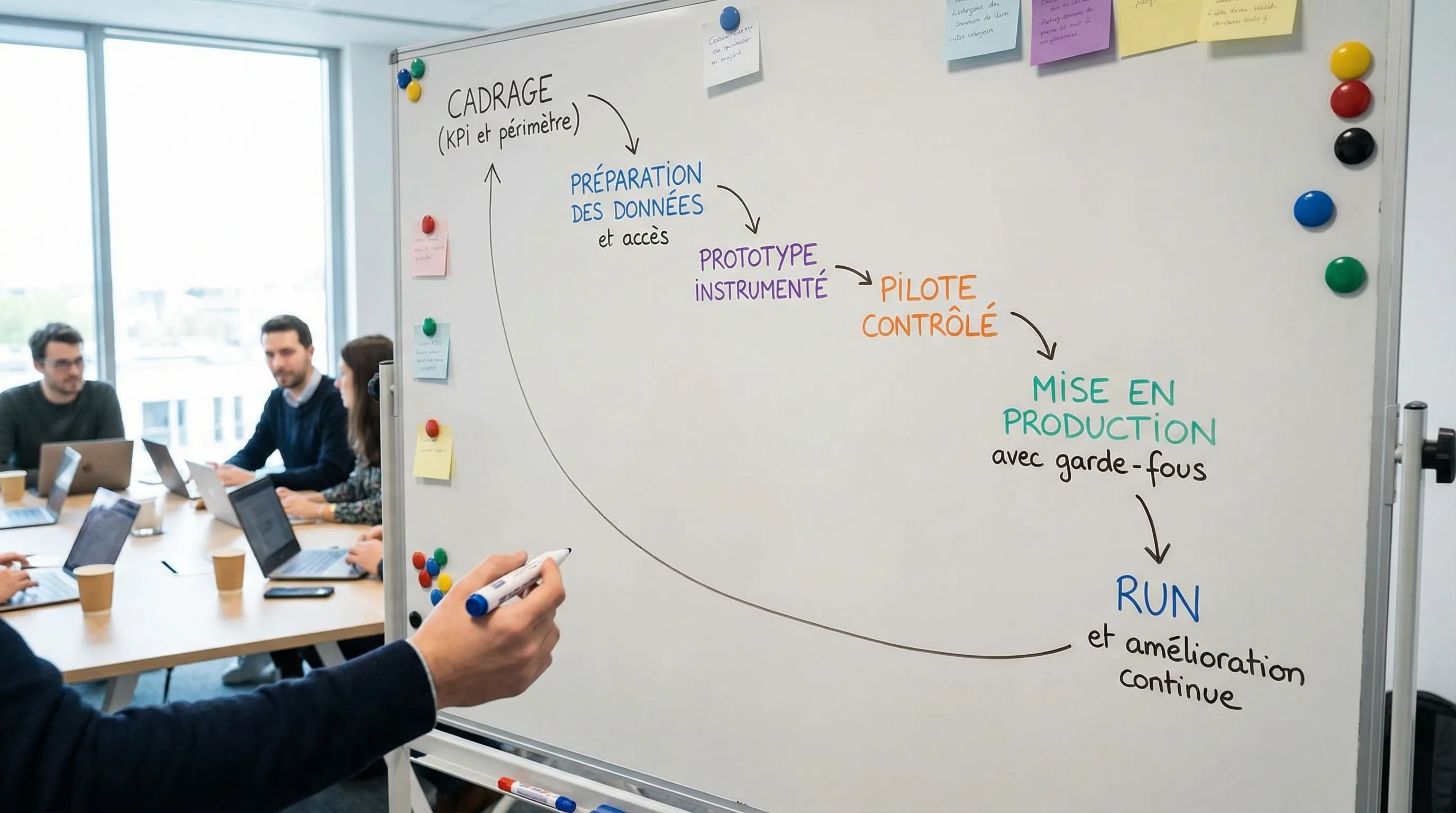
The steps of an AI project that ends up in production (not as a demo)
A successful AI project looks more like a mini-product than an experiment. The classic mistake is to start with the model or the tool, instead of starting with the workflow and measurement.
1) Scope the use case (objective, scope, KPI)
A good scoping often fits on one page, but it must be explicit:
Job-to-be-done: what precise task, at what frequency, for which role.
Main KPI: minutes saved per file, first contact resolution rate, processing time, conversion rate, error rate, etc.
Baseline: where you are today (otherwise, you won't prove anything).
Costs: Why the "price" of an AI is never just the model
In artificial intelligence development, the right reasoning is not "how much does the AI cost?", but how much does the AI capability in production cost.
We talk about TCO (Total Cost of Ownership): build + integration + run + adoption.
Cost centers to anticipate (even on a "simple" project)
Item
Why it exists
Signs of underestimation
Product Scoping
Without KPI/baseline, no credible ROI
"We'll see if it works"
Data + Access
Quality and rights determine reliability
Obsolete docs, vague permissions
Integrations
The AI must act within the workflow
Copy-paste, no tooled actions
API Usage (variable)
Tokens, latency, quotas
Context explosion, no cache
Evaluation and Observability
Measuring quality, costs, incidents
No logs, no reproducible tests
Security and Compliance
AI = new attack surface
No prompt injection review, no DPIA when necessary
Maintenance
Sources, prompts, models evolve
No owner, no ritual
Adoption/Training
An unused AI has a negative ROI
"The teams aren't hooking on"
A simple method to estimate the budget without inventing numbers
Without getting into misleading ranges, you can estimate an order of magnitude by answering these questions:
Volume: how many requests per day/week, and by how many users.
Recurring costs: API usage, observability, maintenance, support, continuous training.
If you use APIs, the most important point is to treat costs as a system to be managed, not as an invoice to be endured. The article AI APIs: Guide to Pricing, Quotas, and Hidden Costs details concrete levers.
A frequent use case, close to cash (cost or revenue).
A main KPI, a baseline, and a definition of "success".
Identified sources of truth, with access rules.
An assessed risk level (GDPR, security, impacts).
An integration strategy (where the AI acts in the workflow).
A reproducible test plan (set of cases).
A run plan (maintenance, incidents, budget, monitoring).
An adoption plan (training, rules, feedback loop).
Conclusion: The right question to ask yourself
If you are looking for "artificial intelligence development", you are probably looking for one thing: avoid paying for a demo, and obtain an AI capability that holds up in production.
The most robust path for an SME or scale-up is generally:
A KPI-oriented scoping.
An instrumented prototype.
A short and controlled pilot.
Industrialization with guardrails, observability, and a runbook.
If you want to accelerate without burning budget, Impulse Lab supports this type of approach via AI opportunity audits, adoption training, and custom web and AI development (with integration into your tools). Recommended starting point: Strategic AI Audit: Mapping Risks and Opportunities or get in touch at Impulse Lab.
AI Services: Audit, Integration, or Custom Development?
Choosing an **AI service** isn't about buying the latest tech. For an SME, scale-up, or growing business, the right choice hinges on three questions: is your problem well-defined, can your current tools connect, and does the expected ROI justify custom work?