Business and Artificial Intelligence: Starting Risk-Free in 30 Days
Intelligence artificielle
Stratégie d'entreprise
Stratégie IA
Gestion des risques IA
Gestion de projet IA
Many companies want to "do AI" but delay starting due to three concrete fears: data leaks, failed projects, and exploding costs. The good news is that in 2026, starting with AI in business doesn't require a heavy program.
Many companies want to "do AI" but delay starting due to three very concrete fears: data leaks, failed projects, and exploding costs. The good news is that in 2026, starting with artificial intelligence in business does not require a heavy program. However, it does require a short, instrumented method and simple guardrails.
This guide offers a 30-day plan designed for SMEs and scale-ups starting to structure their growth: you deliver a useful first V1 (even a modest one), measure real impact, and maintain control over the risks.
What "starting risk-free" (really) means
"Risk-free" does not mean "without technology" or "without ambition". It means:
Controlled data risk: we know what can go out, what must never go out, and how to enforce it.
Limited operational risk: AI is not allowed to break a critical process, and a degraded mode exists.
Bounded financial risk: budget and variable costs are framed, stop thresholds are defined.
Anticipated compliance risk: GDPR, security, and initial AI governance requirements are addressed from the pilot phase.
If you do not define these boundaries at the beginning, you will pay for them later (in rework, internal tensions, or project cancellation).
The key principle: one use case, one owner, 3 to 5 KPIs
To stick to 30 days, the discipline is simple: a single use case, led by a business owner, with a small set of indicators.
A good first use case has three properties:
Frequent: many occurrences per week (otherwise, it's hard to measure).
Standardizable: relatively repetitive inputs and outputs.
Connectable: it touches existing tools (CRM, helpdesk, Google Workspace, ERP, knowledge base), even via minimal integration.
On the measurement side, aim for 3 to 5 KPIs maximum:
1 North Star (example: average processing time, first contact resolution rate, response time, MQL→SQL conversion, etc.)
1 to 2 process metrics (volume, steps, duration)
1 to 2 guardrails (quality, errors, escalations, compliance)
To go further on measurement, you can draw inspiration from an AI KPI framework (business, process, quality, technical) described in this guide: AI KPIs: measuring the impact on your business.
The 5 prerequisites to validate in 48 hours (before "testing a tool")
You can launch a pilot quickly, but not "blindly". Before Day 1, validate these 5 points:
1) Sponsor and owner
A sponsor (executive or manager) who protects from noise and makes quick decisions.
A business owner (the one who suffers from the problem and decides on usage trade-offs).
2) Baseline
You have a "before" measurement (even an imperfect one). Without a baseline, you will prove nothing.
3) Simple data rules (classification)
Create a maximum of 3 categories:
Public: can go out.
Internal: can go out under conditions (anonymization, contract, non-retention).
Sensitive: never goes out (or only in a controlled environment).
The CNIL publishes useful recommendations to frame the uses and protection of personal data: CNIL, Artificial Intelligence.
4) Short delivery channel
You must be able to deliver, test, and fix every week. A sprint-like rhythm is ideal.
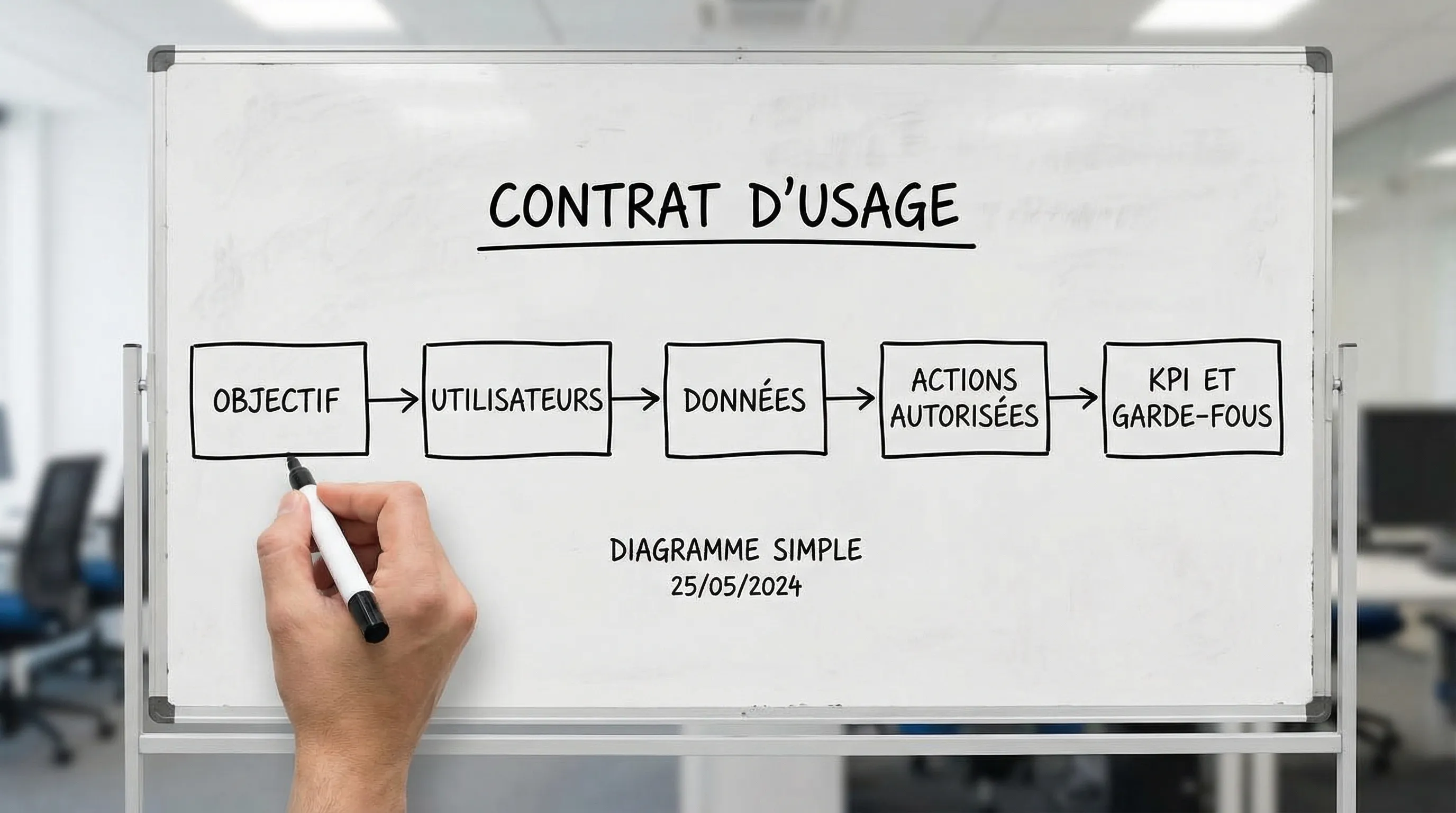
5) "Usage contract" (one-pager)
Before any implementation, write a one-pager:
target user
objective
what the AI is allowed to do
what the AI is not allowed to do
data used
KPIs
failure criteria (and stop conditions)
This is the simplest antidote to impressive but unusable demos.
30-day plan: the week-by-week roadmap
The goal is not to "deploy AI" across the entire company. The goal is to produce proof of impact and a clear path forward.
Overview of deliverables
Week
Objective
Concrete deliverables
Expected decision
W1
Frame, secure, measure
Usage contract, baseline, data rules, test protocol
Go prototyping
W2
Prototype in real conditions
Instrumented prototype, test dataset, first evaluation
Week 1: "ROI + risks" framing in 5 short workshops
In week 1, you code almost nothing. You reduce uncertainty.
Workshop A: Mapping the real workflow
Take a concrete case and describe the end-to-end journey:
who triggers the request
what inputs are available
what decisions are made
where errors, delays, and rework occur
Your AI must fit into an existing workflow, not replace it.
Workshop B: KPIs and baseline
Example (customer support):
baseline: average response time over 2 weeks
North Star: reduction of X%
guardrail: minimum human escalation rate, error rate
Workshop C: Data and compliance
At this stage, do not look for legal perfection, look for clarity:
what personal data exists
where it is stored
who accesses it
how long it must be kept
On the AI governance side, the NIST AI Risk Management Framework is a useful reference for structuring risks and controls (even if you do not apply it fully from the start).
Workshop D: Minimal architecture (choosing the right pattern)
For a first pilot, avoid "heroic" architectures. Generally, you choose between:
Encapsulated AI API: you call a model via a server layer.
RAG: you connect the AI to a documentary source of truth to reduce invented answers.
Tooled agent: only if the case is actionable and highly bounded.
Build a mini corpus: 30 to 50 real cases if possible. You will use them throughout the rest of the process.
Week 2: Instrumented prototyping (not a demo)
The most common trap is confusing "it works once" with "it works for our teams". Your prototype must be:
testable: same cases, same criteria, same scorecard
measurable: logs, processing time, error rate
repairable: versionable, iterable
What you absolutely must instrument
Without turning it into a complex monstrosity, instrument right now:
the input (request type, source)
the output (response type, action)
the result (accepted, modified, rejected)
the cost (at a minimum: call volume or tokens if applicable)
Putting a human in the loop (HITL)
Even on a simple case, the safest rule in week 2 is:
the AI proposes
the human validates (or corrects)
you learn from rejections
This mechanism transforms a fragile prototype into an improvable system.
Week 3: Pilot with minimal integration and guardrails
In week 3, you are looking for a small integration that changes the game. No need for a full deployment, but you must get into the real tool.
Examples of minimal integrations that matter:
a "generate a response" button in the helpdesk, with sources and preview
a "summary + next steps" field in the CRM after a call
an automation that classifies and routes requests (with validation)
Simple risks → guardrails grid
Risk
Typical symptom
Minimal guardrail
Data leak
copy-pasting sensitive content into a public chat
data rules + adapted tool + anonymization + logging
Hallucinations
plausible but false answer
RAG, citations, refusal to answer outside of scope
Dangerous action
the AI modifies client data
preview mode, permissions, double validation
Variable costs
unpredictable bill
volume limits, alerts, more frugal models, caching
Non-adoption
teams do not use it
short training, templates, integration into the workflow
Regarding compliance, keep in mind that the European Union's AI Act entered into force in 2024 with progressive implementation. In practice, your best reflex from the pilot stage is traceability (logs), transparency (scope), and risk management.
Week 4: Scorecard, minimal run, "scale or stop" decision
Week 4 is not just "another week". It is the one where you make the project governable.
Calculating a realistic (and fast) ROI
A simple calculation is enough to decide:
Monthly gain = (time saved per occurrence) × (monthly volume) × (loaded hourly cost)
The important thing is not to have a perfect ROI, but a decision-making ROI.
The minimal runbook
Even for a V1, you must define:
who is the owner in production
how to report an incident
what thresholds trigger a stop (quality, costs, security)
what the degraded mode is (return to manual process)
Your decision at Day 30
At Day 30, you must be able to answer without beating around the bush:
Does it create measurable value?
Is it controlled enough to be expanded?
What is missing to industrialize it properly?
If the value isn't there, stop. It is a success, not a failure, if you learned quickly and protected your teams.
Mistakes that derail an AI launch (and how to avoid them)
Most "AI failures" in SMEs do not come from the model. They come from avoidable decisions.
Mistake 1: Starting with a tool instead of a workflow
A good signal: your specifications start with "we want to use ChatGPT" rather than "we want to reduce processing time by 25%".
Mistake 2: Aiming too broad
"We are going to automate all support" is almost always too broad. Start with a measurable sub-flow (triage, standard responses, extraction).
Mistake 3: Not integrating
An unintegrated AI becomes just another tab. An integrated AI becomes a reflex.
Mistake 4: Measuring usage rather than impact
"10 people used it" is not a KPI. "-18% response time" is.
When to get support (and what you should get)
You can execute this plan internally if you already have: a solid owner, integration capability, and a culture of measurement. Otherwise, the most effective support is often hybrid: short framing, weekly delivery, and targeted training for adoption.
At Impulse Lab, the approach is precisely oriented towards opportunity audits, integration, and delivery in short cycles, with adoption training when necessary. Depending on your situation, you can start with:
If you were to remember only one sentence: your goal is not to adopt AI, it is to deliver a first useful, measured, and controlled use case.
From there, the next steps become much simpler: you reuse your artifacts (usage contract, test protocol, scorecard, runbook), you move on to a second case, and you progressively build a credible AI capability within the company.
If you want to quickly validate a use case, secure your data, and deliver a V1 in short cycles, you can start with a discussion about your context via Impulse Lab.
The Mistakes That Cause an AI Pilot to Fail in Under a Month
AI pilots rarely fail because the tech doesn't work, but because gray areas emerge: vague KPIs, missing users, bad data, or poor integrations. For an SME or scale-up, the real danger is testing without a framework solid enough to drive a clear decision.