Clawdbot: security, integrations, and credible alternatives
Intelligence artificielle
Confidentialité des données
Outils IA
Gouvernance IA
Automatisation
If you're evaluating **Clawdbot**, you want to avoid the classic trap: a great demo followed by security blockers and costly integrations. In 2026, the difference between a useful bot and a risky one lies in **security, governance, integrations, and operations**.
If you are looking for Clawdbot, you are probably in an “evaluation” phase: the tool looks promising, but you want to avoid the classic scenario (convincing demo, then security blocking, costly integrations, soft adoption). In 2026, the difference between a useful bot and a risky bot is not played out on “the model” but on security, governance, integrations, and operations.
Important: without official documentation shared here, I cannot confirm the exact features of Clawdbot. The objective of this article is therefore to give you an evaluation grid (security + integrations), and credible alternatives depending on your context (SME, scale-up, light or structured IT team).
Clawdbot: what needs clarifying before talking “security”
Even before auditing the tool, you must frame what “Clawdbot” means in your company. Security is not the same if you are talking about:
a web support bot (level 0),
an internal assistant connected to Notion/Drive,
an agent that executes actions (ticket creation, CRM modifications, refunds).
Two simple questions avoid 80% of surprises.
1) What data will the bot see?
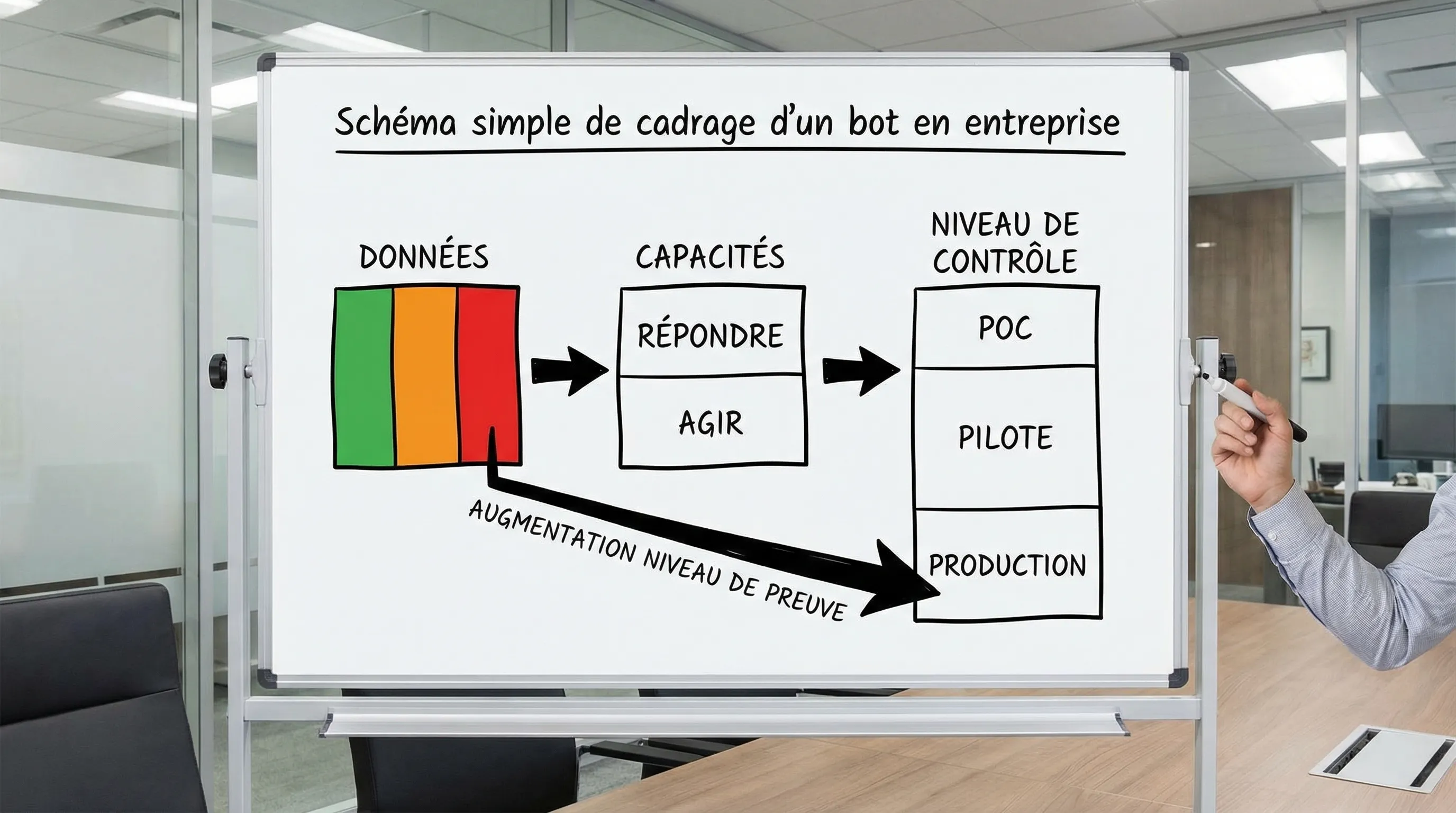
Classify your data into 3 levels (practical and actionable):
Green: Public or low-sensitivity content (public FAQs, marketing pages).
Orange: Non-critical internal data (internal processes, non-public product documentation).
If your use case touches on “red”, you must demand a much higher level of proof (DPA, retention guarantees, access controls, logs, etc.).
2) Does the bot answer, or does it act?
A bot that “answers” can be framed with RAG and good citations. A bot that “acts” (agent) must be treated as a critical automation capability, with an agent contract, safeguards, and progressive validation (offline, pilot, production). To frame this dimension, you can rely on the best practices described in our guide on autonomous agents in the enterprise: safeguards and validation.
Clawdbot Security: the checklist that really counts (and the proofs to ask for)
Most vendors promise “GDPR” and “encryption”. These are prerequisites, not guarantees. What matters are the concrete mechanisms, and your ability to audit them.
1) Data flow and retention: the non-negotiable point
Ask for a clear answer to these subjects:
Where data transits (hosting region, sub-processors)?
How long inputs/outputs are kept (logs, conversations, attachments)?
Is data used to train models (by default, optional, never)?
Can you delete a user, a conversation, a complete export (GDPR rights)?
To ask for as proof: DPA (Data Processing Agreement), retention policy, register of sub-processors.
Useful resource for framing compliance and minimization: the CNIL.
2) Access controls: IAM, SSO, RBAC, and tenant separation
A bot is an entry point. You therefore want access controls consistent with your IS:
SSO (SAML/OIDC) and lifecycle management (joiner/mover/leaver).
RBAC (roles) and, ideally, fine-grained control (by team, by knowledge base, by client).
Strict isolation between organizations (multi-tenant) if Clawdbot is a SaaS.
If you need to review the basics, our lexicon entry on authentication lays out the vocabulary and risks well.
Even a “simple” bot undergoes specific attacks (hidden instructions, rule circumvention, data extraction). The reference standard to know in 2026: the OWASP Top 10 for LLM Applications.
To evaluate Clawdbot, look for concrete answers to:
Anti prompt injection: filtering, sandbox, refusal policy, system/data separation.
Data leakage: PII masking, automatic redaction, rules on attachments.
Citations / traceability if RAG: sources displayed, confidence score, fallback if insufficient.
Action security if the tool can “act”: human approval, idempotency, simulation (dry-run), limitations by scopes.
4) Logs, auditability, and run: without observability, no production
A bot in production is a product. You must be able to:
If your main need is support (ticket reduction, triage, FAQ, handoff), helpdesk-centric solutions can be faster to deploy and simpler to govern, because they are already designed for ticketing, macros, escalation, and permissions.
Prioritize if: you have structured support, a volume of requests, and a clear ROI objective (deflection, handling time).
If the goal is conversion (qualification, appointments, quotes), look for solutions oriented towards journeys, tracking, and CRM integration. In this case, conversational quality matters, but value comes mainly from: routing, scoring, attribution, and integration.
Prioritize if: your site is already an acquisition channel, and you want to measure a KPI (appointments, qualification rate).
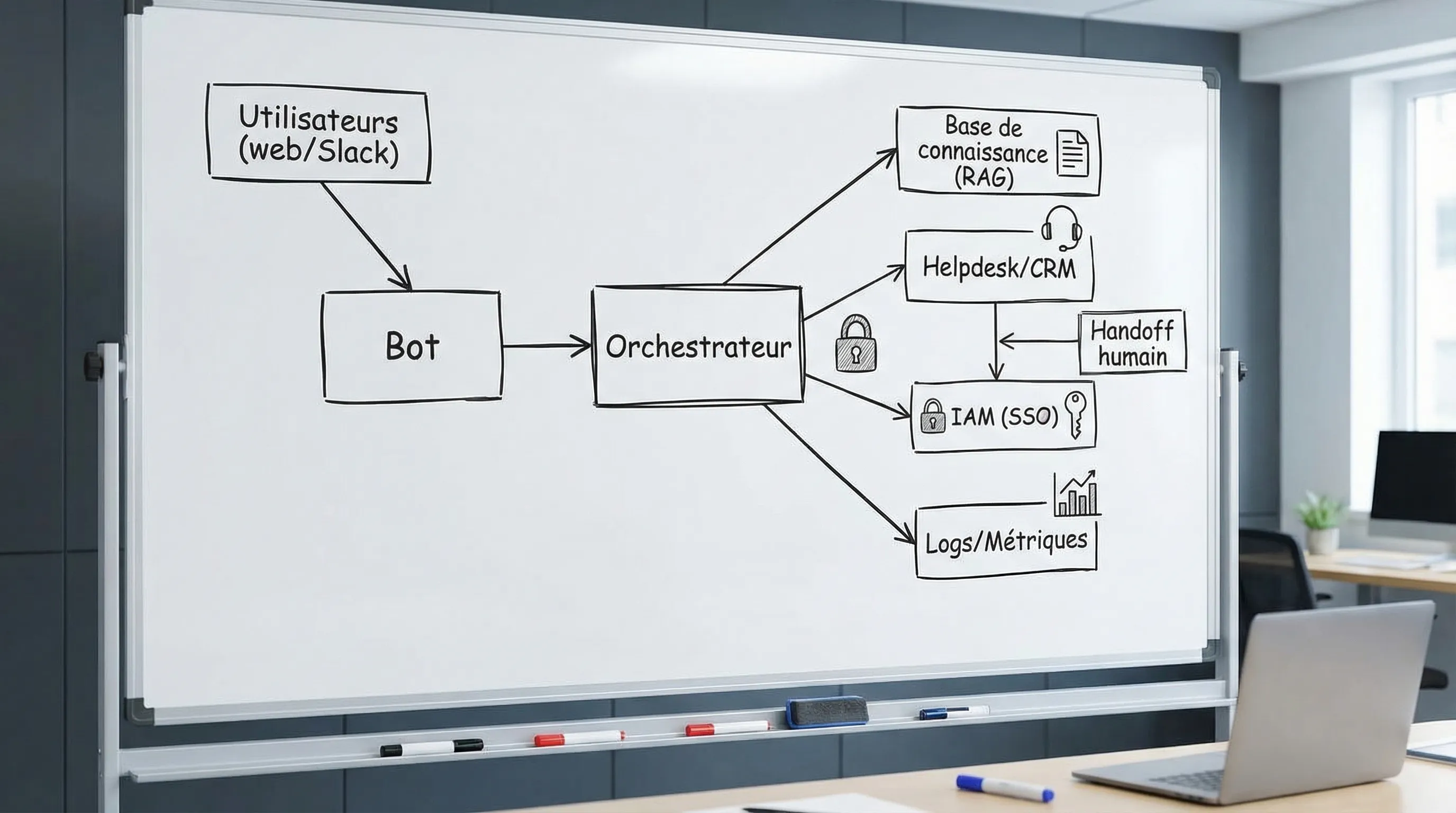
When you have multiple tools and data constraints, the assemble approach (orchestrator, RAG, connectors, simple UI) is often the best control/deadline ratio.
Prioritize if: you want to avoid lock-in, instrument from the start, and evolve the architecture.
4) Open source / self-hosted alternatives (when control is paramount)
If your data is very sensitive or your constraints are strong (regulated sector, internal requirements), self-hosted can be relevant. But be careful: “open source” does not mean “free”, you pay in integration, run, monitoring, security, updates.
Prioritize if: you have a technical team capable of operating (updates, security, infra cost, on-call).
5) Custom alternative (when integration and reliability are your differentiator)
Custom is rational if the stake is:
deep integration (multi-tool actions),
a specific experience (journey, tone, business constraints),
Is Clawdbot “secure” by default? The right answer is: it depends on your use case, the data handled, and the proofs provided (retention, access, logs, anti-injection). Demand auditable elements, not promises.
Which integrations are priority for a bot in the enterprise? Knowledge base (RAG), helpdesk or CRM (depending on the objective), IAM/SSO, and a logs/metrics foundation. Without these bricks, you will have a demo, not an operable product.
When to choose an alternative to Clawdbot rather than Clawdbot? As soon as you have strong constraints on hosting, reversibility, or multi-tool actions. In these cases, an assemble or custom approach reduces long-term risk.
How to avoid vendor lock-in with an AI bot? By keeping an orchestration layer and a mastered RAG, by structuring your prompts/API contracts, and by demanding export, logs, and reversibility clauses.
Can we start small without making a mistake? Yes: start on a green perimeter (public FAQ) or bounded orange, instrument simple KPIs, then expand only after a conclusive pilot.
Need a quick and actionable opinion on Clawdbot (or an alternative)?
At Impulse Lab, we help SMEs and scale-ups to audit a solution (security, integrations, risks), to test fast with real scenarios, then to industrialize (robust RAG, safeguards, observability, adoption).
Artificial intelligence in business raises a question beyond tooling: who actually owns it? The executive funding it, the team using it, the vendor, or the provider? The answer changes depending on whether we discuss ownership, governance, or liability.