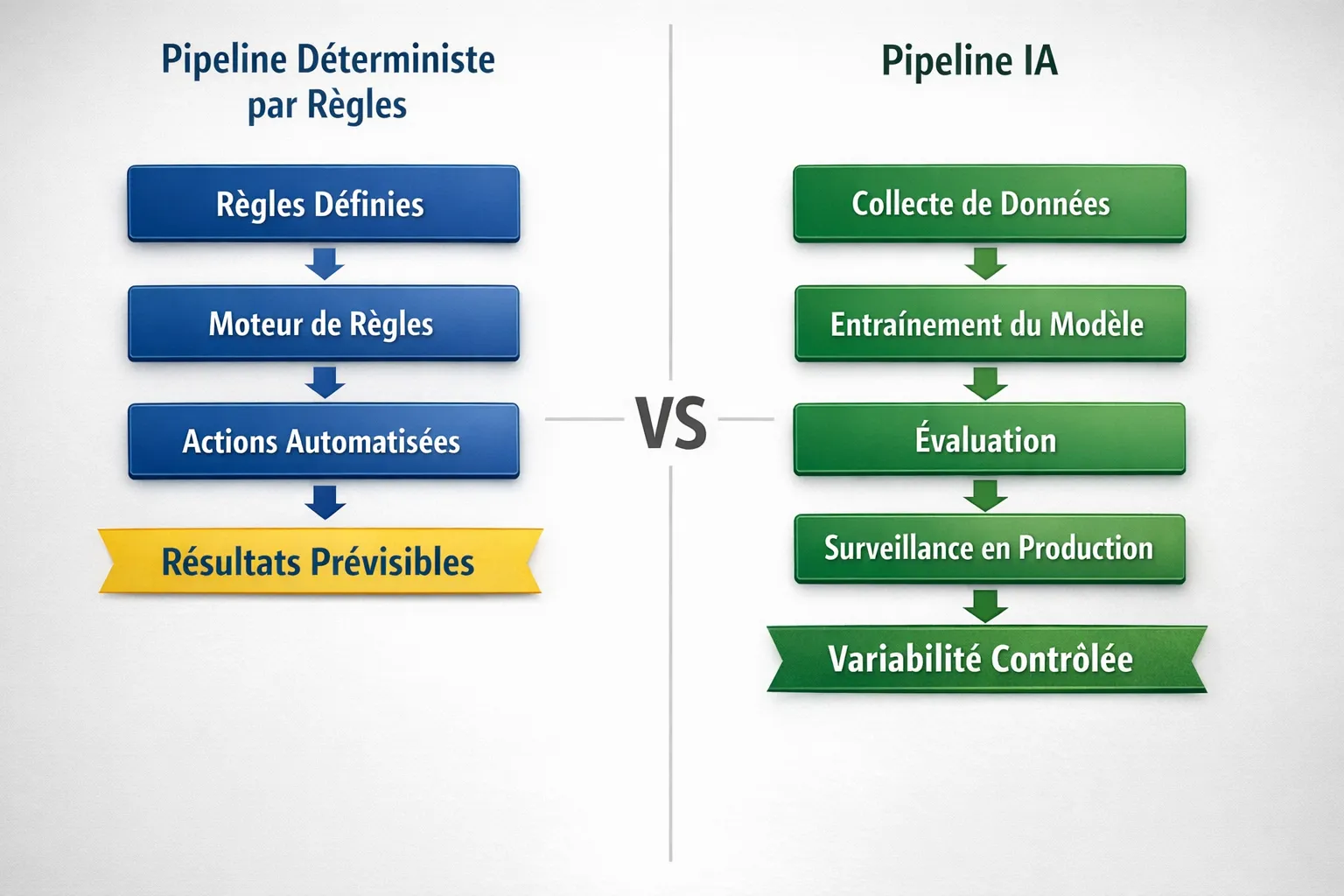
Many decision-makers use computational intelligence and AI interchangeably. Yet, they aren't the same. This confusion leads to poor tech choices and misallocated budgets. Clarifying these concepts helps structure a realistic roadmap and prove ROI.
janvier 02, 2026·7 min de lecture
Many decision-makers use the terms computational intelligence and artificial intelligence interchangeably. However, they do not mean the same thing, and this confusion leads to approximate technological choices, avoidable risks, and misallocated budgets. Clarifying these concepts helps to structure a realistic roadmap, prioritize use cases, and prove ROI to teams and executives.
Defining terms without jargon
Computational Intelligence, in an operational business sense, refers to deterministic systems that apply explicit rules to process data and orchestrate workflows. We talk about rule engines, ETL, scripts, RPA, BI, hand-coded algorithms. The goal is reliable, traceable, and reproducible automation of tasks, with identical results from identical inputs. See also our page Automation.
Artificial Intelligence, in practice today, designates systems that learn from data and generalize beyond hand-written rules. This covers machine learning, deep learning, and generative models, for example LLMs. AI produces probabilistic outputs, adapts to variability, and handles complex tasks where rules are difficult to formalize. For a concise refresher, read What does the term artificial intelligence mean.
In short, computational intelligence formalizes, AI learns. These approaches complement rather than oppose each other. The right choice depends on the problem, the data, and constraints regarding risk, cost, and deadlines.
Historical quality data, representative of reality
Behavior
Stable and predictable, little variability
Variable, sensitive to context and data drift
Explainability
Very high, auditable rules
Variable, requires explanation and traceability techniques
Maintenance
Rule changes, classic versioning
MLOps cycle, retraining, continuous monitoring
Performance measurement
Rule accuracy and SLAs
Statistical metrics, A/B tests, business impact
Risks
Logic errors, technical debt
Bias, hallucinations, prompt and data security
Typical cases
Invoicing, reporting, eligibility checks
Concrete examples that speak to teams
Customer Service. A rule-driven knowledge base answers frequent questions and redirects to the right forms. It is robust and excellent for fixed procedures. A generative chatbot, combined with RAG, understands varied customer phrasings, summarizes exchanges, and personalizes responses. It requires strong scoping, test sets, and quality monitoring.
Finance and Compliance. Deterministic controls verify thresholds, formats, whitelists. When fraud patterns evolve or supporting documents are highly varied, a supervised model spots anomalies and an LLM-guided OCR extracts fields with higher noise tolerance. The AI must then be audited and explained to compliance.
Operations and Supply Chain. Rules calculate simple replenishments. If demand is seasonal, subject to promotions or external events, a forecasting model learns these patterns and reduces stockouts. Performance is measured on forecast error and especially on immobilized stock and service rate.
How to choose, without dogma
Use this short decision checklist before committing a budget.
Are the business rules stable and exhaustive, or tacit and changing over time?
Do you have a sufficient and clean data history to train, validate, and exploit a model?
What is the cost of an acceptable error and the need for explainability for business and compliance stakeholders?
Are you aiming for a binary output or simple arithmetic, or a complex prediction, a ranking, a text summary?
Is the time-to-market critical, and must the solution work offline or with strong embedded constraints?
Do you possess MLOps skills and a monitoring plan, or should you first capitalize on classic automation?
In many organizations, starting with computational intelligence already captures a significant share of value, while preparing the data, APIs, and processes that will allow adding targeted AI where the leverage effect is clear.
Organizational and technical impacts to anticipate
Data and Quality. Computational intelligence tolerates dirty data poorly but is often less sensitive to drift. AI depends heavily on the representativeness of training sets and a governed data pipeline. Without quality, there is no sustainable performance.
Delivery Chain. Automations follow a classic DevOps cycle. AI projects add an MLOps cycle, with retraining, statistical tests, human validations, and drift monitoring. If you are industrializing generative AI, also plan a guardrail strategy, for example filters, test sets, and controlled retrieval.
Interface Design. Rule-guided experiences appear as forms and steps. AI assistants require conversational design, error management, suggestions, and clear limits. See our guide AI UI, key principles of conversational design.
Security and Integration. Centralize secret management, partition data, and minimize footprints. On the architecture side, separate inference services from the rest and ensure observability. To go further, consult our best practices on AI APIs, clean and secure integration models.
Governance and compliance, what changes with AI
Classic IT governance covers continuity, security, and processing compliance. With AI, add bias evaluation, robustness, explainability, training set traceability, and drift management.
Two useful references to structure these practices:
The European AI Act, the application of which is gradually deploying since 2025. It classifies systems according to their risk level and imposes, for certain uses, requirements for data management, conformity assessment, transparency, and human oversight.
For deterministic systems, obligations remain those of classic computing. For AI, formalize documentation, tests, and the monitoring plan from the start. This accelerates internal and external audits and reduces compliance costs.
Costs and ROI, avoiding optical illusions
Initial Costs. Computational intelligence mobilizes business analysis and development time, often predictable. AI can start quickly in prototyping but requires additional iterations to reach expected quality, particularly regarding data and evaluations.
Recurring Costs. Rules evolve with the business and are maintained via versioning. AI adds inference, retraining, and monitoring costs. These costs are sustainable if the AI unlocks value that classic computing cannot reach.
Value Measurement. Beyond technical metrics, track business indicators. Processing time, automation rate, NPS or CSAT, incremental revenue, reduction of errors and manual load. Our guide AI KPIs, measuring the impact on your business details how to choose and steer them.
Recommended roadmap for SMEs and scale-ups
Map processes. Identify what is entirely describable by rules, what is not, and the associated pain points.
Automate the predictable first. Computational intelligence creates robust foundations, exposes APIs, cleans data, and secures access.
Add AI where the leverage is clear. Ambiguous tasks, high variability, high interaction volumes, natural language understanding. For conversational uses, prioritize a RAG approach with controlled sources and test sets. For production, follow our principles of Robust RAG in production.
Test fast, measure, and iterate. A scoped pilot, a reliable test set, and clear metrics avoid costly cycles and align stakeholders.
Industrialize cleanly. Separate responsibilities, automate deployments, trace data and models, periodically review performance and compliance.
How Impulse Lab can help you concretely
Opportunity Audit. We analyze your processes, data, and constraints to distinguish what falls under computational intelligence and what justifies AI. Details in our article Strategic AI Audit.
Integration and Security. We design custom web and AI platforms, integrated with your tools, with a clean, secure, and observable architecture, cf. our recommendations on AI APIs.
Value Measurement. We help you define, track, and communicate the right indicators to demonstrate ROI, relying on our guide AI KPIs.
Key Takeaways
Computational intelligence and AI do not solve the same problems. The former optimizes the execution of explicit rules; the latter learns and generalizes when rules are no longer sufficient.
Start by automating what is stable and predictable, then introduce AI where uncertainty and variability require a learning model.
Anticipate governance and compliance from the design phase, especially for AI. A clear risk framework avoids bad surprises later.
Measure business impact continuously, not just technical metrics.
You are hesitating on the boundary between computational intelligence and AI for your use cases? Contact Impulse Lab. Our product and technical team helps you choose the right approach, move fast without sacrificing quality, and transform AI into measurable value for your company.