Eleven Labs AI: Use Cases, Pricing, and Alternatives in 2026
Intelligence artificielle
Stratégie IA
Outils IA
Génération audio
Automatisation
Voice has become a full-fledged "product" channel. In 2026, it's not just about voice-overs for marketing videos, but also **vocal customer support**, industrialized e-learning content, **multilingual dubbing**, and even voice interfaces in business apps.
Voice has become a full-fledged "product" channel. In 2026, we are no longer just talking about voice-overs for marketing videos; we are talking about vocal customer support, industrialized e-learning content, multilingual dubbing, and even voice interfaces in business apps. In this ecosystem, Eleven Labs AI (often written "ElevenLabs") is one of the most cited tools for realistic voice generation.
The goal of this article: to help you understand the use cases, the pricing logic (without getting trapped by a number that changes), and credible alternatives in 2026, with a decision framework oriented towards SMEs and scale-ups.
Eleven Labs AI: What is it actually used for?
Eleven Labs AI is a voice generation platform based on neural models. In practice, companies use it primarily for:
Text-to-Speech (TTS): transforming text into natural audio (intonation, rhythm, and emotions that are more credible than "classic" TTS).
"Custom" Voice: creating a brand voice (or a character voice) usable across your content.
Large-scale production via API: integrating audio generation into a product (SaaS, mobile app, training platform) or an internal workflow.
Localization / Dubbing: depending on current capabilities, producing multilingual versions and accelerating post-production.
To avoid judging the tech "by the demo," the most important thing is to think in terms of the value chain: what content, for which channel, with what quality requirement, and what level of acceptable risk.
7 Use Cases That Work Well for SMEs and Scale-ups
Here are the most frequent (and most "ROI-compatible") scenarios observed in the field.
1) Marketing Voice-over (videos, ads, social)
You need a consistent voice, short production times, and numerous iterations.
What this changes:
reduction in production time (script → audio render in minutes)
A/B testing of hooks and tones
ability to produce more variants without multiplying service providers
2) E-learning and Onboarding Content (internal or client)
Typical case: training modules, micro-learning, app onboarding.
Key point: the audio must be stable and natural enough not to cause listening fatigue. You will often need a simple "versioned text → versioned audio" pipeline.
3) Vocal Customer Support and IVR (with human handoff)
We are seeing the emergence of voice assistants capable of handling simple requests (tracking, hours, resets, qualification). Good design isn't about "automating everything," but filtering and routing.
Indispensable:
scoped scenarios (intent coverage)
logging and metrics (resolution rate, escalation)
security rules, because voice encourages divulging sensitive information more easily
4) Accessibility and Audio for Sites and Platforms
Transforming key pages into audio (articles, procedures, FAQ, documentation) to improve accessibility and experience. On certain sites, this is a differentiator.
5) Rapid Localization (Multilingual)
Goal: publish content faster in multiple languages. Be careful, the real cost is often proofreading and validation (terminology, compliance, brand tone), not the generation itself.
6) "Corporate" Podcasts and Long-form Content
When tone and narration matter. Here, the question isn't just voice quality, but the ability to maintain episode consistency (pronunciations, energy, pacing).
7) In-Product Audio (SaaS, app, notifications)
Examples: audio reading of a report, meeting minutes, an action plan. This is often a feature with high perceived impact, but it requires clean integration (latency, caching, monitoring, cost per generation).
To help frame this quickly, here is a summary table.
Use Case
What you produce
Realistic Prerequisites
KPIs to Track
Marketing Voice-over
Ads, videos, demos
short scripts, brand validation
cost/video, prod time, CTR/CPA (A/B)
E-learning
modules, onboarding
versioned text, audio QA
completion rate, satisfaction, rework
Vocal Support
IVR, voice agent
intents, handoff, logs
resolution rate, escalation, CSAT, avg duration
Accessibility
audio pages
clean content, GDPR/cookies
usage, time spent, user feedback
Localization
multilingual versions
glossary, local validation
time to publish, correction rate
Podcasts
narrated episodes
script, editorial direction
listening retention, cost/episode
Product Feature
integrated audio
API, monitoring, budget
latency, cost per user, feature adoption
Eleven Labs AI Pricing in 2026: How to Read It Correctly
Most teams look for a single number, but in 2026 the real question is: what is your total cost per minute (or per content piece), including operations.
1) What Drives the Bill (Beyond the "Plan")
Even though Eleven Labs AI generally offers formulas (with a monthly quota) and API consumption, the budget depends mainly on these variables:
Cost Driver
Why it matters
Example Trap
Volume (minutes, characters, generations)
the main multiplier
a full e-learning course explodes a budget planned for marketing
Expected Quality
more retakes, more QA
an "okay" voice for internal use becomes insufficient for ads
Number of Voices / Profiles
brand voice, languages, characters
ungoverned multiplication of variants
API vs Interface Usage
industrialization and caching
regenerating instead of caching
Compliance and Rights
process + validation
voice without clear consent, legal risk
Operations
monitoring, storage, versioning
untraceable audio, impossible to audit
2) Where to Find the "Real" Price
Rates change quickly in this market. The most reliable source remains:
the official ElevenLabs pricing page (verify at the time of your decision): pricing ElevenLabs
the API documentation (quotas, limits, terms): docs ElevenLabs
(When comparing, keep a dated screenshot, and have the terms validated by purchasing/legal.)
3) Simple Method to Estimate a Budget in 30 Minutes
Without getting into a heavy financial model, create 3 scenarios:
Scenario A (marketing): 20 videos/month, 60 to 90 seconds each, 2 to 3 voice variants maximum.
Scenario B (training): 2h of audio/month, with proofreading and retakes.
Scenario C (product/API): X active users, Y generations per user, caching enabled.
Then, add the most common "hidden cost": validation and maintenance (scripts, proofreading, corrections, storage, governance). If you are already working on AI APIs, the logic is very similar to what we describe in our guide on costs: AI API: Guide to Rates, Quotas, and Hidden Costs.
Limitations and Watch Points (Quality, Legal, GDPR)
Quality: The Risk Isn't "The Voice," It's Consistency
A voice can be impressive for 15 seconds, then degrade over long content (pronunciations, proper names, energy). Always test:
your industry terms
your product names
your numbers, units, acronyms
Usage Rights and Consent
As soon as we talk about "voice cloning" or lookalike voices, you must define:
who gave consent and how it is proven
what is authorized (scope, duration, channels)
what is prohibited (impersonation, politics, etc.)
On this point, it is better to treat the subject as a brand asset: contract, traceability, and access rules.
Data, GDPR, and Operational Security
Voice can contain personal data (identity, accent, contextual information). In a corporate setting, at a minimum establish:
Alternatives to Eleven Labs AI in 2026 (Depending on Your Priorities)
There is no universal "best alternative." The right alternatives depend on your dominant constraint: compliance, integration, creative quality, unit cost, self-host.
"Cloud" API Alternatives (Robust, Enterprise-Friendly)
Often chosen if you want a provider already present in your IS (contracts, security, IAM, regions).
If you already have a testing process, you can also structure the validation like a mini protocol (hypotheses, metrics, go/no-go). Our "enterprise AI test" resource gives a reusable framework: Enterprise AI Test: Simple Protocol to Validate Your Ideas.
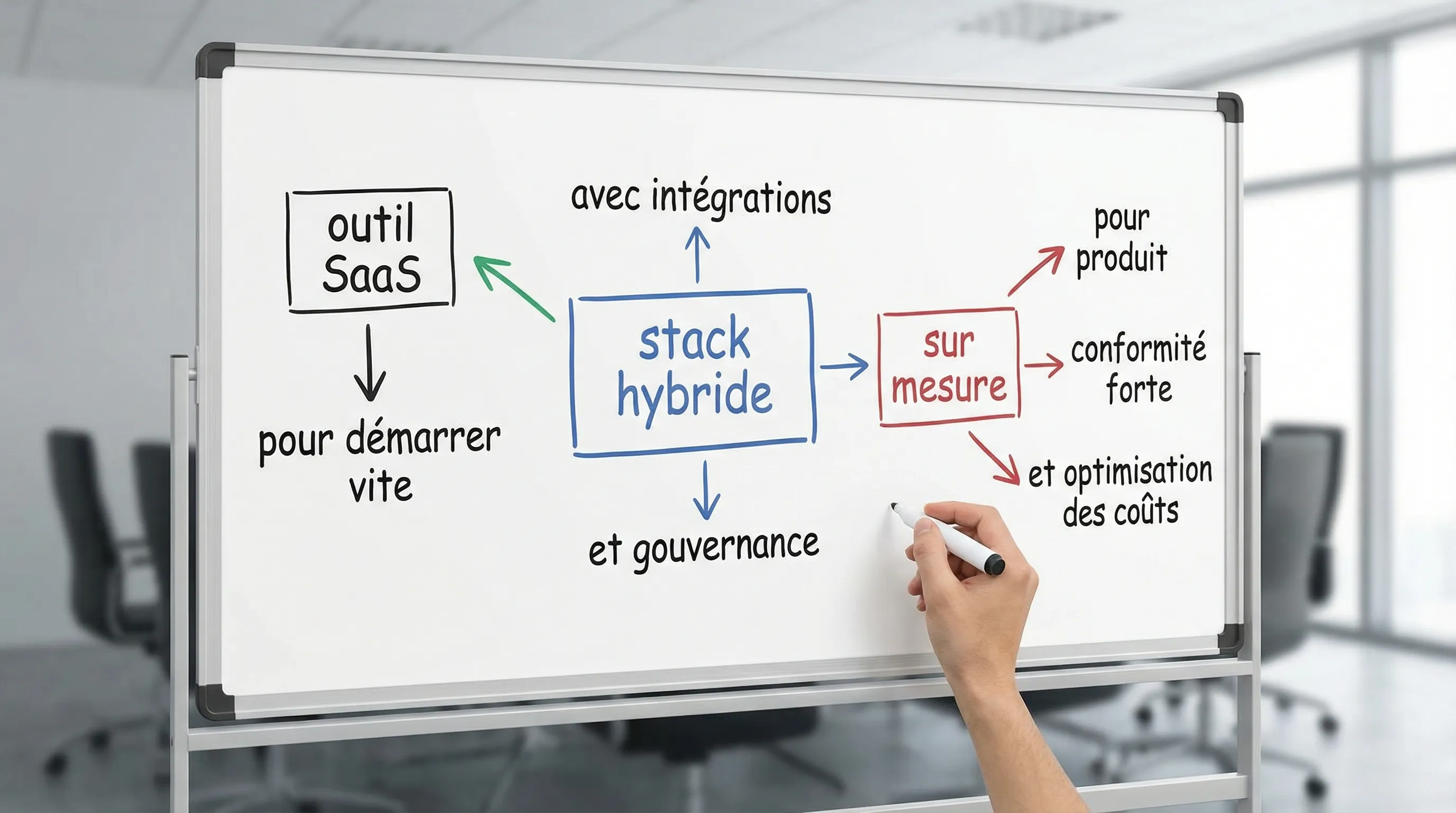
When to Switch from a Tool (ElevenLabs or other) to a Custom Solution
You should consider a custom approach when:
voice becomes a product brick (SLA, monitoring, scalability)
you have strong GDPR / security constraints
you need to integrate voice into existing tools (CRM, helpdesk, LMS, knowledge base)
you are looking to optimize cost via routing, caching, batching, or a mix of providers
On the architecture side, effective patterns look a lot like those for "text" AI APIs: a gateway, an orchestration layer, storage, actionable logs, and guardrails. If you want to dig into the technical audio side, we have a dedicated article: AI Sound: Generating Quality Voice and Audio.
Next Step (Pragmatic) for Your Company
If you are hesitating between Eleven Labs AI and an alternative, the most profitable move is often to do a short scoping exercise: 1 to 2 use cases, a test protocol, and a total cost estimate over 3 scenarios. This is typically what an AI opportunity audit allows you to decide without starting a massive project.
Impulse Lab supports SMEs and scale-ups with: AI audits, integrations (API, existing tools), automation, and web and AI platform development. If you want to validate a voice use case in real conditions (quality, compliance, cost, integration), you can start via the site: impulselab.ai.
IA et cybersécurité : les contrôles minimums pour une PME
Un assistant qui résume des contrats, un outil connecté au CRM ou un agent qui prépare des factures : chaque usage crée de nouveaux accès à contrôler. Pour une PME, **IA et cybersécurité** doivent donc se traiter ensemble, avant de connecter des données confidentielles ou d’autoriser des actions aut...