Enterprise AI Chat: A Quick Buyer's Guide for SMEs
Intelligence artificielle
Stratégie IA
Confidentialité des données
Outils IA
Productivité
Buying an **enterprise AI chat** isn't just about drafting emails. For SMEs, the right choice comes down to three concrete points: **what the chat actually needs to do**, **how it integrates with your tools**, and **what guardrails you put in place** (GDPR, privacy, traceability).
Buying an enterprise AI chat isn't just about getting a "nice" tool to draft emails. For SMEs, making the right purchase comes down to three very concrete points: what the chat actually needs to do, how it integrates with your tools, and what guardrails you put in place (GDPR, privacy, traceability, costs).
This guide aims for a quick and rational decision: by the end, you will know what to ask for in a demo, how to compare 2 to 3 options, and when to switch from "buy" to custom-built.
1) Before comparing solutions: what "AI chat" are you actually buying?
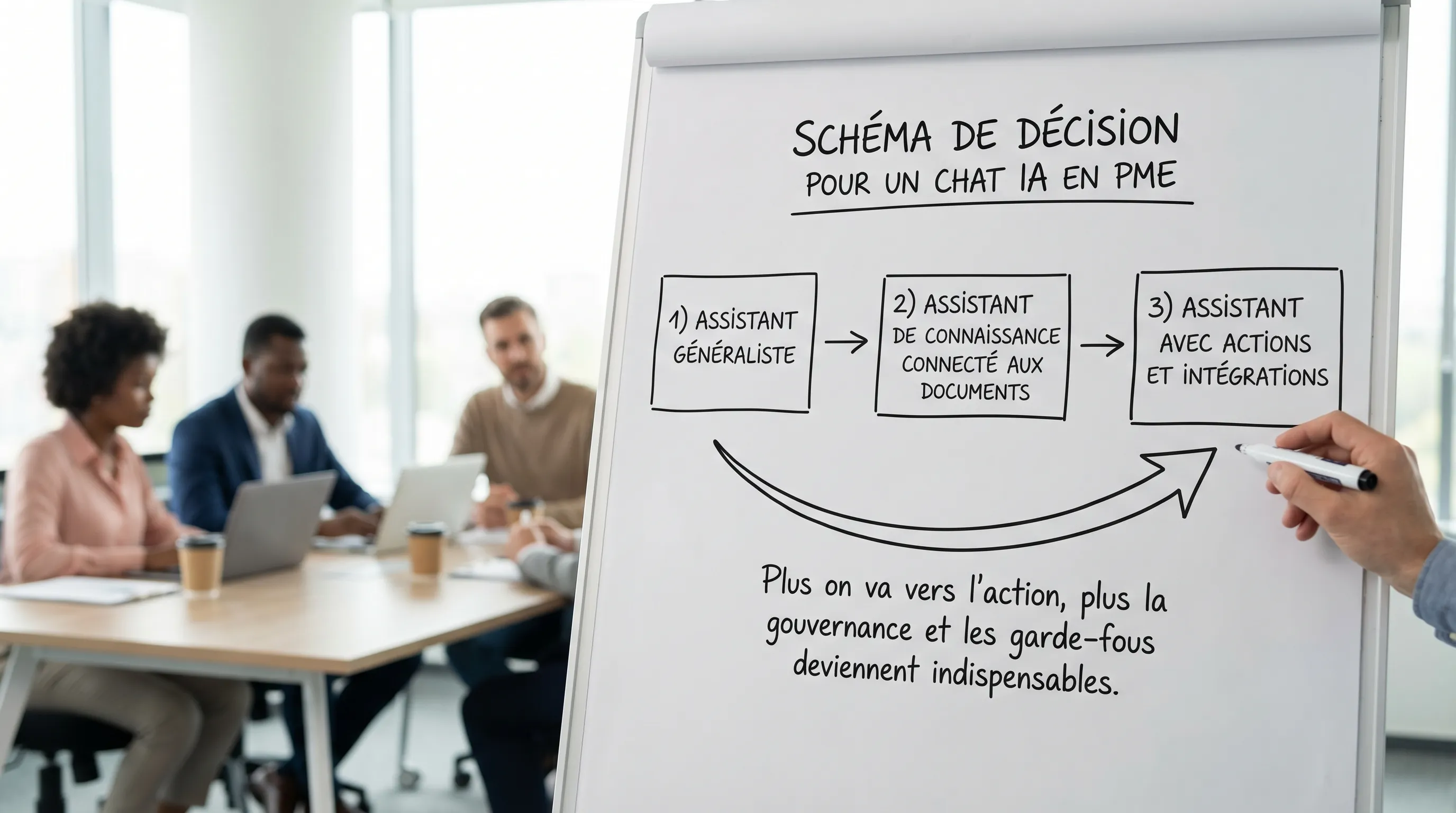
In the enterprise world, "AI chat" covers at least 3 different products. Confusing them is the #1 cause of disappointing purchases.
Productivity AI Chat (Generalist Assistant)
Objective: accelerate individual tasks (writing, summarizing, brainstorming). Quick time-to-value, but high risk if teams paste sensitive data into it without a framework.
Knowledge AI Chat (Assistant connected to your documents)
Objective: answer based on a source of truth (procedures, contracts, internal documentation), often via RAG-type approaches. This is the most cost-effective format to standardize quality and reduce interruptions.
"Action-oriented" AI Chat (Assistant with actions and integrations)
Objective: execute actions (create a ticket, push a CRM note, prepare a quote, trigger a workflow). Here, we are often talking about an agent with guardrails, not just conversation.
A compliance reminder (France + EU, without unnecessary jargon)
GDPR: if personal data is processed, you must define the purposes, minimization, legal basis, security, and your subcontractors (DPA). The CNIL regularly publishes recommendations and points of attention.
AI Act: the European regulation frames AI according to risks, and imposes increasing requirements (transparency, risk management, documentation) depending on the case. Reference: official text on EUR-Lex.
(Practical advice: don't try to "settle everything" in the contract. Above all, demand a usage framework, technical controls, and a measured pilot.)
3) The demo checklist (15 minutes): questions that reveal reality
In a demo, everything works. Your goal is to force the vendor to talk about the cases that break, not the cases that shine.
Here are the questions that generally separate a "presentation" solution from a usable one.
Data and privacy
Where does the data go? (country, subcontractors, storage, retention)
Are conversations used to train models? (by default, optional, never)
Can sensitive info be automatically masked or redacted?
Reliability of answers (especially if you are doing "business" chat)
Show a case where the AI doesn't know: what does it do, does it propose an escalation, does it refuse?
Can it cite its sources (internal documents) and handle contradictory documents?
Integrations and action
What out-of-the-box integrations exist with your actual tools (CRM, helpdesk, Google Workspace, Microsoft 365)?
Permission management: on whose behalf does the AI act, with what rights, and how is it audited?
On this point, you can also look at the Impulse Lab glossary on the Model Context Protocol (MCP), useful for standardizing certain connections to tools.
Operations (the forgotten topic)
Who is the "owner" on the client side and the provider side in case of an incident?
What logs and metrics are available to manage quality, costs, and adoption?
4) Buy, assemble, custom-built: how to decide without dogma
For an SME, the right decision isn't "tool vs. custom-built". It's: what level of control are you paying for, and where do you put your efforts (product, integration, run).
Option
When it's the right choice
Typical limitations
Out-of-the-box SaaS
Simple need, very short timeframe, low integration
Data control, customization, variable costs, vendor lock-in
"Assemble" (API + building blocks)
You want to connect to 2-3 key tools and keep control
Requires a minimum of engineering and governance
Open source / self-hosted
Sensitive data, need for strong control, solid tech team
Run, maintenance (MCO), security, infra costs, complexity
Custom-built (agency)
Differentiating case, critical integrations, need for traceability and KPIs
Higher initial investment, need for serious scoping
Common (and costly) mistakes when buying an AI chat
Buying a "generalist" AI chat when your need is "knowledge" (you need a source of truth, not a good copywriter).
Not addressing permissions and authentication from the start. An AI chat without SSO is often future shadow AI.
Measuring usage instead of impact. "Number of messages" is not a business KPI.
Discovering variable costs after deployment. You want limits, alerts, and a simple estimation model.
FAQ
What is the best enterprise AI chat for an SME? There is no universal "best". The right choice depends on your scenario (productivity, knowledge, action), your data, and your integrations. Use a scorecard with evidence (SSO, DPA, logs, sources, costs).
Do SMEs need an AI chat with RAG? If the chat needs to answer business questions (procedures, offers, HR, support), yes, often. RAG reduces invented answers by linking the AI to a document base, provided your sources are clean and governed.
Can you use an AI chat if you have sensitive data? Yes, but not "just anyhow". You need classification, minimization rules, a contractual framework (DPA), and technical controls (permissions, retention, redaction). Depending on the case, a self-hosted option or an API gateway might be preferable.
What are the security essentials for an enterprise AI chat? At a minimum: SSO, role management, retention policy, exportable logs, connector control, environment separation, and a human escalation mode. For an action-oriented chat, add validations, idempotency, and action auditing.
How long does it take to choose and deploy an AI chat in an SME? A serious choice can be made in 1 to 3 weeks if you test on 10 to 30 real cases and if security is framed. Initial deployment can be fast, but adoption and management (KPIs, costs, quality) must be planned from day 1.
Moving from purchase to value: audit, integration, and training
If you want to avoid the demo effect and buy an AI chat that holds up in production, Impulse Lab can help you scope it quickly and effectively:
Conduct an AI opportunity audit to choose a profitable and measurable use case.
Implement an AI chat solution connected to your tools (CRM, helpdesk, documentation) with the right guardrails.
Launch an adoption training focused on real workflows, to reduce shadow AI.
You can start with a short discussion via Impulse Lab to validate your scenario (productivity, knowledge, action) and define a pragmatic trajectory.
Training managers to **validate AI outputs** is not about spotting text that "sounds off." An answer can be clear and persuasive yet contain errors or false promises. Here is how to build practical validation skills.